
Every Dussehra we burn Ravana's effigy as the triumph of good over evil. But there's a quieter story inside it that rarely gets told: Ravana was extraordinarily wealthy. His Lanka was described as a city of gold; he had power, scholarship, an empire. By every measure of riches he had won — and he still lost the lot. Look past the ten heads and the effigy, and his downfall reads like a masterclass in how wealth actually gets destroyed.
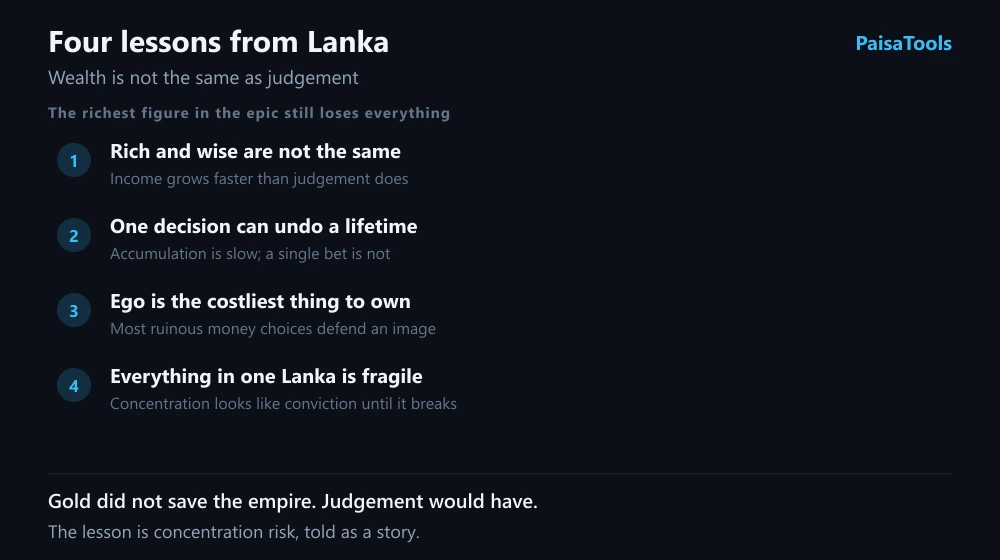
Lesson 1: Being rich and being wise are not the same thing
Ravana was no fool — he was a scholar, a devotee, a brilliant strategist. Wealth plus intelligence still wasn't enough, because he lacked the one thing that protects wealth: the judgement to know when to stop. Plenty of high-earning, clever people today make the same error — a big income and a sharp mind, undone in the one domain where ego overrides sense. Money doesn't usually fail people who are dumb; it fails people who are smart everywhere except the place that counts.
Try it on your numbersWealth Reality Check CalculatorTrue value of your SIP after inflation + tax (the shock number)Lesson 2: One bad decision can undo a lifetime of accumulation
Ravana's empire didn't crumble over years of slow mismanagement. It fell because of a single catastrophic decision he refused to reverse. That's the brutal maths of wealth: you can build carefully for decades and lose most of it in one over-leveraged bet, one blow-up, one 'sure thing' you put everything into. The people who stay rich aren't the ones who never make mistakes — they're the ones who never make a mistake big enough to end the game.
Could one shock undo you? Stress-test your finances — free Financial Health ScoreLesson 3: Ego is the most expensive thing you can own
Ravana was warned — by his brother Vibhishana, by his own advisors — and his ego made the counsel unbearable. He'd rather burn than be told he was wrong. In money terms, ego is what makes people refuse to book a loss, double down to 'prove' a bad call, hide debt from their family, and buy status they can't afford to look like they've already made it. The costliest thing most people carry isn't a bad loan — it's the need to be seen as winning.
Lesson 4: Everything in one Lanka is a fragile empire
Ravana's power was concentrated — one city, one throne, one man's will. When it was hit, there was nothing to fall back on. Concentration is how fortunes vanish: everything in one stock, one property, one business, one income. Diversification isn't glamorous, but it's the thing that means a single fire doesn't take the whole kingdom. A humble, spread-out portfolio outlives a golden, all-in one.
Get a clear verdict on where your money should actually goSo this Dussehra, by all means cheer as the effigy goes up. But the useful bit isn't that evil loses — it's how it loses: rich, clever, warned, and taken down by ego, concentration and one decision he wouldn't take back. Burn those, and your wealth has a far better chance of outliving you than his did.
Frequently asked questions
- What money lessons can we learn from Ravana?
- Four stand out: being rich isn't the same as being wise (judgement protects wealth); one catastrophic decision can undo decades of building, so never bet big enough to end the game; ego is the most expensive thing you can own — it stops you booking losses and makes you buy status you can't afford; and concentrating everything in one place is fragile, so diversify. Ravana had wealth, brains and power and still lost it all by ignoring these.
- Why is Ravana relevant to personal finance?
- Because his fall mirrors exactly how wealthy people lose money today — not through stupidity, but through ego, over-concentration, refusing good advice, and one irreversible bet. He's a vivid reminder that accumulating wealth and protecting it are two different skills, and the second is where most fortunes are lost.
- What does Dussehra teach about wealth?
- That the real triumph is wisdom over ego, not just good over evil. Ravana had every advantage and destroyed himself; Dussehra is a yearly prompt to 'burn' the traits that quietly ruin finances — arrogance, the refusal to admit a mistake, and the greed to have everything in one place — and keep the humility and judgement that let wealth last.
- How do I protect my wealth from a 'Ravana' mistake?
- Never put so much into one bet, stock, property or business that a single failure ends you; keep an emergency buffer; book losses instead of doubling down to protect your ego; take counsel from people who'll tell you you're wrong; and check regularly that you could survive a shock. Diversification and humility are the real armour.