
An MBA is sold as an investment, and it genuinely can be one. But it is evaluated almost entirely on two numbers, the fee and the average placement package, and those two together tell you remarkably little about whether the decision works for you specifically.
The cost the brochure prints, and the two it does not
Tuition is the visible figure. Around it sit living costs for the full duration, materials, and the travel a residential programme assumes. Those are inconvenient but predictable.
- Top IIMs (Ahmedabad, Bangalore, Calcutta): roughly ₹24 lakh to ₹27 lakh in tuition for the two-year programme.
- The newer IIMs: roughly ₹12 lakh to ₹20 lakh.
- Top private schools: roughly ₹22 lakh to ₹28 lakh, and about ₹38 lakh for a one-year programme at the top end.
- Tier-two private colleges: roughly ₹6 lakh to ₹15 lakh.
- Living, materials and travel on a residential campus: about ₹2.5 lakh to ₹4 lakh a year on top of any of these.
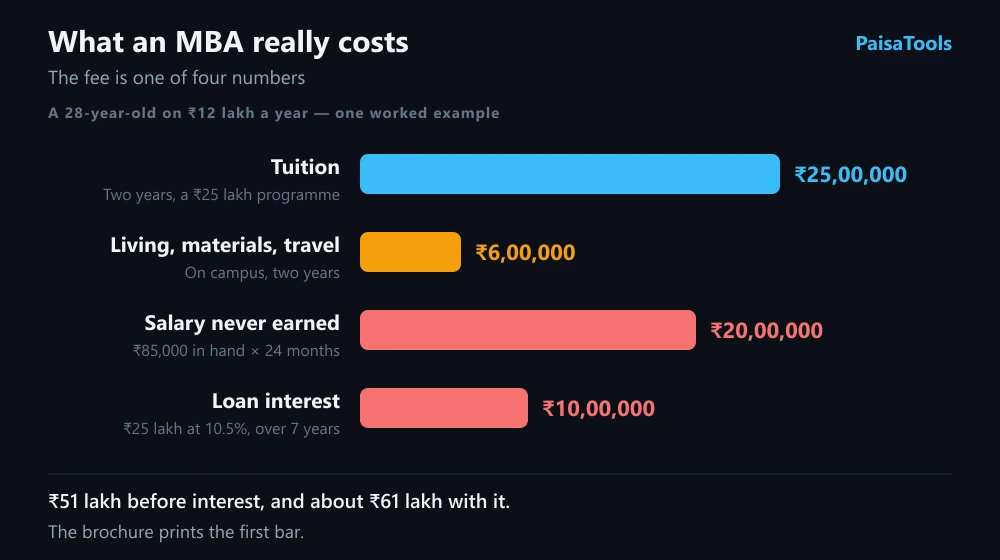
The two that decide the outcome are less obvious. The first is the salary you do not earn while studying, which for a working professional is often comparable to the tuition itself and is almost never counted. The second is interest on the education loan, which depends less on the rate than on how many years repayment actually runs.
Put numbers on it. A 28-year-old earning ₹12 lakh a year takes about ₹85,000 a month home. Two years at a ₹25 lakh programme costs ₹25 lakh in tuition, about ₹6 lakh in living costs, and roughly ₹20 lakh in salary never earned - ₹51 lakh before a rupee of interest. Borrow ₹25 lakh of it at around 10.5% and repay over seven years, and the loan adds close to ₹10 lakh more. The brochure shows the first of those four numbers.
Why the average package is the wrong number
Average placement figures are pulled upward by a small number of exceptional offers, and they are reported as cost to company rather than what reaches your account. Comparing a CTC headline against a very real fee compares two different kinds of number.
The honest comparison is between your in-hand salary after the degree and your in-hand salary without it, across the years the loan is being repaid. That difference is what is actually funding the decision.
See what a CTC figure leaves you in handThe repayment period does more damage than the rate
Borrowers negotiate hard over a fraction of a percent and accept a longer tenure without blinking, because the longer tenure makes the monthly figure comfortable. On an education loan that trade is expensive. Stretching repayment raises total interest substantially, and it does so during exactly the years when your income is rising and could have absorbed a larger instalment.
The years immediately after an MBA are also when lifestyle expands to meet the new salary. A loan scheduled around the comfortable monthly figure tends to stay outstanding for its full term for precisely that reason.
Compare tenures before you signThe question worth answering before you apply
Not whether an MBA is worth it in general, because that question has no answer. The useful one is how many years of the salary difference it takes to repay the total cost including forgone earnings and interest, and whether you believe that difference will hold for that long.
Frequently asked questions
- Is an MBA in India worth the cost?
- It depends on the gap between your in-hand salary with the degree and without it, measured against the total cost including the salary you forgo while studying and the interest on the loan. The same programme can be an excellent decision for one person and a poor one for another.
- What is the most ignored cost of an MBA?
- Forgone earnings. For a working professional the salary given up over the programme is often comparable to the tuition, and it appears in no brochure or fee structure, which is exactly why it gets left out of the comparison.
- Should I choose a longer education loan tenure?
- A longer tenure lowers the monthly instalment and raises total interest considerably, across the years your income is rising fastest and could support a larger payment. Compare the total cost of each tenure, not just the monthly figure.
- Why is the average placement package misleading?
- It is skewed upward by a handful of exceptional offers and quoted as cost to company rather than what reaches your account. Comparing that headline against a very real fee compares two different kinds of number.