
Almost every cafe budget that gets written down is a fit-out budget. Machine, grinder, counter, lights, chairs, signage — the things you can photograph. They are real costs and they are usually estimated fairly accurately, because they come with quotations.
The costs that close cafes do not come with quotations. They are the deposit that leaves the account before a single cup is sold, and the months of rent and salaries that have to be paid while the neighbourhood is still deciding whether to come in.
The five lines, on one scale
For a 400 to 800 square foot cafe, which is the size most first cafes actually are:
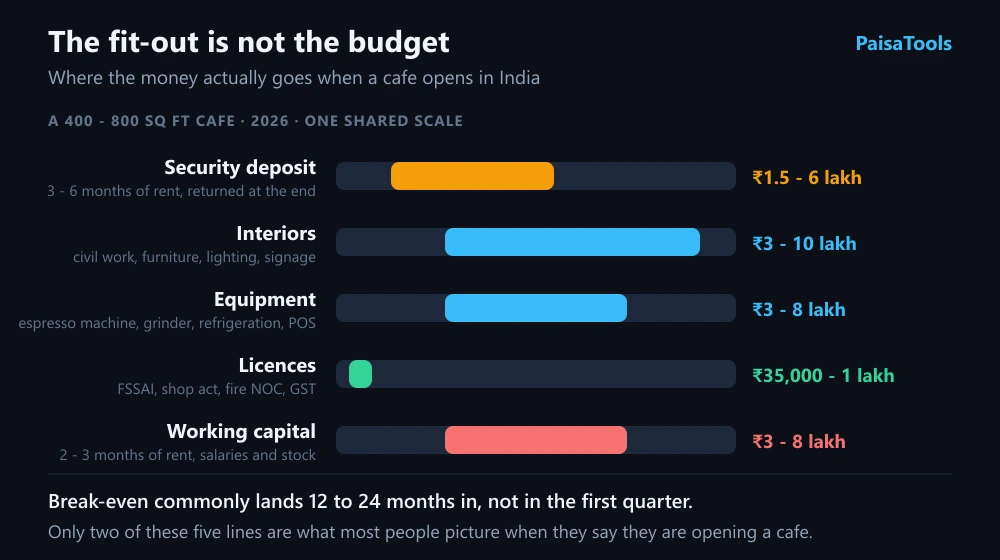
- Security deposit: three to six months of rent, commonly ₹1.5 lakh to ₹6 lakh. It comes back at the end, which makes it easy to dismiss — but it is gone from your working account for the entire life of the business.
- Interiors: ₹3 lakh to ₹10 lakh for civil work, furniture, lighting and signage. This is the line that overruns, because it is the line the owner cares about most.
- Equipment: ₹3 lakh to ₹8 lakh for the espresso machine, grinder, refrigeration, small kitchen and billing.
- Licences: ₹35,000 to ₹1 lakh all in, and cheap relative to how long they take.
- Working capital: ₹3 lakh to ₹8 lakh, being two to three months of rent, salaries and stock held in reserve before the first rupee of revenue.
Licences: cheap, slow, and not optional
- FSSAI: a basic registration costs ₹100 a year while turnover stays under ₹12 lakh; above that you need a state licence at ₹2,000 a year. The fee is trivial; the paperwork and the inspection window are not.
- Shop and establishment registration with the local authority, plus a fire NOC — both of which are municipality-specific and are the usual reason an opening date moves.
- GST registration, mandatory once turnover crosses ₹20 lakh a year, or ₹10 lakh in the special category states. Most cafes with a visible storefront register from the start anyway, because suppliers and delivery platforms expect it.
- A music licence if you play recorded music, and a trade licence in some cities.
The GST detail that quietly sets your margin
A standalone restaurant or cafe charges GST at 5 per cent and cannot claim input tax credit on what it buys. That combination is the important part and it catches nearly every first-time owner.
It means the GST you pay on rent, on equipment, on packaging and on your supplier invoices is not recoverable — it is simply part of your cost. A margin model built by someone used to a business that nets off input credit will be wrong by several percentage points, in the wrong direction, every month.
Work out GST on a bill or an invoiceWhat a realistic opening actually adds up to
A 600 square foot cafe in a metro suburb — ₹4 lakh of deposit, ₹7 lakh of interiors, ₹6 lakh of equipment, ₹60,000 of licences and ₹6 lakh of working capital — comes to about ₹23.5 lakh. The part worth noticing is the split: roughly ₹13 lakh of that is the fit-out everyone plans for, and ₹10 lakh is deposit and reserve, which buy nothing visible and are the difference between a slow first year and a closed shutter.
A smaller cafe in a tier-2 city runs the same shape at a lower rent, and therefore a smaller deposit and a smaller reserve.
The number that decides survival
Not the setup cost — the monthly fixed cost against daily covers. Add rent, salaries, electricity and the platform commissions, divide by thirty, and divide again by your average bill. That gives the number of customers a day at which nothing is lost. Everything else is detail.
Break-even on the whole investment commonly lands somewhere between twelve and twenty-four months for a small to mid-size cafe. A plan that needs it in the first quarter is not a plan, and the reserve line above exists precisely because the first quarter almost never delivers.
Funding it without mortgaging the outcome
Most first cafes are funded by savings, family money, or a business or personal loan. If there is an EMI, it is a fixed cost from month one, and it belongs in the break-even calculation above rather than in a separate mental account.
Two practical guards. Keep the working capital reserve out of the setup budget so it cannot be spent on better tiles. And size the loan so the EMI survives a quiet month, because there will be several before the neighbourhood settles into a habit.
Work out the EMI on the business loan firstCheck whether the whole plan is affordable for youFrequently asked questions
- How much does it cost to open a small cafe in India?
- A 400 to 800 square foot cafe commonly needs ₹8 lakh to ₹12 lakh in a tier-2 city and ₹20 lakh to ₹40 lakh for a metro location with premium interiors. The spread is driven by rent, and therefore by the deposit, far more than by the equipment.
- What licences are needed to open a cafe in India?
- An FSSAI registration or state licence, a shop and establishment registration, a fire NOC, and GST registration once turnover crosses the threshold. A music licence applies if recorded music is played. The fees are small; the approval timelines are what move opening dates.
- How much is the FSSAI licence for a cafe?
- Basic registration is ₹100 a year while annual turnover stays below ₹12 lakh. Above that a state licence is required, at ₹2,000 a year.
- Can a cafe claim input tax credit on GST?
- A standalone restaurant or cafe charges 5 per cent GST and cannot claim input tax credit. The GST paid on rent, equipment, packaging and supplies is a real cost rather than something recovered later, which is why margin models borrowed from other businesses come out wrong.
- How long does a cafe take to break even?
- Commonly twelve to twenty-four months for a small to mid-size cafe. That is the reason two to three months of rent, salaries and stock should be held in reserve and kept out of the setup budget entirely.