
Once a year, on Diwali evening, India's stock exchanges shut for the day and then reopen for a single symbolic hour. It's called Muhurat Trading — an auspicious 'first trade' to mark the start of the new Samvat (Hindu accounting) year. For that one hour, lakhs of investors who don't otherwise trade log in to buy something 'for luck'. It's part ritual, part market event — and every year the same questions trend: when is it, what should I buy, and does it actually do anything for my money?
What Muhurat Trading actually is
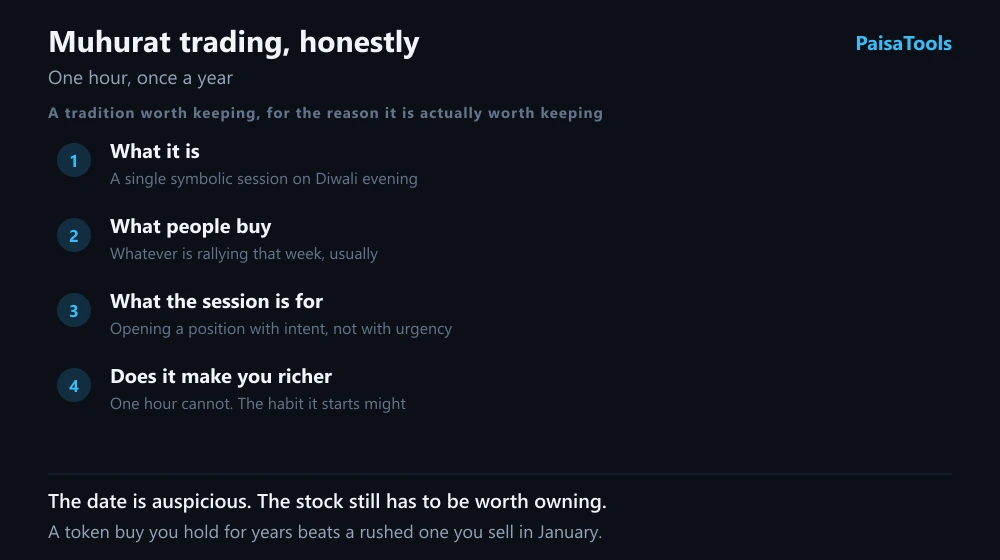
It's a special, roughly one-hour trading window held on the evening of Diwali, when regular markets are otherwise closed for the festival. It marks Samvat — the traditional Hindu financial new year — and carries a belief that a trade placed in this muhurat (auspicious time) brings prosperity for the year ahead. The trades are real: shares you buy settle normally, just like any other session. For 2026 the date is set: Sunday, 8 November, Diwali (Laxmi Pujan), which is on the exchanges' 2026 holiday list with a Muhurat session that evening. The exact timings (pre-open, the one-hour session and closing) come in a separate NSE and BSE circular, usually issued in late October, so treat any time you see before then, including the 6:00 to 7:15 pm slot doing the rounds, as unconfirmed.
Normal trading resumes on Monday 9 November. Tuesday 10 November (Diwali Balipratipada) is a market holiday.
What people actually buy — and what they should
Two very different things happen in that hour. One crowd treats it as tradition: they buy a small quantity of a fundamentally strong, long-term stock — a bluechip they'd have held anyway — as a symbolic, keep-forever purchase. The other crowd treats it as a tip-driven punt, chasing whatever's 'recommended for muhurat', often small, hyped names, hoping the festive mood delivers a quick pop. The first is harmless and even nice. The second is how the auspicious hour quietly turns into a bad decision — thin festive volumes and hype make it exactly the wrong time to gamble.
Log every trade and see what your 'lucky' buys really returned — free Trading JournalDoes it actually make you richer? The honest answer
There's no market magic in the muhurat — a share bought in that hour behaves exactly like one bought on any other day; only the sentiment is festive. Historically the session often closes green, but that's a tiny, low-volume window and says nothing about your returns a year later. If Muhurat Trading gets you to start investing, or to add one quality stock you'll hold for years, it's genuinely good for your wealth — not because of the muhurat, but because you invested. If it gets you to punt on a hyped tip in a thin market, the tradition is working against you.
Before you place that first trade, know what it'll cost in brokerage and taxes so a ₹500 'lucky' buy isn't eaten by charges — and decide whether you're buying to keep or to flip.
Check the real cost of your trade — free Brokerage CalculatorThe bigger point: one auspicious hour won't build wealth, but a habit will. If Diwali is your nudge to start, make it a monthly SIP, not a one-night punt — that's the trade that actually compounds.
See what a monthly SIP grows intoFrequently asked questions
- When is Muhurat Trading 2026?
- It's held on the evening of Diwali, in a special one-hour window while regular markets are closed for the festival. On Sunday 8 November 2026 (Diwali), in an evening session. The exact timings are published in a separate NSE and BSE circular, usually in late October; until then, any time you see is unconfirmed.
- What should I buy in Muhurat Trading?
- If you want to honour the tradition, buy a small quantity of a fundamentally strong stock you'd be happy to hold for years — treat it as a symbolic long-term purchase, not a punt. Avoid chasing hyped 'muhurat tips' on small, illiquid names: festive volumes are thin and the mood makes it an easy time to overpay. The best muhurat buy is a quality asset you'd have bought anyway.
- Does Muhurat Trading give guaranteed profit?
- No. A share bought in the muhurat hour behaves exactly like one bought on any normal day — there's no market magic in the timing. The session has often closed higher historically, but that's a tiny low-volume window and tells you nothing about your returns months later. Your profit depends on what you buy and how long you hold, not on the auspicious hour.
- Is Muhurat Trading good for beginners?
- It can be a lovely nudge to start — but only if you use it to begin a real habit rather than to gamble. Buying one quality stock to keep, or starting a monthly SIP off the back of it, is far more valuable than a one-night speculative trade. The muhurat is a good excuse to invest; it's a bad excuse to punt.