
A cloud kitchen is a restaurant with no dining room. Orders come only through delivery apps, so the rent is small, there are no tables to furnish and no street-front to pay for. That is why it costs far less to open than a cafe.
The catch is where the savings go. A cafe's shop front is a lease you pay once a month. A cloud kitchen's shop front is the delivery platform, and it takes a share of every single order, forever. Setup decides whether you can start. The per-order cut decides whether you last.
What the setup costs
- A small single-brand kitchen in a smaller city: roughly ₹3 lakh to ₹6 lakh.
- A multi-cuisine setup: roughly ₹8 lakh to ₹15 lakh.
- A 250 to 400 square foot single-brand kitchen in a tier-1 city such as Pune, Bengaluru, Mumbai or Hyderabad, all in: roughly ₹12 lakh to ₹22 lakh, depending on the cuisine and whether you rent inside a managed cloud-kitchen facility.
- Commercial kitchen equipment on its own: commonly ₹1.8 lakh to ₹2.5 lakh, for a 200 to 600 square foot space.
Licences
The same food-business paperwork as any restaurant: FSSAI registration, a trade licence from the municipality, a fire NOC, and GST registration. Both delivery platforms need your FSSAI number before they will list you. The fees are modest; the approval timelines are what move opening dates.
The licence list in full, and what each one costsThe cut on every order
Platform commission commonly runs 18 to 25 per cent of the order, depending on the city, the platform and the deal you sign. Add the platform's fees and the GST charged on the commission itself, and the effective cut commonly lands between 25 and 35 per cent.
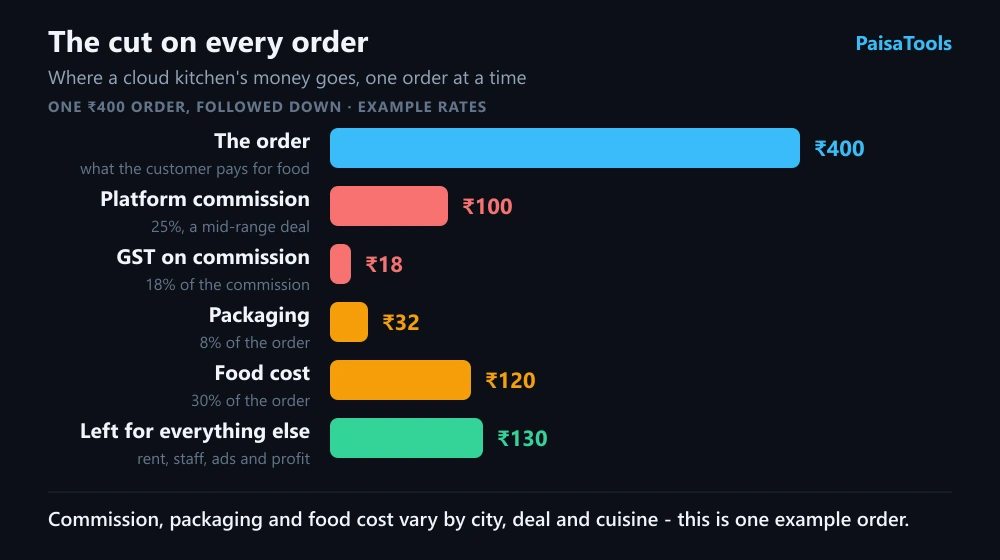
Follow a ₹400 order at example rates: a 25 per cent commission takes ₹100, 18 per cent GST on that commission takes ₹18, packaging at 8 per cent takes ₹32, and food at 30 per cent takes ₹120. The kitchen keeps ₹130 — about a third of the order — and that ₹130 has to pay rent, salaries, electricity and advertising before a single rupee is profit. Every point of commission you negotiate away goes straight onto that last line.
GST works differently here
Since 1 January 2022, when food is ordered through an app like Swiggy or Zomato, the platform itself collects and pays the 5 per cent GST on the meal. The kitchen does not charge it on those orders. What the kitchen does pay is 18 per cent GST on the commission and fees the platform charges it — a cost that is easy to leave out of a margin plan.
Work out GST on a bill or an invoicePackaging is not a rounding error
Packaging commonly makes up 8 to 15 per cent of the cost of each order. On a menu where the platform already takes a quarter, the difference between 8 and 15 per cent is the difference between a kitchen that pays its rent and one that does not.
When it pays back
A well-run cloud kitchen commonly breaks even in 8 to 18 months, and operating margins after that can land anywhere from 15 to 35 per cent depending on cuisine, pricing and order volume. The single biggest lever is the one the platform does not control: running more than one brand from the same kitchen, so the rent and the staff are shared across several menus.
Paying for it
If the setup is funded with a loan, the EMI is a fixed cost from the first month, before order volume has built. Put it inside the per-order sum above, not in a separate mental account.
Work out the EMI on the business loan firstCheck whether the whole plan is affordable for youFrequently asked questions
- How much does it cost to start a cloud kitchen in India?
- Roughly ₹3 lakh to ₹6 lakh for a small single-brand kitchen in a smaller city, ₹8 lakh to ₹15 lakh for a multi-cuisine setup, and about ₹12 lakh to ₹22 lakh all-in for a single-brand kitchen in a tier-1 city.
- How much commission do Swiggy and Zomato charge a cloud kitchen?
- Commonly 18 to 25 per cent of the order, depending on city and deal. With platform fees and GST on the commission, the effective cut commonly lands between 25 and 35 per cent.
- Does a cloud kitchen charge GST on Swiggy and Zomato orders?
- No. Since 1 January 2022 the platform collects and pays the 5 per cent GST on food ordered through it. The kitchen pays 18 per cent GST on the commission and fees the platform charges it.
- How long does a cloud kitchen take to break even?
- A well-run kitchen commonly breaks even in 8 to 18 months. Running several brands from one kitchen is the usual way to get there faster, because rent and staff are shared.
- What licences does a cloud kitchen need?
- FSSAI registration, a municipal trade licence, a fire NOC and GST registration. The delivery platforms need the FSSAI number before they list a kitchen.