
The Dhirubhai Ambani story is told as nerve: the man who worked at a petrol pump in Aden, came back with almost nothing, started trading yarn, and built Reliance. Every retelling lands on the same moral, which is that he dared more than everyone else.
It makes a good story and a poor lesson, because plenty of people dare and stay poor. What separated him was structural, and looking at it properly is more useful than admiring the risk.
He moved up the chain instead of sideways
Reliance did not grow by selling more of the same thing. It kept buying the step above it. Trading yarn led into making textiles, which led into the polyester that fed the textiles, which led into the petrochemicals that fed the polyester, and eventually into refining.
Each step meant his input cost stopped being someone else's profit margin. That is a different mechanism from working harder at one level, and it compounds, because every stage makes the next one cheaper to enter.
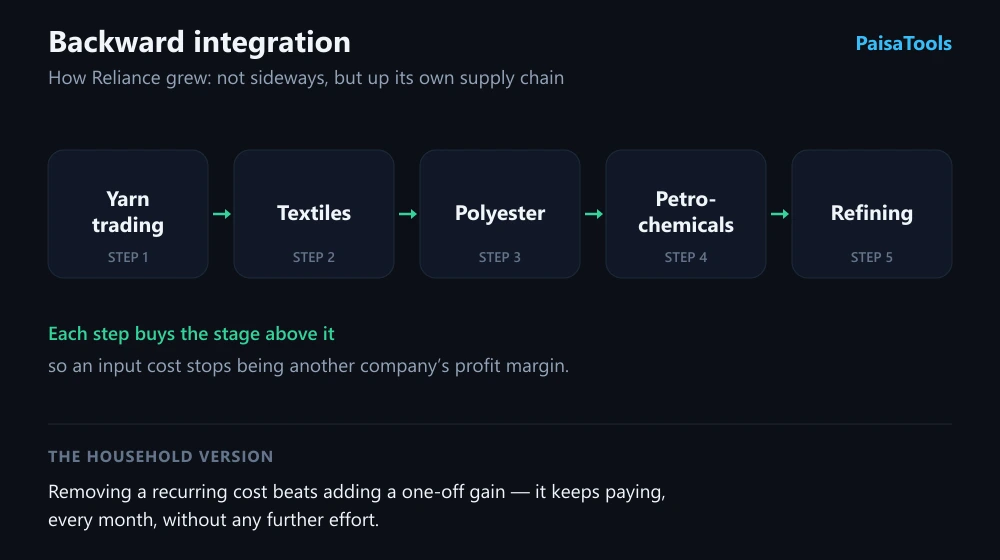
The household version of this is unglamorous but real: the money you stop paying out permanently is worth more than the money you occasionally earn extra. Clearing high-interest debt, ending a subscription you forgot, cutting a recurring charge — each removes a cost forever rather than adding income once.
Try it on your numbersIncome Tax CalculatorOld vs New regime, side by side (FY 2026-27)He funded growth from people nobody else was asking
His most genuinely original move was not industrial. At a time when equity in India belonged to a narrow circle, he went to ordinary savers in small towns and asked them to own part of the company. Reliance annual meetings famously outgrew halls and moved into stadiums.
That gave him capital that did not depend on the lenders and institutions his competitors were queuing for. It also created a shareholder base with a personal stake in the company's survival. He found a source of funding nobody was competing for, which is a far rarer advantage than courage.
See what small, regular investing compounds intoThe part that is honestly not copyable
It would be dishonest to present this as a repeatable formula. He operated in a licence-era economy where proximity to policy and the ability to navigate approvals were decisive, and that environment does not exist now. Some of the advantage came from access, not insight.
The clearest evidence that brilliance is not enough came after him. He died in 2002 without leaving a will, and the succession dispute that followed split what he had built. A fortune assembled over four decades needed one document to protect it, and did not have one.
What actually transfers
- Removing a recurring cost beats adding a one-off gain, because it keeps paying every month without further effort.
- Look for the funding or opportunity nobody is competing for, rather than competing harder for the one everybody wants.
- Separate the parts of any success story that came from access from the parts that came from method. Only the second kind transfers.
- Write the will. The largest single destruction of wealth in this story happened after the wealth was already built.
Frequently asked questions
- What made Dhirubhai Ambani successful?
- Mostly structure rather than daring. He integrated backwards up his own supply chain so each input stopped being another company's margin, and he raised capital from small retail shareholders when almost nobody was courting them. Both are mechanisms; the risk-taking is the part the retellings emphasise.
- Can his strategy be copied today?
- Partly. Backward integration and finding uncontested sources of funding are real, transferable ideas. But he operated in a licence-era economy where policy access mattered enormously, and that advantage is neither available nor repeatable now.
- What is the household version of backward integration?
- Removing a recurring cost rather than chasing extra income. Clearing high-interest debt or ending a forgotten subscription stops a payment permanently, which compounds quietly, whereas a one-off gain arrives once and is done.
- What happened to the Reliance fortune after him?
- He died in 2002 without a will, and the resulting succession dispute split the group between his sons. It is the sharpest illustration in Indian business that building wealth and protecting it are separate problems, and the second one needs paperwork.