
Rakesh Jhunjhunwala is remembered as India's Big Bull: the trader with the loud calls, the television appearances, the conviction that made headlines. That reputation is accurate as far as it goes. It is also the least useful part of his record for anyone trying to learn something from it.
The trading was real, and it funded things. But the wealth that made him a household name did not come from being right often. It came from a handful of decisions he then refused to undo, held across market cycles that would have shaken almost anyone out.
Concentration, which is the opposite of the usual advice
Standard advice tells you to diversify. His portfolio did the opposite: a small number of positions carried an outsized share of the outcome, with Titan the most discussed of them, held for well over a decade while the story played out.
It is worth being honest about what that means. Concentration magnifies whatever you own. It made his correct calls enormous, and it would have made a wrong one just as painful. Copying the concentration without his research depth, his balance sheet and his ability to sit through drawdowns is not following his method. It is taking his risk without his cushion.
Try it on your numbersSIP CalculatorPlan systematic investmentsThe holding period nobody wants to hear about
The uncomfortable part of his record is how boring the winning years were. A position that compounds for a decade spends most of that decade doing nothing interesting, and often several stretches looking like a mistake.
Most retail investors never find out whether their thesis was right, because they sell during the stretch where it looks wrong. The difference is not intelligence. It is the willingness to stay invested through a period that offers no reassurance.
See what a decade of compounding actually doesHe kept the two activities separate
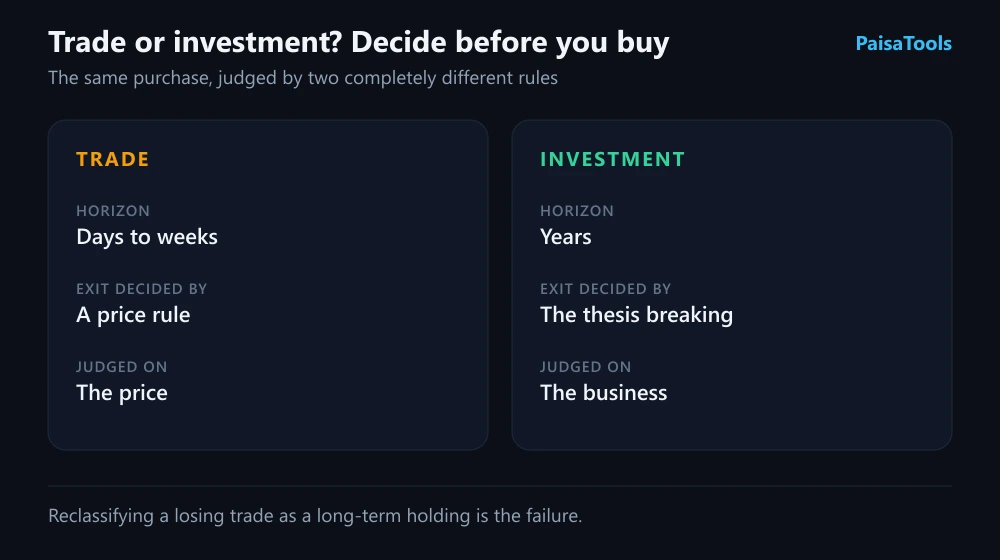
He traded and he invested, and he did not confuse them. Trading has an exit rule and a time horizon measured in days or weeks. Investing has a thesis and a horizon measured in years. Both can work. Blending them is what quietly destroys retail portfolios.
The common failure is buying for a trade, watching it fall, and reclassifying it as a long-term investment to avoid booking the loss. That is not conviction. It is a trade with the exit removed, and it is how small losses become permanent ones.
What actually transfers
- Decide before you buy whether this is a trade or an investment, and write down what would make you exit. The decision is worthless if it is made after the price moves.
- Judge a long-term holding on whether the business thesis still holds, not on the last few months of price.
- Size positions so that being wrong is survivable, because his tolerance for a bad outcome was not the same as yours.
- Expect the productive years to feel uneventful. Nothing about compounding is dramatic while it is happening.
He died in August 2022, weeks after backing a new airline, still taking positions. The story people repeat is the boldness. The part worth borrowing is the patience underneath it.
Frequently asked questions
- Should retail investors copy a concentrated portfolio?
- Concentration magnifies both outcomes, and it works only alongside deep research and the financial capacity to survive being wrong. Copying the concentration without those is taking the risk without the cushion that made it survivable for him.
- Was Rakesh Jhunjhunwala a trader or an investor?
- Both, and he kept them separate, which is the part usually missed. Trades had exit rules and short horizons; long-term holdings were judged on whether the business thesis still held. Blending the two is a common way retail portfolios come apart.
- What is the most copyable part of his approach?
- Deciding in advance whether a purchase is a trade or an investment, and writing down what would make you sell. That decision costs nothing, requires no capital, and stops the most common failure — turning a losing trade into a long-term holding to avoid booking the loss.
- Why do long-term holdings feel like mistakes?
- Because a position that compounds over a decade spends most of that decade doing nothing interesting, with stretches where it looks plainly wrong. Most investors sell during those stretches and never learn whether the thesis was right.