
Search for a PF withdrawal and the advice is always the same: attach Form 15G and no tax will be deducted. It is repeated so often that people sign it without checking whether it applies to them at all.
Two things are worth knowing before you do. Most withdrawals never needed the form in the first place — and signing it when you do not qualify is not a paperwork slip, it is a false declaration.
First: is any tax even being deducted?
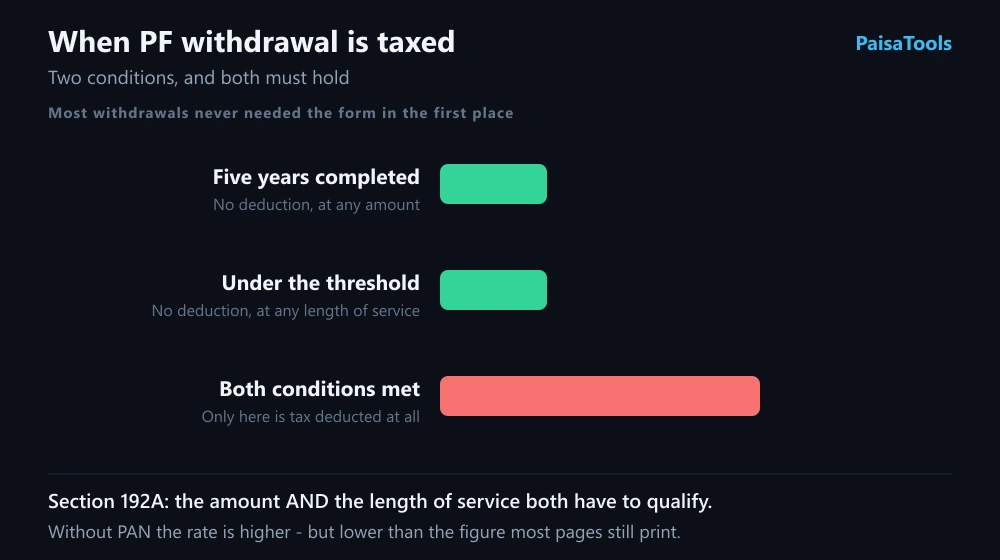
Tax is deducted from a provident fund withdrawal only when TWO conditions hold together, under section 192A. The amount has to cross ₹50,000, and your continuous service has to be under five years. Miss either one and nothing is deducted, with or without the form.
So the member who has completed five years owes no TDS on any amount, and the member withdrawing ₹30,000 owes none regardless of service. Both are told to file 15G anyway, and for both it is a blank form in an envelope.
Second: without PAN, the number is not what most pages say
When TDS does apply, it is 10% if your PAN is on the account. Without PAN it used to be the maximum marginal rate, which is where the figure of 34.608% comes from — and most pages still print it.
That changed. The Finance Act 2023 replaced the maximum marginal rate in section 192A with a flat rate, well below the old one. It is still a strong reason to get PAN seeded before withdrawing, but the scare figure doing the rounds is out of date.
The condition that decides whether you may sign at all
Form 15G is a declaration that your total estimated income for the year, INCLUDING this withdrawal, will fall below the basic exemption limit — ₹4,00,000 under the regime in force for FY 2026-27. It is not a request to skip tax. If you have worked part of the year, or you withdraw a large balance, adding the two together usually pushes you past the limit, and at that point you do not qualify. Form 15H is the same declaration for anyone aged 60 or above.
What signing it wrongly actually means
The form carries a verification: you are certifying the figure is true to the best of your knowledge. A false declaration to avoid tax is an offence under the Income-tax Act, not an invalid form that simply gets ignored.
And it rarely helps even when it works. TDS is not the tax — it is tax collected early. If the withdrawal is taxable, stopping the deduction only moves the bill to your return, where it arrives without the credit already paid on your behalf.
The short version, by situation
- Five years of continuous service completed: nothing is deducted. No form needed.
- Under ₹50,000 withdrawn: nothing is deducted. No form needed.
- Over ₹50,000, under five years, and your total income for the year genuinely stays under the limit: 15G applies, and it is worth filing.
- Over ₹50,000, under five years, and your income crosses the limit: you do not qualify. Let the tax be deducted and claim what is due in your return.
- PAN not seeded against the UAN: fix that first. It changes the rate more than the form does.
Frequently asked questions
- Is Form 15G compulsory for PF withdrawal?
- No. It is optional, and for most withdrawals it is unnecessary because no tax was going to be deducted in the first place.
- When is tax deducted from a PF withdrawal?
- Only when the amount crosses the threshold AND continuous service is under five years. Both must be true; either one alone means no deduction.
- What if I do not have PAN linked?
- A higher rate applies than with PAN, though the Finance Act 2023 lowered it from the old maximum-marginal-rate figure that many pages still quote. Seeding PAN against the UAN is the better fix.
- Should I use Form 15G or 15H?
- 15H is for members aged 60 and above; 15G is for everyone below that age. The income condition works the same way in both.
- Does stopping TDS mean the withdrawal is tax-free?
- No. TDS is collection in advance, not the final tax. If the withdrawal is taxable it stays taxable, and the amount is settled in your return.