
Every September, Apple launches a new iPhone, the pre-orders open, and within hours your feed fills with the same line: 'from ₹X,XXX a month, no-cost EMI'. Split into small monthly pieces, the most expensive phone most people will ever own suddenly feels reasonable. That's exactly the point of the offer — and it's why the sticker price is the least useful number in the whole decision. The real cost of an iPhone in India is bigger than the price tag, and most of it hides in the parts nobody adds up.
The sticker price is only where it starts
GST is already baked into the MRP, so that isn't the hidden bit. The extra money leaks out elsewhere — and it adds up fast. A case and a screen protector you'll 'definitely' buy. A fast charger, sold separately. AppleCare+ if you want the accidental-damage cover. And the big one: if you finance it instead of paying upfront, the way you pay quietly changes what you pay. Stack those up and the amount you actually part with is meaningfully higher than the figure on the price sticker.
Try it on your numbersEMI CalculatorLoan EMI + amortization schedule'No-cost EMI' is not free
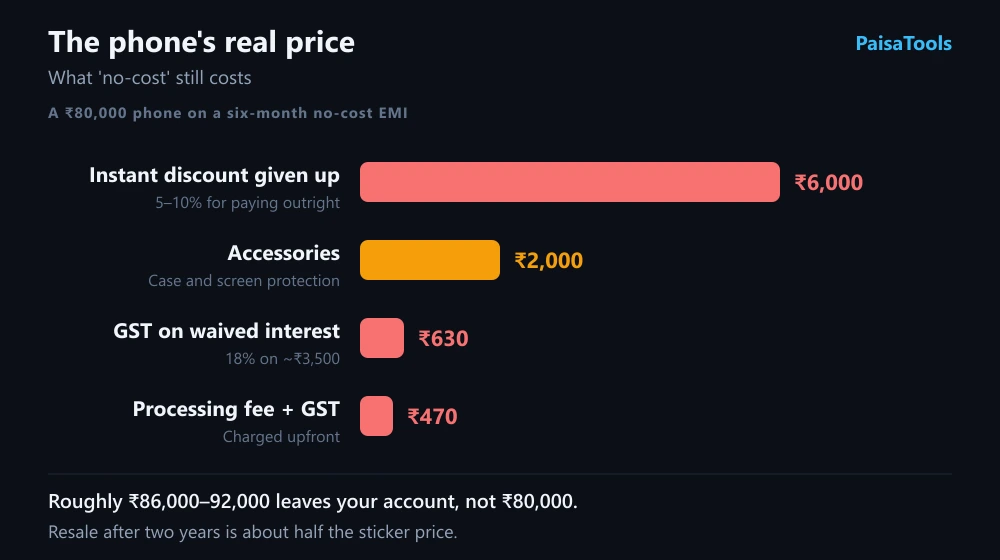
Take a phone at ₹80,000 as the example - the arithmetic holds whatever this year's model costs. Over six months at a typical 15% card rate, the interest the bank charges comes to roughly ₹3,500. The seller absorbs that as a discount, which is what makes it 'no-cost'. What the seller does not absorb is the tax on it.
- 18% GST on that waived interest, charged to you: about ₹630.
- Processing fee: about ₹199 to ₹599, plus 18% GST on the fee.
- The instant discount you gave up by not paying outright, often 5 to 10% on card offers: ₹4,000 to ₹8,000 on this phone.
- A case and screen protection, which almost nobody skips: about ₹1,500 to ₹3,000.
So the ₹80,000 phone leaves your account at roughly ₹86,000 to ₹92,000 once the tax on the waived interest, the processing fee, the forgone instant discount and the basic accessories are counted. Two years later it resells for about half the sticker price, which makes the true cost of those two years closer to ₹45,000 than to zero.
This is the line that does the most quiet damage. 'No-cost EMI' rarely means the bank lends you money for nothing — it means the interest has been moved somewhere you won't see it. Usually one of two ways: the interest is added to the price and then knocked off as an equal 'discount' (so you pay the full pre-discount amount over the tenure), or you simply forfeit the upfront-payment discount and instalment cashbacks a cash buyer would have taken. On top of that, GST applies to the interest component even when the EMI is 'no-cost'. The bank still earns; the retailer still earns; the only person who can't see the cost is you. Run the exact tenure through an EMI calculator and the true total pops out — it's almost never the same as the sticker.
Price your own no-cost EMI offer — GST, fee and lost discountThe cost nobody counts: what that money would have become
Here's the number that changes the decision. A phone is a depreciating asset — an iPhone typically sheds a large chunk of its resale value within two to three years, which is roughly how long most people keep it before the next upgrade itch. Now picture the same amount not going into a phone that's losing value, but into a simple index fund for those same years. One number shrinks; the other compounds. The gap between them — the phone's fall in value plus the growth you gave up — is the true cost of buying the top model now versus a phone that does 90% of the job for half the price and investing the difference. That gap is usually far larger than the EMI 'saving' that sold you the deal.
See what that money grows into if you invest it insteadWhen the iPhone is actually worth it
None of this means don't buy it. An iPhone can be a genuinely good buy — the honest test is how you buy it. It's worth it when you'll keep it four or five years (which spreads the cost thin and makes the depreciation stop mattering), when you can pay upfront or take a genuine no-cost EMI without losing a bigger cash discount, and when the amount fits your budget without touching your emergency fund. It's a bad buy when you upgrade every year, when you finance it at a real interest rate, or — worst of all — when it goes on a credit card you don't clear in full that month, because then the phone quietly costs you another 35–45% a year on top.
Carrying a card balance? See what it really costs — Credit Card PayoffThe iPhone isn't the mistake. Buying it on the ad's terms, without doing this one bit of math, is. Take this year's price for the model you actually want, run it through the EMI and the invest-it-instead numbers above, and decide with the real figure in front of you — not the friendly little monthly one designed to stop you doing exactly that.
Frequently asked questions
- Is buying an iPhone on EMI worth it?
- It depends entirely on the terms and how long you'll keep it. A genuine no-cost EMI — where you don't forfeit a bigger upfront cash discount and you clear it on schedule — can be fine; you spread a large one-time cost without paying extra. It stops being worth it the moment there's real interest, a lost discount, or a credit-card balance you don't clear in full, and when you upgrade again before the phone has earned its keep. Run your exact price and tenure through an EMI calculator before deciding.
- Is no-cost EMI on an iPhone really free?
- Rarely. 'No-cost EMI' usually means the interest is hidden rather than removed — either added to the price and shown back as an equal discount, or paid for by the upfront-payment discount and cashbacks you give up. GST also applies to the interest portion even on a no-cost plan. You often pay the same or slightly more than a cash buyer who negotiated a discount; the cost is just harder to see.
- How much does an iPhone really cost in India?
- More than the sticker. On top of the MRP you're usually looking at a case and screen protector, possibly a separate charger and AppleCare+, and — if you finance it — the true EMI cost. The bigger 'cost' is what that money would have grown into if invested for the two-to-three years you'll own the phone while it loses resale value. The exact number is yours to compute from this year's price; the calculators above give it in seconds.
- Should I buy an iPhone or invest the money?
- It isn't all-or-nothing — the useful question is the gap. Take the price of the model you want, see what it would grow to if invested for the years you'd keep the phone, and compare that with what the phone will be worth by then (much less). If a cheaper phone covers your actual needs, the difference invested is real money you're choosing to spend on the badge. Decide with that number visible, not hidden behind a monthly instalment.