
Every product page in the festive sales carries the same three words under the price, and they are doing a lot of work. No-cost EMI sounds like the bank has decided to lend you money for free. It has not. The interest is still charged. It has simply been moved somewhere you are not looking.
Where the interest actually goes
When you convert a purchase to a no-cost EMI, the card issuer or lender charges its normal EMI interest rate, exactly as it would on any other instalment plan. What changes is the price. The seller or the brand gives you a discount equal to that interest, so that the principal plus the interest adds back up to the sticker price. The interest is real. It has been paid for by a discount rather than by you, at least on paper.
That arrangement leaves three costs that the discount does not cover, and one that is easy to miss entirely.
The three costs that survive the discount
- GST on the interest. Interest on a card EMI attracts 18% GST, and it is charged on the interest component of every instalment. The seller's discount cancels the interest, not the tax on it.
- The processing fee. Most lenders charge a fee to convert a purchase into EMIs, commonly somewhere between ₹99 and ₹299 per conversion, and some charge a percentage instead. GST at 18% applies to the fee as well.
- The discount you gave up. Many offers give you a choice: an instant discount if you pay in full, or no-cost EMI. Choosing the EMI means forfeiting that discount, and this is usually the largest cost of the four.
A worked example
Take a ₹60,000 phone on a six-month no-cost EMI where the card's EMI rate is 15% a year. The interest over six months comes to about ₹2,652, and the seller's discount absorbs it. The GST on that interest, about ₹477, does not get absorbed. Add a ₹199 processing fee and its GST, about ₹235 together, and the phone costs roughly ₹712 more than the sticker price. Stretch the same purchase to twelve months and the interest rises to about ₹4,986, which carries around ₹897 of GST on its own.
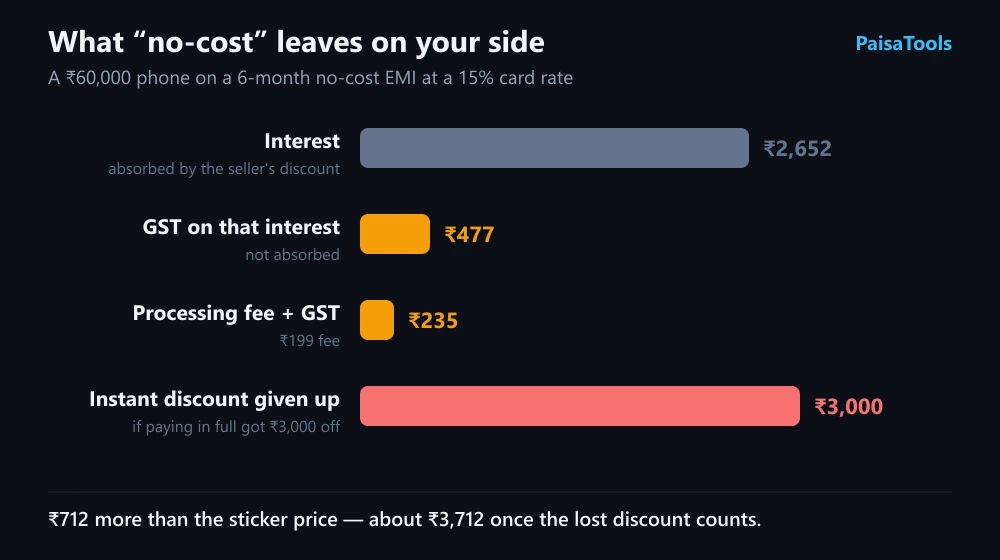
Those amounts are small, and on their own they would not be a reason to avoid the offer. The expensive part is the alternative. If paying the full amount on the day earned a ₹3,000 instant discount, the no-cost EMI has cost about ₹3,712 in total. You borrowed an average of roughly ₹35,000 across those six months to save that money, which works out to an annualised cost of more than 20%. That is credit-card pricing, dressed as a free offer.
The fine print that turns it into real debt
- The full purchase amount is blocked against your credit limit on day one, which pushes up your credit utilisation and can weigh on your credit score while the plan runs.
- Miss an instalment and the late fee applies, interest can be charged at the card's regular rate, and some issuers withdraw the no-cost benefit on the remaining balance.
- Closing the EMI plan early can attract a foreclosure charge on some cards, with GST on top.
- If you return the product, check that the EMI plan has been cancelled as well as the order. The two are processed separately, and the instalments can keep arriving after the refund.
When no-cost EMI genuinely makes sense
It makes sense when there is no instant discount for paying in full, when you would have bought the product at that price anyway, and when every instalment will be paid on time from money you already have. In that case the GST and the fee are a small price for keeping your cash where it is.
It stops making sense the moment the EMI is what makes the purchase possible. If the monthly amount is what persuaded you, the product is more expensive than your budget, and the offer has done exactly what it was designed to do.
The honest summary
No-cost EMI is a discount paid to cancel interest, and it leaves the tax on that interest, a processing fee, and very often a forgone instant discount on your side of the ledger. Compare the full-payment price, including every discount available for paying in full, against the total you will actually pay across the instalments. Whichever is lower is the real price.
Frequently asked questions
- Is no-cost EMI really interest-free?
- No. The lender still charges its normal EMI interest rate. The seller or brand gives a discount equal to that interest, so the total of your instalments matches the sticker price, but the interest itself exists and is taxed.
- Why is GST charged on a no-cost EMI?
- GST at 18% applies to the interest component of each instalment and to any processing fee. The seller's discount cancels the interest amount, not the GST on it, so that tax is paid by the customer.
- Does no-cost EMI affect my credit score?
- It can. The full purchase amount is blocked against your credit limit immediately, which raises your credit utilisation while the plan runs, and any missed instalment is reported like any other late payment.
- Should I choose no-cost EMI or the instant discount?
- Compare the totals. Add the GST on the interest, the processing fee and its GST to the sticker price for the EMI route, and subtract the instant discount for the full-payment route. When an instant discount of a few thousand rupees is on offer, paying in full is usually cheaper.