Loading…
Loading PaisaToolsLoading…
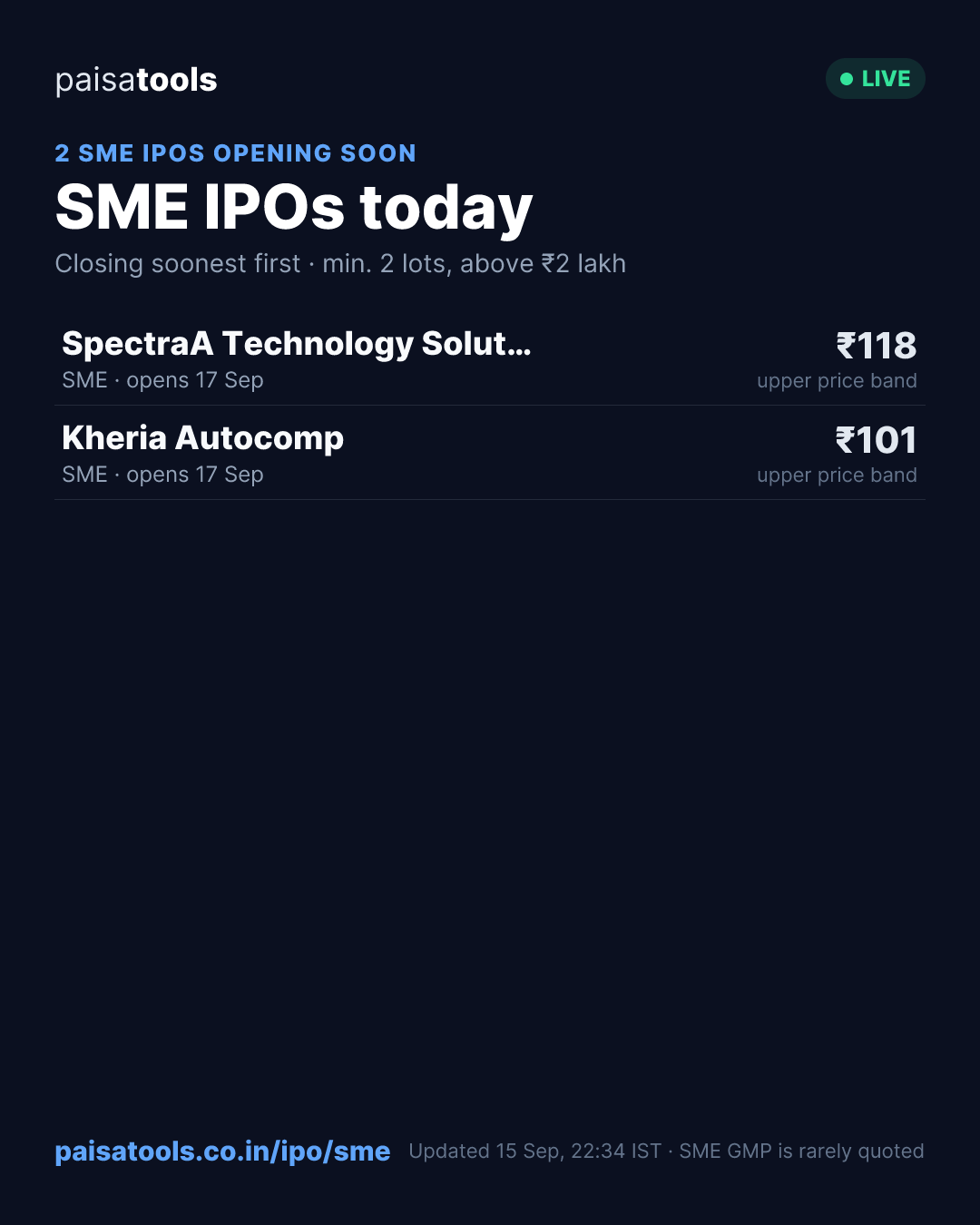
Loading PaisaToolsEvery SME issue that is open, about to open or just closed, with its dates, price band, the grey-market premium where one is quoted, and the minimum you need to apply — which for SME issues is very different from a mainboard IPO.
Where a lot size or GMP shows as missing, the exchange or the grey market has not published one yet — common for SME issues. Whatever the lot size, an individual investor's minimum is two lots, above ₹2 lakh.
Allotment and listing dates follow SEBI's T+1 / T+3 schedule and are estimates until the registrar and exchange confirm them. Check allotment status
SME issues look like any other IPO in a broker app, but the rules around them were tightened from 1 July 2025, and several of the differences change what an application costs and how easy the shares are to sell later.
A much bigger minimum
Individual investors must apply for at least two lots, with the application above ₹2 lakh. A mainboard IPO needs roughly ₹15,000.
No retail category
The retail individual investor category was replaced by 'individual investors'. There is no retail subscription figure, so allotment odds have to be read from the overall book.
Stricter eligibility
An issuer needs operating profit (EBITDA) of at least ₹1 crore in two of the last three years, and existing shareholders can sell at most 20% of the issue.
A separate trading platform
SME shares list on NSE Emerge or BSE SME and trade in lots, not single shares — so selling a small holding after listing can take longer.
Thin grey-market quotes
Many SME issues have no GMP at all, and the ones that do are quoted by fewer traders. A thin quote is easier to move.
Less coverage, more reading
Fewer analysts and brokers publish notes on SME issues, so the prospectus (RHP) is often the only detailed source. Read the objects of the issue and the promoter holding.
Since 1 July 2025, an individual investor in an SME IPO must apply for at least two lots, and the application must be above ₹2 lakh. That is more than ten times the roughly ₹15,000 minimum on a mainboard IPO, which is why SME applications are sized in lakhs rather than thousands.
Because the retail individual investor category was replaced by an 'individual investor' category for SME issues from 1 July 2025. Exchanges report subscription for qualified institutions, non-institutional investors, individual investors and the issue overall — there is no separate retail line to read allotment odds from.
Less than for mainboard issues. SME issues are small, so fewer grey-market quotes exist, many issues have no GMP at all, and a thin quote is easier to move. Treat an SME GMP as a rough sentiment signal. Our GMP track record separates SME from mainboard results so the difference can be measured as listings accumulate.
On the exchanges' dedicated SME platforms — NSE Emerge and BSE SME — rather than the main board. Shares on these platforms trade in lots rather than single shares, which makes buying and selling small quantities after listing harder than on the main board.
The same way as any IPO: on the registrar's allotment page for that issue, using your PAN, application number or DP/Client ID. Allotment follows roughly one working day after the issue closes, and the allotment status page links each issue to its registrar.
SME IPO data comes from exchange and public grey-market sources and may lag the exchange. GMP is unofficial. SME rules as notified by SEBI and the exchanges effective 1 July 2025. Informational only, not investment advice.