
The quote and the final bill for a 2BHK interior fit-out are two different documents, and the gap between them is rarely a surprise to the company producing them. It is almost always the same set of line items, left out in the same order.
The three real bands
Ignore the headline offers for a moment. For a standard 2BHK of roughly 900 to 1,100 square feet, quotes in Indian metros cluster into three bands, and which band you are in is decided mostly by material choice rather than by design.
- Basic, roughly ₹4 lakh to ₹6 lakh: a modular kitchen, two wardrobes, basic false ceiling and painting. Commercial-grade plywood or engineered board, laminate finishes, standard hardware.
- Mid, roughly ₹7 lakh to ₹12 lakh: the same scope done in better material, plus a TV unit, a crockery unit, some wall treatment and better hardware. This is where most families actually land.
- Premium, ₹15 lakh and upward: solid or high-grade ply throughout, acrylic or veneer finishes, branded hinges and channels, lighting design, and bespoke carpentry rather than modules.
A quote that lands far below the basic band for a full 2BHK is not a better deal. It is a smaller scope, thinner board, or both, and the difference will show up in year three when a wardrobe shutter starts to sag.
Try it on your numbersPrepay vs Invest CalculatorPrepay your home loan or invest the surplus? See which winsWhere the money genuinely goes
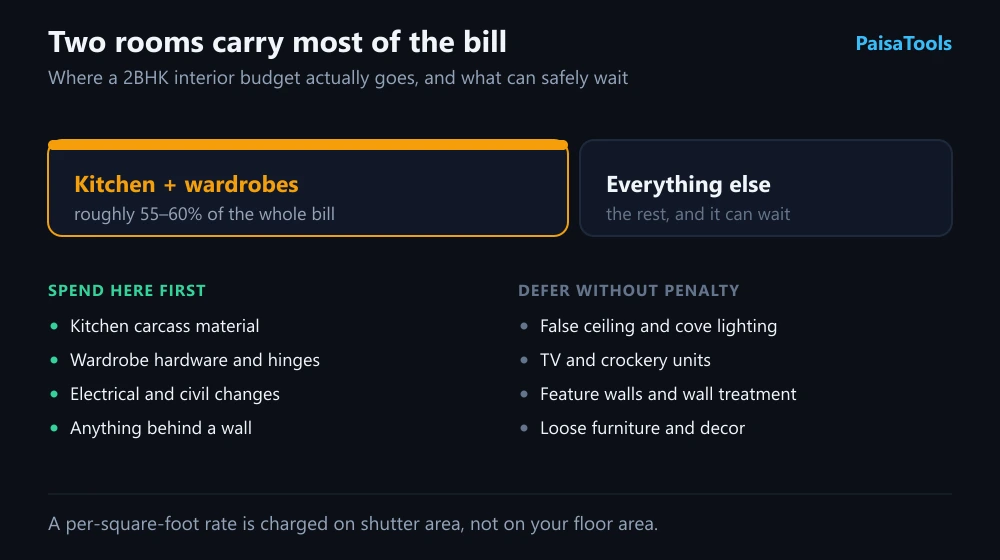
People imagine the budget spreads evenly across the flat. It does not. In almost every 2BHK fit-out, the kitchen and the wardrobes together account for somewhere around 55 to 60 per cent of the entire bill.
That single fact is the most useful thing in this article, because it tells you where to spend and where to stop. Money put into kitchen carcass material and wardrobe hardware buys you something you will operate several times a day for a decade. Money put into a feature wall in the living room buys you something you will stop noticing in a month.
The per-square-foot trap
This is the one that catches almost everyone. When a company advertises interiors at a rate per square foot, that rate is generally applied to the surface area of the units being built — the shutter or panel area of the kitchen and wardrobes — not to the floor area of your flat.
So a 1,000 square foot 2BHK advertised at a rate per square foot is not floor area multiplied by that rate. The units in a 2BHK typically work out to a few hundred square feet of shutter area, and the quote is built from that. The two numbers are not comparable, and comparing them is how people arrive at a budget less than half of what the work actually costs.
Ask any vendor one question before you compare quotes: what area is your rate applied to, and how many square feet of it does my flat have. A vendor who will not answer that plainly is telling you something.
What the quote usually excludes
- Appliances. The hob, chimney, oven and dishwasher are frequently shown in the render and absent from the price.
- Electrical and plumbing changes. Moving a point, adding sockets behind the TV unit, or shifting a water line is civil work and is usually billed separately.
- False ceiling and painting, in the cheaper quotes. Check whether these are in scope or listed as optional.
- Loose furniture. Sofa, dining table, beds and mattresses are often outside a modular quote entirely, and they are not a small number.
- Taxes. Confirm whether the figure you are comparing is inclusive, because a quote quoted before tax against one quoted after tax is not a like-for-like comparison.
How people pay for it, and what that costs
Interior work is usually financed, and the route chosen makes a larger difference to the total than most of the design decisions do.
A personal loan is the fast route and the expensive one, typically in the low to mid teens on interest. Adding the amount to a home loan, where the lender permits it, is usually several percentage points cheaper because it is secured against the property. On eight to ten lakh over several years that difference is not a rounding error — it is a meaningful share of a wardrobe.
The trap in the cheaper route is the tenure. Financing a fit-out over twenty years because it is attached to the home loan means paying for a kitchen long after you have replaced its hardware. Cheaper rate, longer term, more total interest. Run both before you choose.
Compare what each financing route actually costs youThe order that saves the most
If the full budget is not there, the sequence that works is the one that follows the 55-to-60 per cent rule. Do the kitchen and the wardrobes properly, in good material, with hardware you will not have to replace. Do the electrical and any civil changes at the same time, because opening walls again later costs far more than doing it once.
Then stop. False ceilings, feature walls, TV units and decor can be added in any later year at almost no penalty, because none of them require touching what is already built. Spending the whole budget thinly across every room, so that nothing is done well, is the common and expensive mistake.
Frequently asked questions
- How much do 2BHK interiors cost in India?
- For a 900 to 1,100 square foot 2BHK, quotes cluster into three bands: roughly ₹4 lakh to ₹6 lakh for a basic fit-out, ₹7 lakh to ₹12 lakh for a mid-range one, and ₹15 lakh and upward for premium materials and bespoke carpentry. The band is decided mostly by material and hardware quality rather than by design.
- Why is the per-square-foot rate misleading?
- Because the rate is generally applied to the shutter or panel area of the units being built, not to your flat's floor area. A 1,000 square foot flat does not have 1,000 square feet of chargeable area, so multiplying floor area by the advertised rate produces a budget well below the real cost. Ask each vendor what area their rate applies to.
- What share of the budget do the kitchen and wardrobes take?
- Together they usually account for around 55 to 60 per cent of a 2BHK fit-out. That is why the sensible way to phase the work is to do those two properly first and defer ceilings, feature walls and decor, which can be added later without disturbing anything.
- Is it cheaper to add interiors to a home loan?
- The interest rate is usually several percentage points lower than a personal loan because it is secured. But the tenure is typically far longer, so the total interest paid can end up higher. Compare the total cost of both, not just the rate.
- What is normally excluded from an interior quote?
- Appliances, electrical and plumbing changes, loose furniture such as sofas and beds, and sometimes false ceiling and painting. Taxes may also be quoted separately. Confirm each of these in writing before comparing two quotes against each other.