
The festive season is when most Indian families buy a car, and it is when dealers push finance hardest. The question buyers who have the money ask is simple: should I just pay cash? The answer is not simply yes, because cash is not free either. It is money that could be earning something, and that is the comparison that decides it.
What the loan costs
New-car loan rates at the large private and public sector banks sit roughly between 8.75% and 9.75% a year in 2026 for borrowers with a strong credit score, and a few public sector banks advertise starting rates from around 7.4%. Dealer-arranged and NBFC finance is often priced higher, and a credit score below 750 typically adds to the rate or narrows your choice of lender.
On an ₹8 lakh loan at 9%, a five-year tenure gives an EMI of about ₹16,607 and total interest of about ₹1,96,401. Stretch it to seven years and the EMI falls to about ₹12,871, while the interest rises to about ₹2,81,186. The lower EMI costs roughly ₹85,000 more.
The comparison that actually decides it
A fair comparison has two paths. On the first, you pay ₹8 lakh in cash and invest the ₹16,607 you would have paid as EMI every month. On the second, you take the loan, keep the ₹8 lakh invested, and pay the EMI. Both paths cost you the same every month. The only difference is whether your money is working against a 9% loan or not.
After five years, with the same return on both paths: if the money would sit in a fixed deposit earning 7% before tax and you are in the 30% slab, the cash path finishes roughly ₹1.05 lakh ahead. At a 7% return with no tax drag it is still about ₹55,000 ahead. Only if the money earns around 12% a year does the loan path come out ahead, by about ₹97,000, and a 12% return is an equity-market assumption that is neither guaranteed nor smooth.
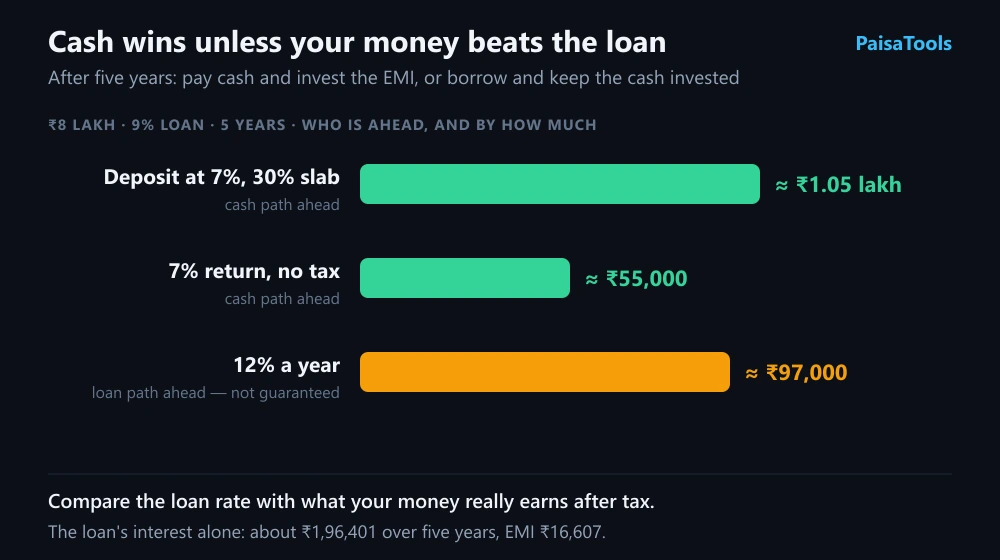
That gives a usable rule. Compare the loan rate with the return your money realistically earns after tax, over the loan's tenure, in the investment you would actually keep it in. If the loan rate is higher, cash wins. For most buyers whose spare money sits in deposits, it is.
One detail tilts it further. For a salaried buyer, car loan interest is not tax-deductible. A business that uses the car for its operations can generally claim the interest and depreciation as expenses, which changes the arithmetic, but that does not apply to a car bought for personal use.
The costs on top of the interest
- A processing fee, which ranges from a small flat amount to a fraction of a percent of the loan depending on the lender.
- Foreclosure or prepayment charges. Car loans are usually fixed-rate, and many lenders charge a percentage of the outstanding balance if you close the loan early.
- Insurance with the bank noted as the financier, and a trip to the RTO to remove the hypothecation once the loan is closed.
- Dealer-arranged finance is sometimes bundled with insurance, extended warranties or accessories at prices you would not have chosen separately.
When the loan is the better choice
- Paying cash would empty your emergency fund. A car loan is expensive; being without a buffer when something goes wrong is more expensive.
- Raising the cash would mean selling investments that trigger capital gains tax or exit loads, or breaking a deposit early at a penalty.
- The manufacturer is genuinely subsidising the loan rate as a festive offer. Compare that against any cash discount offered instead, because the two are often alternatives.
- The car is a business asset and the interest is a deductible expense.
The honest summary
For most families whose savings sit in deposits, paying cash, or making the largest down payment you comfortably can and taking the shortest tenure you can afford, is cheaper than financing the whole car. The loan wins when it protects your emergency fund, when the rate is genuinely subsidised, or when your money is invested in something that reliably earns more than the loan costs. Decide on the numbers, not on the EMI that fits the salary.
See if a car fits your income and savingsFrequently asked questions
- Is it better to buy a car on EMI or pay cash?
- For most buyers whose spare money is in fixed deposits, paying cash is cheaper, because a car loan at around 9% costs more than a deposit earns after tax. A loan can make sense when paying cash would wipe out your emergency fund or when a manufacturer is subsidising the loan rate.
- How much interest will I pay on an ₹8 lakh car loan?
- At 9% a year, about ₹1,96,401 over five years with an EMI of about ₹16,607, or about ₹2,81,186 over seven years with an EMI of about ₹12,871.
- What are car loan interest rates in 2026?
- Large banks commonly price new-car loans between about 8.75% and 9.75% for borrowers with strong credit scores, and some public sector banks advertise starting rates from around 7.4%. Rates depend on your credit score, income, the car and the tenure.
- Can I claim a tax deduction on car loan interest?
- Not for a car used personally by a salaried buyer. A business that uses the car for its operations can generally claim the interest and depreciation as expenses.