
Most people planning a first home save for the down payment the bank quotes, and discover at the registration office that it was only part of the cash they needed. The loan covers a share of the property's value. It does not cover the costs of buying it, and those costs are paid up front.
What the bank will lend
The Reserve Bank caps how much of a home's value a bank may lend, and the cap depends on the value of the property.
- Property value up to ₹30 lakh: the loan can be up to 90% of the value.
- Property value above ₹30 lakh and up to ₹75 lakh: up to 80%.
- Property value above ₹75 lakh: up to 75%.
These are ceilings, not promises. A lender can offer less based on your income, age and credit history. The value used is the property value excluding stamp duty and registration, which banks may not add to the loan except on the smallest homes. And most lenders use the lower of the agreement price and their own valuation, so if the bank values the flat below what you agreed to pay, the gap comes out of your pocket too.
The costs the loan does not touch
- Stamp duty, set by the state, commonly around 5% to 7% of the property value, with several states charging less when a woman is the buyer or a co-owner.
- Registration charges, commonly around 1%, capped at a fixed amount in some states.
- GST on an under-construction property bought from a builder: 5%, or 1% for homes that qualify as affordable housing. A ready-to-move property with a completion certificate carries no GST.
- Brokerage on a resale purchase, commonly 1% to 2%.
- The loan's processing fee, legal and technical charges, and society transfer or maintenance deposits.
- Moving, basic furnishing and any interior work, which the loan will not fund.
A worked example: a ₹60 lakh flat
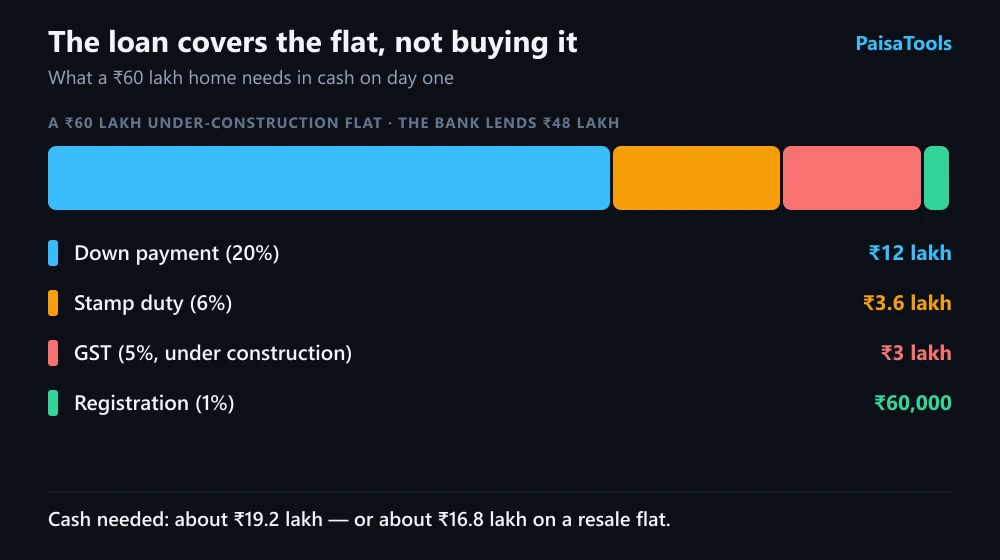
At 80%, the bank lends up to ₹48 lakh, so the down payment is ₹12 lakh. Assume stamp duty at 6%, which is ₹3.6 lakh, and registration at 1%, which is ₹60,000. On a resale flat with 1% brokerage, the cash needed on day one is about ₹16.8 lakh, close to 28% of the price. On an under-construction flat from a builder, swap the brokerage for 5% GST, ₹3 lakh, and the cash needed is about ₹19.2 lakh, or roughly 32% of the price. Interiors come on top of either.
The loan itself, ₹48 lakh at 8% over twenty years, carries an EMI of about ₹40,149. Lenders typically cap your total EMIs at a share of take-home pay, often somewhere around 40% to 50%, so this flat needs a household take-home income comfortably above ₹80,000 a month before any other loans are counted.
How much to save, by price
- ₹25 lakh home: the bank can lend up to 90%, so ₹2.5 lakh down, plus roughly 7% for stamp duty and registration, about ₹1.75 lakh. Save about ₹4.25 lakh. The EMI on ₹22.5 lakh at 8% over twenty years is about ₹18,820.
- ₹60 lakh home: save about ₹17 lakh for a resale flat or ₹19 lakh for an under-construction one, as worked out above.
- ₹1 crore home: the cap falls to 75%, so ₹25 lakh down, plus about ₹7 lakh for stamp duty and registration. Save about ₹32 lakh, before GST if the flat is under construction. The EMI on ₹75 lakh at 8% over twenty years is about ₹62,733.
Where to keep the money while you save
Down payment money has a date attached to it, and that should decide where it sits. If you expect to buy within three years, a market fall at the wrong moment can push the purchase back by years, so deposits, recurring deposits and low-risk debt options are the natural home for it. Keep it separate from your emergency fund. Buying a home should not leave the household without a buffer.
The honest summary
Plan for cash of roughly a quarter to a third of the property's price, not the 10% to 25% the loan caps suggest, once stamp duty, registration and GST or brokerage are added. Price in the bank's valuation, keep the fund in something that cannot fall when you need it, and make sure the EMI still leaves room to save after you move in.
Check whether your family can afford the flat you have in mindFrequently asked questions
- What is the minimum down payment for a home loan in India?
- RBI caps home loans at 90% of the property value up to ₹30 lakh, 80% between ₹30 lakh and ₹75 lakh, and 75% above ₹75 lakh, so the minimum down payment is 10%, 20% or 25% of the value. Stamp duty, registration and GST are paid on top.
- Can stamp duty be included in a home loan?
- Generally no. Banks calculate the loan-to-value ratio on the property value excluding stamp duty and registration charges. An exception allows these costs to be included for low-cost homes valued up to ₹10 lakh.
- How much cash do I need to buy a ₹60 lakh flat?
- About ₹16.8 lakh for a resale flat and about ₹19.2 lakh for an under-construction flat, assuming an 80% loan, 6% stamp duty, 1% registration, and either 1% brokerage or 5% GST. Interiors and furnishing are extra.
- Is GST charged on buying a flat?
- GST at 5%, or 1% for affordable housing, applies to under-construction properties bought from a builder. Ready-to-move properties with a completion certificate and resale purchases do not attract GST.