
Almost every retirement plan in India is built around one person's expenses. It quietly assumes that the person stays able to manage their own day. For a large share of families, the last stretch of a parent's life does not work that way, and the money it needs is not a rounding error on the plan. It is often the largest single line in it.
The figures below are typical urban Indian ranges for 2026. They move sharply between a metro and a smaller city, and between an agency and a locally arranged attendant, so read them as the shape of the budget rather than as a quotation.
Elder care is not one cost. It is three stages.
This is the part that breaks most family budgets, and it is structural rather than bad luck. Care is usually planned for the stage the parent is in today, and then billed at the stage they move into later.
- Independent. The parent manages daily life alone. The costs here are medical rather than custodial: medicines, check-ups, a health policy premium that rises every year.
- Assisted. They need help with some things and supervision for others. Somebody has to be present for part of the day, and the household starts paying for hours.
- Dependent. They need help with most or all daily activities, including at night. This is where cost stops being a monthly top-up and becomes a second rent.
The money roughly triples between the first stage and the third. The dangerous part is duration: the dependent stage is commonly measured in years, not months, which is exactly the opposite of how families instinctively budget for it.
Care at home, which is what most families choose
Home care is priced by hours and by skill, and both matter more than people expect when they first ask around.
- Visiting attendant, an eight to twelve hour shift: roughly ₹12,000 to ₹22,000 a month in a metro.
- Live-in attendant, untrained, with food and a place to sleep provided: roughly ₹18,000 to ₹35,000 a month.
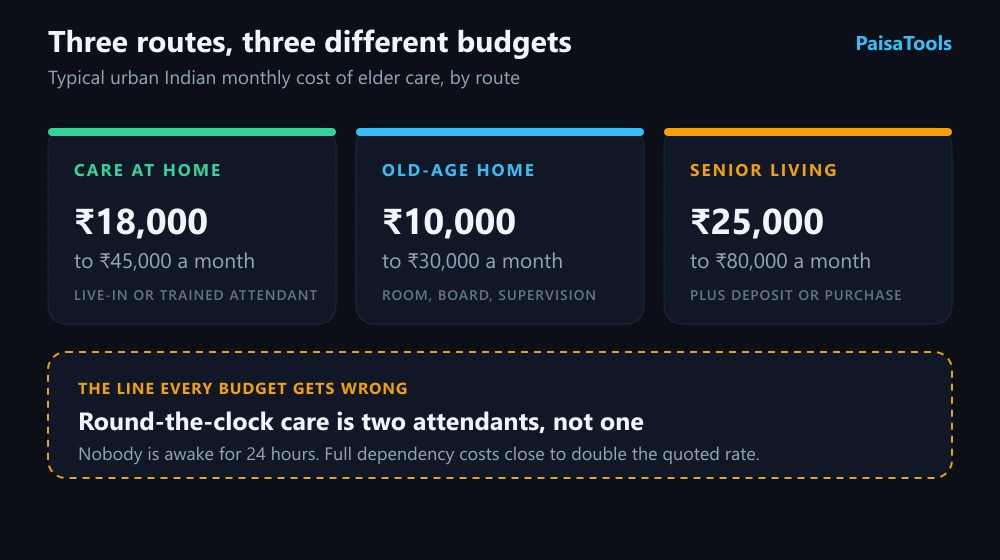
- Trained nursing attendant, for a patient who needs transfers, catheter care or feeding support: roughly ₹25,000 to ₹45,000 a month.
- Qualified nurse at home: roughly ₹35,000 to ₹70,000 a month, and this is usually arranged for a defined recovery period rather than indefinitely.
- Physiotherapy at home: ₹500 to ₹1,200 a visit, often three times a week after a fall or a stroke.
One number in that list is routinely misread. A live-in attendant is not twenty-four hour care. A single person cannot be awake and responsible around the clock, and a household that treats one attendant as continuous cover finds out during the first bad night. Genuine round-the-clock care needs two people in shifts, which means the realistic monthly figure is closer to double the rate quoted for one.
Old-age homes, and why the price range is so wide
The term covers two quite different things, which is why quoted costs range from nothing to a great deal.
Charitable and trust-run homes, often attached to a religious institution, charge little or nothing. Places are limited, there is frequently a waiting list, and many will only take residents who are still largely independent, because they are not staffed for nursing. A family that assumes this option is available when they need it may find it is not available for the parent they actually have.
Paid private homes generally run from about ₹10,000 to ₹30,000 a month for room, board and basic supervision. Medical care, medicines, diapers and any one-to-one attendant are extra, and an ageing resident who moves from assisted to dependent will usually be told that a personal attendant is now required at the family's cost, on top of the monthly fee.
Senior living, which is a property decision wearing a care costume
Senior living communities are the fastest growing option in Indian metros and the one most often misunderstood, because the marketing is about companionship and the contract is about real estate.
They come in two shapes. Some sell you a flat, at anywhere from roughly ₹30 lakh to well over a crore depending on city and developer, with a monthly maintenance charge of ₹15,000 to ₹40,000 on top. Others take a large refundable deposit and charge a monthly fee, typically ₹25,000 to ₹80,000 all in.
Three questions decide whether a given community is worth it, and none of them are about the clubhouse. What happens when a resident becomes bedridden, because many communities are built for active seniors and will require the family to arrange separate care at that point. What exactly the monthly fee includes, and which of nursing, meals, housekeeping and transport are billed separately. And on the purchase model, whether the flat can actually be resold, since the buyer pool is restricted by age and the resale market in most Indian senior housing is thin.
The costs that are not on anybody's price list
- Consumables. Adult diapers, underpads, protein supplements and dressings run ₹3,000 to ₹8,000 a month for a dependent parent, every month, and no policy pays for them.
- Home modification. Grab bars, a ramp, anti-skid flooring in the bathroom, a hospital bed and an air mattress typically land between ₹30,000 and ₹1.5 lakh as a one-time cost. The hospital bed alone is ₹15,000 to ₹40,000 to buy, or a few thousand a month to rent.
- Attendant turnover. Attendants leave, often at short notice and frequently after a festival. Agency replacement fees, the overlap while training a new person, and the days a family member has to take off are a real recurring cost that no budget includes.
- The caregiver's own earnings. When a family member reduces work or leaves a job to manage care, that lost income is usually the single largest number in the whole exercise, and it is almost never written down.
What insurance and the tax code actually do here
Less than families hope, and it is better to know that in advance than to discover it during a crisis.
A standard health policy pays for hospitalisation. Custodial care, which is the bulk of elder care spending, is not hospitalisation, and attendants at home are outside almost every retail policy. Domiciliary cover exists in some products but is narrowly written and usually requires that the treatment would otherwise have needed a hospital bed. Buying a fresh policy for a parent in their seventies is also difficult and expensive, with loadings, waiting periods for anything already diagnosed, and in many products an entry age ceiling. The time to buy a parent's health cover is years before anybody thinks they need it.
The tax code offers three genuine reliefs worth confirming against current rules before you rely on them. Section 80D allows a deduction for health insurance premiums paid for senior citizen parents, and also permits medical expenditure for a senior citizen parent who has no policy at all. Section 80DDB covers treatment of specified serious illnesses, with a higher limit for senior citizens. Section 80DD covers maintenance and medical treatment of a dependent with a disability, at a fixed amount rather than against bills. These sit under the old regime, so a household on the new regime should check what it is actually claiming.
Work out whether your own retirement plan can carry this lineHow to size it without guessing
Treat elder care as a monthly recurring liability with a defined start that you cannot predict, rather than as a lump sum. That single change fixes most of the planning error.
Take the dependent-stage figure for the route your family would realistically choose, not the assisted-stage figure that applies today. Add consumables. Assume it runs for several years rather than several months. Then ask the uncomfortable question of who pays it, because the answer decides whether it belongs in the parent's retirement corpus or in yours, and those are two different plans.
The families who handle this well are rarely the wealthiest ones. They are the ones who had the conversation while the parent was still in the first stage and could take part in it.
Frequently asked questions
- How much does a full-time attendant for an elderly parent cost in India?
- A live-in attendant typically runs ₹18,000 to ₹35,000 a month in a metro, and a trained nursing attendant ₹25,000 to ₹45,000. Genuine round-the-clock cover needs two attendants in shifts rather than one, so the realistic figure for a fully dependent parent is close to double the rate quoted for a single live-in.
- How much do old-age homes charge in India?
- Charitable and trust-run homes charge little or nothing but have limited places and often accept only residents who are still largely independent. Paid private homes generally run ₹10,000 to ₹30,000 a month for room, board and supervision, with medicines, consumables and any personal attendant billed separately.
- Does health insurance cover elder care at home?
- Generally not. Standard policies pay for hospitalisation, while most elder care spending is custodial rather than medical. Attendants at home fall outside almost every retail policy, and domiciliary cover, where it exists, is narrowly written. Consumables such as diapers and supplements are not payable either.
- What tax deductions are available for looking after elderly parents?
- Section 80D allows a deduction for health insurance premiums paid for senior citizen parents, and medical expenditure for a senior citizen parent with no policy. Section 80DDB covers specified serious illnesses at a higher limit for senior citizens, and Section 80DD covers a dependent with a disability. These sit under the old regime, so confirm current limits and which regime you are on.
- What does senior living actually cost in India?
- Two models exist. Purchase communities sell a flat from roughly ₹30 lakh upward with ₹15,000 to ₹40,000 a month in maintenance. Deposit-and-fee communities take a large refundable deposit plus roughly ₹25,000 to ₹80,000 a month. Ask specifically what happens when a resident becomes bedridden, since many are built for active seniors only.