
Two things go wrong in the same week for most Indian families facing a hospital admission. The bill is larger than they expected, and the insurance pays less of it than they expected. The second is the more avoidable of the two, because the clause responsible is printed in the policy and almost nobody reads it until the discharge desk explains it.
The figures here are typical private hospital ranges in Indian cities for 2026. Government and trust hospitals are dramatically cheaper, and a corporate chain in a metro sits at the top of every range.
What common admissions actually bill at
- Normal delivery: roughly ₹40,000 to ₹1 lakh. A caesarean typically ₹80,000 to ₹2 lakh.
- Appendectomy: roughly ₹60,000 to ₹1.5 lakh depending on whether it is open or laparoscopic.
- Angioplasty with a stent: roughly ₹2 lakh to ₹4 lakh, with the stent itself price-capped but the procedure, stay and medication not.
- Knee replacement, single knee: roughly ₹2.5 lakh to ₹5 lakh, with implant choice driving most of the spread.
- Cataract surgery: roughly ₹25,000 to ₹1 lakh per eye, again decided mostly by the lens.
- A dengue admission with a few days of supportive care: roughly ₹50,000 to ₹1.5 lakh.
Then there is intensive care, which is what turns a manageable admission into a serious one. A private ICU bed in a metro commonly runs ₹15,000 to ₹50,000 a day before treatment, and ventilator support sits at the upper end and above. A fortnight in intensive care is not an exotic scenario, and at these rates it clears most family health policies on its own.
The room rent clause, and the arithmetic behind it
This is the single most expensive sentence in a typical Indian health policy, and it does something people do not anticipate: it does not merely cap the room charge.
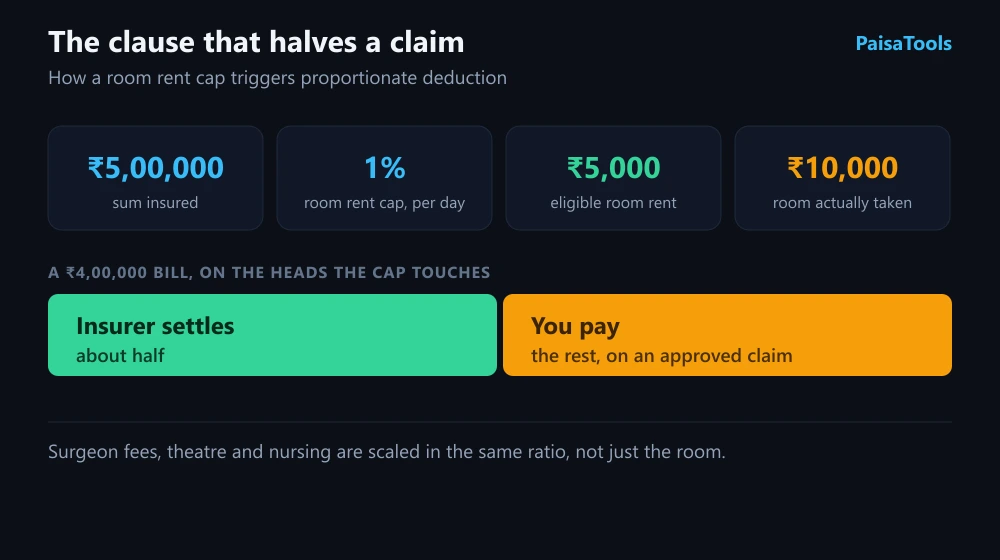
Many policies cap the eligible room rent at a percentage of the sum insured per day, commonly one per cent. If the room you occupy costs more than that cap, the insurer applies a proportionate deduction, and it applies it across the associated charges as well, not just the room line. Surgeon fees, operation theatre charges, nursing and several other heads get scaled down in the same ratio, on the reasoning that a costlier room category carries costlier everything.
Worked through, on a ₹5 lakh policy with a one per cent cap, the eligible room rent is ₹5,000 a day. Admit into a room costing ₹10,000 a day and the ratio is one half. On a ₹4 lakh bill, the associated heads are settled at roughly half their value. The family is left paying a large share of a claim that was approved, on a policy with a sum insured that comfortably exceeded the bill.
The practical instruction that follows is simple and worth telling a relative at the admission desk. Ask what the eligible room rent is under the policy before choosing a room, and take a room at or below it. Choosing a nicer room is not a small indulgence here. It is a decision to co-pay a percentage of the whole bill.
The other four reasons a claim pays less than the bill
- Non-medical consumables. Gloves, syringes, administration sets, PPE and similar items are excluded from most policies and commonly run somewhere around three to eight per cent of a surgical bill. Some insurers now sell an add-on that covers them.
- Disease-wise sub-limits. Many policies cap specific procedures, cataract and knee replacement being the usual examples, at a fixed amount regardless of the sum insured.
- Co-payment. A fixed percentage of every claim that you pay, common in policies sold at lower premiums and in most senior citizen products.
- Waiting periods. Specified conditions are excluded for the first two to four years, and pre-existing conditions for a stated period from the policy start date. This is why a policy bought after a diagnosis is far less useful than one bought years before.
What this means for the sum insured you choose
Put the room cap and the sub-limits together and a familiar conclusion falls out. A ₹5 lakh policy in a metro is not a ₹5 lakh policy. After a room cap that triggers a proportionate deduction, consumables that are not payable, and any co-pay, the effective protection against a serious admission is materially less than the number on the certificate.
So the two things worth checking in a policy are not the premium and the sum insured. They are whether there is any room rent capping at all, since policies without it exist and are worth the difference in premium, and what the sub-limits and co-pay are. A higher sum insured with a room cap can protect you less than a lower one without.
Check whether your finances could absorb the part insurance will not payThe money that has to be liquid
Even a fully cashless admission asks for money on the day. Pre-authorisation takes hours and is sometimes approved for less than the estimate, emergency admissions frequently begin with a deposit, and consumables and the non-payable share are settled at discharge before the patient leaves.
That argues for keeping a defined sum genuinely liquid rather than merely invested. Enough to cover a deposit and the non-payable share of a serious admission, in something reachable the same day, is the practical answer for most households. Equity that has to be sold and settled, or a deposit that has to be broken, is not the instrument for a Tuesday afternoon in a hospital lobby.
The right order is worth stating plainly. A policy without a room rent cap first, an honest sum insured second, and liquid money for the part no policy ever pays third. Families who have all three find a hospital admission stressful. Families missing the third find it expensive as well.
Frequently asked questions
- How much does an ICU bed cost per day in India?
- A private ICU bed in an Indian metro commonly runs ₹15,000 to ₹50,000 a day before treatment costs, with ventilator support at the upper end and above. Government and trust hospitals are dramatically cheaper. An extended intensive care stay can exhaust a typical family sum insured on its own.
- What is the room rent limit in health insurance?
- Many policies cap eligible room rent at a percentage of the sum insured per day, commonly one per cent. On a ₹5 lakh policy that is ₹5,000 a day. The cap matters far beyond the room charge, because exceeding it triggers a proportionate deduction across associated heads.
- What is proportionate deduction on a health insurance claim?
- When the room you occupy costs more than the policy's eligible room rent, the insurer scales down not only the room charge but also associated heads such as surgeon fees, operation theatre charges and nursing, in the same ratio. Taking a room at twice the eligible rate can therefore halve the settlement on those heads.
- Why does insurance not pay the full hospital bill?
- Usually a combination of four things: a room rent cap triggering proportionate deduction, non-medical consumables that are excluded and commonly run three to eight per cent of a surgical bill, disease-wise sub-limits on procedures such as cataract and knee replacement, and any co-payment clause in the policy.
- How much health cover do you need in a metro?
- More than the headline figure suggests, because a room cap, sub-limits and co-pay all reduce effective protection. Whether the policy caps room rent matters more than the sum insured alone, since a higher cover with a cap can protect you less than a lower cover without one.