
Adopting an Indian street dog costs nothing. Buying a pedigree can cost anywhere from twenty thousand rupees to well over a lakh. Both facts are widely discussed, and both are close to irrelevant, because the purchase price is the smallest number in the entire decision.
What follows are typical urban Indian ranges. Prices vary sharply between a metro and a smaller city, and between a corporate veterinary chain and a neighbourhood clinic, so treat these as the shape of the budget rather than a quotation.
The first year is the expensive one
A puppy arrives with a schedule of one-time costs that never recur, and they cluster in the first twelve months.
- Vaccination course: roughly ₹3,000 to ₹6,000 for the puppy series, then ₹1,500 to ₹3,000 a year for boosters and the annual rabies shot.
- Sterilisation: roughly ₹5,000 to ₹15,000 depending on city, size and clinic. It is a one-time cost that prevents several later ones, medical and otherwise.
- Basic equipment: bed, crate, bowls, collar, leash, harness. Budget ₹5,000 to ₹12,000, and expect to replace the leash and collar as a puppy grows.
- Deworming and tick prevention: ₹300 to ₹800 a month, all year, and skipping it in monsoon is how a small problem becomes a vet bill.
The monthly running cost is mostly food, and food scales with size
This is where the size of the dog stops being an aesthetic preference and becomes a budget decision. A Labrador does not cost slightly more than a Shih Tzu to feed. It costs several times more, every month, for a decade.
- Small breed: roughly ₹1,000 to ₹1,800 a month on food.
- Medium breed: roughly ₹2,000 to ₹3,500 a month.
- Large breed: roughly ₹4,000 to ₹6,500 a month, and more if you feed fresh alongside kibble.
- Grooming: ₹800 to ₹2,500 a session, and a long-coated breed in an Indian summer needs it regularly rather than occasionally.
The number nobody budgets for
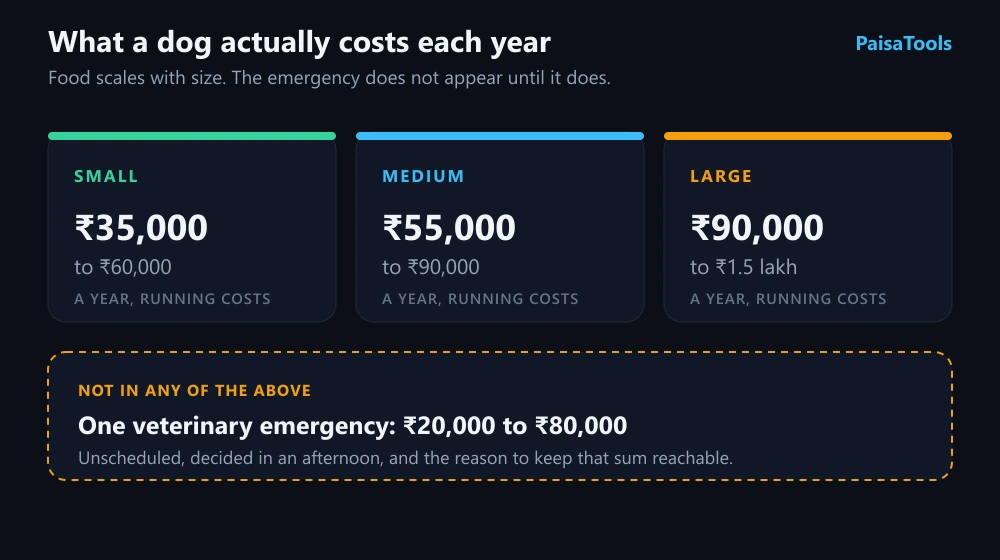
Every honest cost estimate for a dog has one line that ruins the arithmetic, and it is the veterinary emergency. A swallowed object, a road accident, a tick-borne illness caught late, a torn ligament in a large breed, a tumour in an older dog. Any one of them can produce a bill between twenty thousand and eighty thousand rupees, and the decision is made in an afternoon with no time to arrange money.
Pet insurance now exists in India, but the market is young: cover is thin, exclusions are broad, and pre-existing conditions and hereditary problems are commonly outside it. It is worth reading, not worth assuming.
The practical answer for most households is not a policy. It is a named, separate sum of money, sized at roughly one serious surgery, kept where it can be reached the same day. That is what turns an emergency into an inconvenience.
Check whether your finances can absorb a bill like thatWhat it actually adds up to in a year
Adding food, preventive medicine, an annual vet visit, grooming and consumables, and excluding both the purchase price and any emergency, a reasonable annual expectation looks like this.
- Small breed: roughly ₹35,000 to ₹60,000 a year.
- Medium breed: roughly ₹55,000 to ₹90,000 a year.
- Large breed: roughly ₹90,000 to ₹1.5 lakh a year.
- Across a twelve-to-fourteen-year life, that is a commitment measured in lakhs, and the last two years are usually the most expensive of all as age-related care begins.
The costs people genuinely do not see coming
- Boarding when you travel: ₹500 to ₹1,200 a day. Two family trips a year quietly adds a month of food costs.
- Rent. Many landlords and societies charge more, ask for a larger deposit, or refuse outright, which narrows where you can live and can raise what you pay for it.
- Damage during the first year. A teething puppy and a rented flat's woodwork is a well-known and expensive combination.
- Travel and moving. Taking a dog on a flight or across cities is a logistics exercise with real costs attached.
- Time, which is not money but is the resource people most often find they do not have. A dog left alone all day develops problems that are then treated at a clinic.
The honest summary
A dog is not an expensive purchase. It is a decade-long recurring expense with an unpredictable tail risk attached, and it should be budgeted like a subscription you cannot cancel rather than like a thing you buy.
If the monthly running cost fits comfortably and you can put aside the price of one surgery without strain, the finances are not the obstacle. If either of those is a stretch today, adopting a smaller dog is a genuinely better decision than taking on a larger one and hoping.
Frequently asked questions
- How much does it cost to keep a dog in India per year?
- Excluding the purchase price and any emergency, typical urban ranges are roughly ₹35,000 to ₹60,000 a year for a small breed, ₹55,000 to ₹90,000 for a medium one, and ₹90,000 to ₹1.5 lakh for a large one. Food is the line that scales most sharply with size.
- What is the biggest hidden cost of owning a dog?
- The veterinary emergency. A single surgery or hospitalisation commonly runs between ₹20,000 and ₹80,000, and it arrives without notice. Pet insurance in India is still thin on cover, so the practical protection is a separate reachable sum roughly the size of one surgery.
- Is a large dog much more expensive than a small one?
- Yes, and mostly through food, which can be three to four times higher every month for a decade. Medication is dosed by weight, boarding often costs more, and large breeds carry a higher risk of joint and ligament problems that are expensive to treat.
- Does adopting instead of buying make it cheaper?
- It removes the purchase price, which is the smallest number in the decision. Everything after that — food, vaccination, sterilisation, grooming, boarding and emergencies — is identical, so adoption changes the entry cost and not the running cost.
- Should I buy pet insurance in India?
- It is worth reading rather than assuming. The market is young, so cover tends to be limited and exclusions broad, with pre-existing and hereditary conditions commonly outside it. Compare what a policy actually pays against simply keeping the equivalent sum reachable yourself.