
Most families price a Canadian education off the tuition figure on the college website. That figure is real, and it is less than half the bill. The rest is living costs Canada now requires you to prove before it issues a permit, a handful of one-time charges, and an exchange rate that has quietly made the same course far dearer in rupees than it was a few years ago.
The figures below use the Canadian dollar at ₹68.92, the rate on 14 September 2026. Every one of them moves with that rate, which is the first thing worth understanding about this decision.
Tuition, by what you actually enrol in
- Postgraduate diploma at a public college, the most common route for Indian students: roughly CAD 15,000 to CAD 22,000 a year, usually for one or two years.
- Master's degree at a university: roughly CAD 20,000 to CAD 45,000 a year, with business, engineering and computer science at the top.
- Undergraduate degree: roughly CAD 30,000 to CAD 50,000 a year for international students, over three or four years.
- Tuition for international students is set by each institution and rises most years, so budget for the figure to climb rather than stay flat.
The living-cost figure Canada makes you prove
Canada does not take your word on living costs. A study permit application has to show funds for the first year's tuition, travel, and a separate living-cost amount set by the immigration department.
For applications made on or after 1 September 2026, that living-cost requirement for a single student outside Quebec is CAD 23,448, about ₹16.2 lakh. It is the government's floor, not a comfortable budget. In Toronto or Vancouver, where rent for a shared room commonly runs CAD 900 to CAD 1,400 a month, a realistic year is closer to CAD 25,000 to CAD 30,000.
Many students show that amount through a Guaranteed Investment Certificate with a Canadian bank, which releases the money in instalments after arrival. That is not an extra cost, but it is money that has to exist in full before the visa, which is why families feel this line first.
The one-time costs
- Study permit fee CAD 150 and biometrics CAD 85.
- English test, usually IELTS, around ₹17,000 to ₹18,000, and more if a retake is needed.
- Immigration medical examination, typically several thousand rupees.
- One-way flight, roughly ₹60,000 to ₹1.2 lakh depending on season and city.
- Health insurance, roughly CAD 600 to CAD 1,000 a year where it is not already bundled into tuition. Provinces differ on when international students qualify for public cover.
- Initial setup: deposit, winter clothing, a phone plan and furniture, easily CAD 2,000 to CAD 3,000 in the first month.
What it adds up to
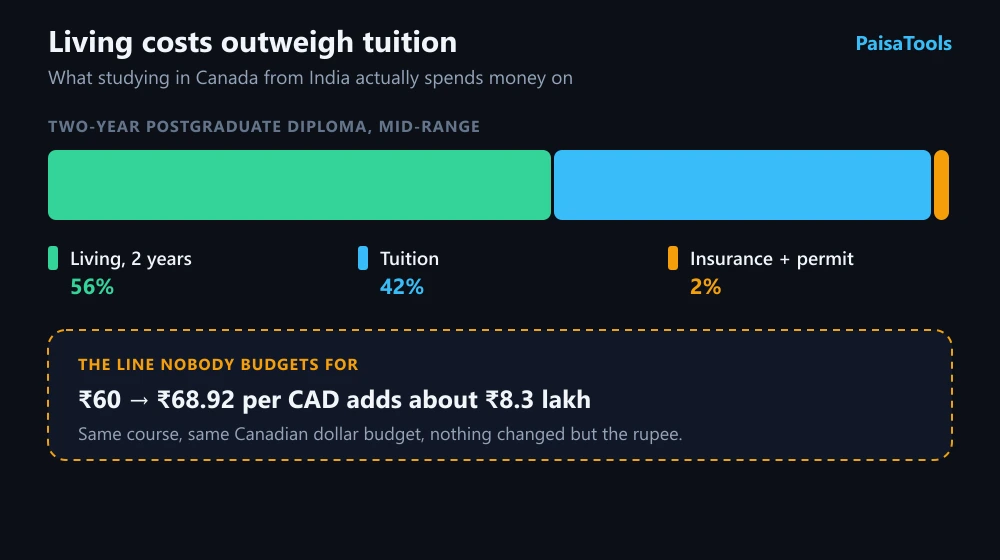
Put a two-year postgraduate diploma together at mid-range figures: about CAD 39,000 in tuition, about CAD 52,000 in living costs across two years, and roughly CAD 1,800 in insurance and permit fees. That is about CAD 92,800, or roughly ₹64 lakh at today's rate, before flights, the English test, the medical and setup costs push it past ₹65 lakh. A master's at a large university in Toronto or Vancouver can run well above that, and a diploma in a smaller city with cheaper rent can come in well below.
The exchange rate is a cost line of its own
Nobody budgets for it, and it is as large as a year of rent. A few years ago a Canadian dollar cost nearer ₹60. At ₹68.92, the same two-year programme costs about ₹8.3 lakh more in rupees than it would have at ₹60, with nothing about the course having changed.
The rate can move either way over two years of payments. Families who fix the rupee amount they can afford, rather than the dollar figure on the offer letter, are the ones who are not surprised in the second year.
Part-time work, honestly
Study permit holders can currently work up to 24 hours a week off campus during term, and full-time during scheduled breaks. At provincial minimum wages that can cover a meaningful share of living costs once a job is found.
Two cautions. The permit application must show the full living-cost amount without counting on that income, so it does not reduce what has to be arranged beforehand. And jobs are not guaranteed, especially in the first months and in cities with many students, so a budget that only works if the part-time job arrives in the first term is a fragile budget.
Sending the money: tax and forex
Education remittances above ₹10 lakh a year attract tax collected at source when they are self-funded, at a far lower rate than most families fear, and none when funded by an education loan from a qualifying Indian lender. That tax is also claimable back, so it is a timing cost rather than a loss.
How TCS on studying abroad actually works, and how to keep it at zeroThe larger and quieter cost is the forex markup. Banks commonly build 2 to 3.5 per cent into the exchange rate on an international transfer, which on ₹60 lakh is ₹1.2 lakh to ₹2.1 lakh over the programme. Compare the rate you are given against the mid-market rate before every transfer.
Financing it
Most families combine savings with an education loan. The loan does two useful things beyond the money: it removes the TCS on remittances, and the interest paid qualifies for a deduction under Section 80E for up to eight years, in the old tax regime. What it does not change is the size of the EMI the student starts with on graduation, which deserves to be checked against a realistic first salary in Canada or back in India before the admission is accepted, not after.
Work out the EMI on the education loan before you commitFrequently asked questions
- What is the total cost of studying in Canada from India?
- A two-year postgraduate diploma at mid-range figures comes to roughly CAD 92,800 in tuition, living costs, insurance and permit fees, about ₹64 lakh at ₹68.92 to the Canadian dollar, and past ₹65 lakh with flights, the English test and setup costs. A master's in Toronto or Vancouver can cost substantially more, and a diploma in a smaller city less.
- How much bank balance is needed for a Canada study visa?
- First-year tuition, travel costs, and a separate living-cost amount. For applications from 1 September 2026, the living-cost requirement for a single student outside Quebec is CAD 23,448, about ₹16.2 lakh. Many students show it through a Guaranteed Investment Certificate.
- Can part-time work pay for living costs in Canada?
- It can cover a meaningful share once a job is found, since study permit holders can currently work up to 24 hours a week off campus during term. But the permit application must show the full living-cost amount without that income, and jobs are not guaranteed in the first months.
- How does the exchange rate affect the cost of studying in Canada?
- Directly and across the whole bill. On a CAD 92,800 two-year programme, a rate of ₹68.92 instead of ₹60 adds about ₹8.3 lakh in rupees with nothing about the course changing. Budget in rupees you can afford, not in the dollar figure on the offer letter.
- Is there TCS on fees paid to a Canadian college?
- Education remittances above ₹10 lakh a year attract TCS when self-funded, at a low rate, and none when funded by an education loan from a qualifying Indian lender. TCS can be claimed back against your tax, so it affects cash flow rather than the final cost.