
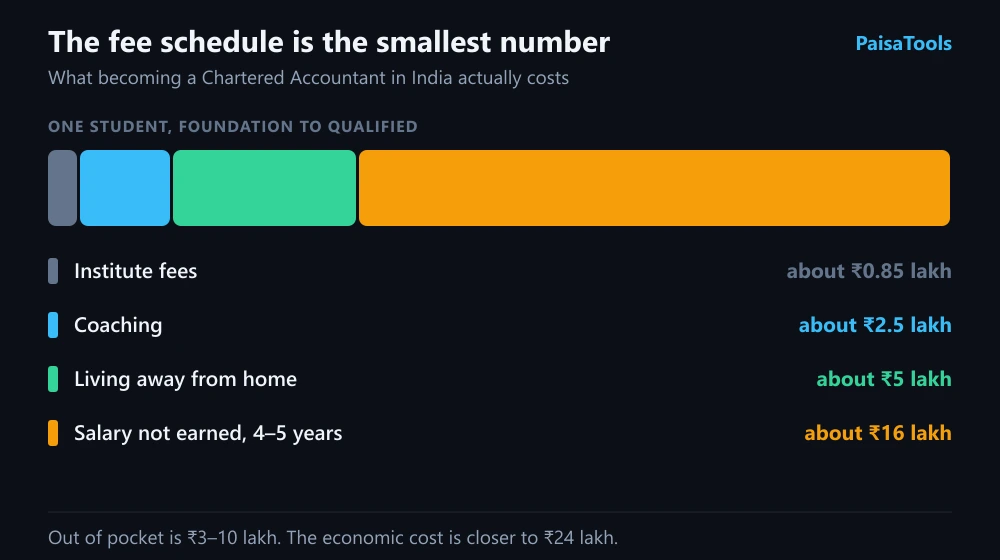
Chartered Accountancy is widely described as the cheapest professional qualification in India, and on the fee schedule that is true. The institute charges a fraction of what a private MBA does. The fee schedule is also the smallest of the four numbers that decide what this actually costs a family.
What the institute charges
Registration and examination fees across the three levels, plus articleship registration, typically add up to somewhere in the region of ₹80,000 to ₹90,000 for a student who clears each level without repeating it. Spread across four or five years, that is genuinely modest, and it is the number everybody quotes.
Confirm the current schedule on the institute's own site before budgeting, since fees are revised and the scheme itself has been restructured in recent years. What does not change is the proportion: institute fees are a minor share of the total.
Coaching, which is where the money actually goes
Almost nobody clears the Intermediate and Final levels on the study material alone, and the coaching market has priced itself accordingly. Costs vary enormously by format.
- Foundation: roughly ₹20,000 to ₹50,000 for a full course.
- Intermediate, all groups: roughly ₹50,000 to ₹1.2 lakh, with face-to-face classes in a major coaching city at the top of that range.
- Final, all groups: roughly ₹60,000 to ₹1.5 lakh, and popular individual faculty for a single subject can run ₹15,000 to ₹25,000 on their own.
- Test series, revision batches and last-minute crash courses: ₹5,000 to ₹25,000 per level, and these are usually bought in addition to the main course rather than instead of it.
A student who takes recorded online classes throughout and never relocates can complete the whole journey for well under ₹2 lakh in coaching. A student who takes face-to-face classes in a coaching hub for every level, with revision batches, lands closer to ₹3.5 lakh to ₹4 lakh. Both are common paths and the gap between them is larger than the entire institute fee.
The cost of attempts, which nobody budgets for
This is the line that separates the brochure from reality, and it has to be said plainly: pass percentages at Intermediate and Final are low, frequently in the teens or twenties for a given group in a given attempt. That is the norm, not a bad year.
The consequence is that the honest expected timeline is not the brochure timeline. A student who clears everything first go can finish in roughly four years from Foundation. The common outcome is five to six, and a sizeable share take longer or stop. Each repeated group carries an exam fee, usually a revision course, and, far more expensively, another six months.
Articleship: three years of working at a training stipend
Articleship is genuine full-time work. The institute prescribes a minimum monthly stipend, and it is set at training rates rather than employment rates, running from a few thousand rupees a month in a smaller city to a somewhat higher figure in a metro. Larger firms often pay above the minimum, and some pay substantially above it, but the base case is a few thousand rupees a month for three years of full-time work.
If the student has relocated, those three years also carry rent, food and travel. A modest shared arrangement in a metro is ₹12,000 to ₹20,000 a month all in, which over three years is ₹4.5 lakh to ₹7 lakh, and it is usually funded by the family rather than by the stipend.
The number that dwarfs the other three
Consider two people who finish a commerce degree at twenty-one. One takes a job. The other continues with CA and qualifies at twenty-five or twenty-six.
Over those four to five years the first person earns a salary, modest at first and rising, while the second earns a stipend. Put a plain number on it: if the job pays an average of ₹4 lakh a year across that stretch and the stipend contributes very little, the forgone earnings alone are in the region of ₹15 lakh to ₹18 lakh. That is several times the coaching bill and roughly twenty times the institute fee.
This is not an argument against doing it. It is the reason the decision deserves to be made against the actual number rather than the fee schedule, and it is why dropping out late is so much more expensive than dropping out early.
See what a starting salary actually leaves you in handWhat the qualification pays, honestly
Every year a headline figure circulates for the average package at institute campus placements, and every year it is read as what a fresher CA earns. It is not. It is an average over the students who were placed through that particular campus process, which is a minority of those who qualify, and it is skewed upward by a small number of very large offers.
The broader picture is that a newly qualified CA outside the top campus offers commonly starts well below that headline, with industry roles and smaller firms paying considerably less than the large audit and consulting firms. The compounding argument is real, though: salaries in this profession rise steeply with experience, and practice can eventually outpay employment. The payback is genuine. It just arrives in the late twenties rather than immediately at qualification.
The honest summary
Run the numbers the way a family would actually experience them. The out-of-pocket cost, meaning institute fees, coaching and living expenses if relocating, realistically lands between ₹3 lakh and ₹10 lakh depending on format and city. The total economic cost, once forgone earnings are included, is somewhere between ₹18 lakh and ₹28 lakh.
Against a private MBA, CA is still dramatically cheaper in cash terms and roughly comparable once the extra years are counted. Against walking into a job at twenty-one, it is an expensive decision that pays off later and pays off well for those who finish. The people it hurts are the ones who spend four years and most of the money and then stop, which is a large enough group that it deserves to be part of the decision rather than a footnote to it.
Frequently asked questions
- How much does the CA course cost in total in India?
- Institute registration and examination fees across all levels typically come to around ₹80,000 to ₹90,000 for a student who does not repeat a level. Coaching adds roughly ₹1.5 lakh to ₹4 lakh depending on whether classes are online or face-to-face, and living costs apply if the student relocates. Out of pocket, most families spend between ₹3 lakh and ₹10 lakh.
- How long does it realistically take to become a CA?
- Roughly four years from Foundation for a student who clears every group at the first attempt. Because pass percentages at Intermediate and Final are commonly in the teens or twenties for a given group, five to six years is the more common outcome, and each repeated group costs another exam fee, usually a revision course, and another six months.
- How much stipend do CA articles get?
- The institute prescribes a minimum monthly stipend set at training rates rather than employment rates, ranging from a few thousand rupees in smaller cities to somewhat more in metros. Larger firms often pay above the minimum. For a student who has relocated, the stipend generally does not cover rent and living costs.
- Is CA cheaper than an MBA?
- In cash terms, substantially. A private MBA can cost several times the entire CA journey in fees alone. Once forgone earnings are counted the gap narrows, because CA typically takes longer and pays only a training stipend during articleship, while an MBA is usually two years.
- What does a fresher CA actually earn?
- Lower than the headline campus placement average, which is computed over students placed through that process and pulled upward by a small number of large offers. Industry roles and smaller firms commonly start well below it. Salaries in the profession do rise steeply with experience, so the payback is real but arrives some years after qualification.