
Every rooftop solar quote you will be shown leads with two numbers: the system size in kilowatts and the price after subsidy. Both are true. Neither tells you whether the thing pays for itself in your house, because the figure that decides that is not on the quote at all. It is on your electricity bill.
What a system actually costs
For a standard on-grid rooftop system — panels, inverter, mounting structure, wiring and installation — Indian households are typically quoted somewhere in the range of ₹55,000 to ₹70,000 per kilowatt before any subsidy. A 3 kW system, which is the common size for a family home, therefore lands around ₹1.7 lakh to ₹2.1 lakh gross.
That spread is not vendor greed. It is the difference between a basic polycrystalline setup and higher-efficiency panels with a better inverter and a structure that will survive twenty summers. The cheapest quote and the dearest quote in your inbox are usually not describing the same object.
- Roof space: budget roughly 100 square feet of unshaded roof per kilowatt. A 3 kW system needs about 300 square feet that nothing shades between mid-morning and mid-afternoon.
- Working life: panels are generally warranted for around 25 years of output. The inverter is the part that does not last that long — expect to replace it somewhere around year ten to twelve, at ₹15,000 to ₹30,000.
- What the quote usually includes: panels, inverter, structure, cabling, installation and net-meter application support.
- What it often does not: civil work if your roof needs strengthening, a long cable run to a distant meter, and any electrical upgrade your existing wiring needs.
The subsidy, and what it is not
The central residential subsidy is structured per kilowatt rather than as a flat percentage: a higher rate for the first two kilowatts, a lower rate for the third, and then a ceiling. For a 3 kW system that ceiling is the operative number, and it is capped — going bigger does not get you more central subsidy.
Three things about it are worth knowing before you sign anything. It is claimed through the national portal, not paid by the vendor as a discount, so you pay more up front and are reimbursed after commissioning and inspection. It requires an empanelled installer, so the cheapest quote from an unregistered local fitter can quietly cost you the entire subsidy. And several states add their own on top, which is why the same system genuinely has a different net price in two different states.
Confirm the current rates and your state's addition on the official portal before you budget. Subsidy structures are revised, and a vendor quoting last year's figure is not necessarily lying to you — they may simply not have updated their deck.
The number that decides payback is your tariff slab
This is the part almost every payback calculation gets wrong, and it works in your favour.
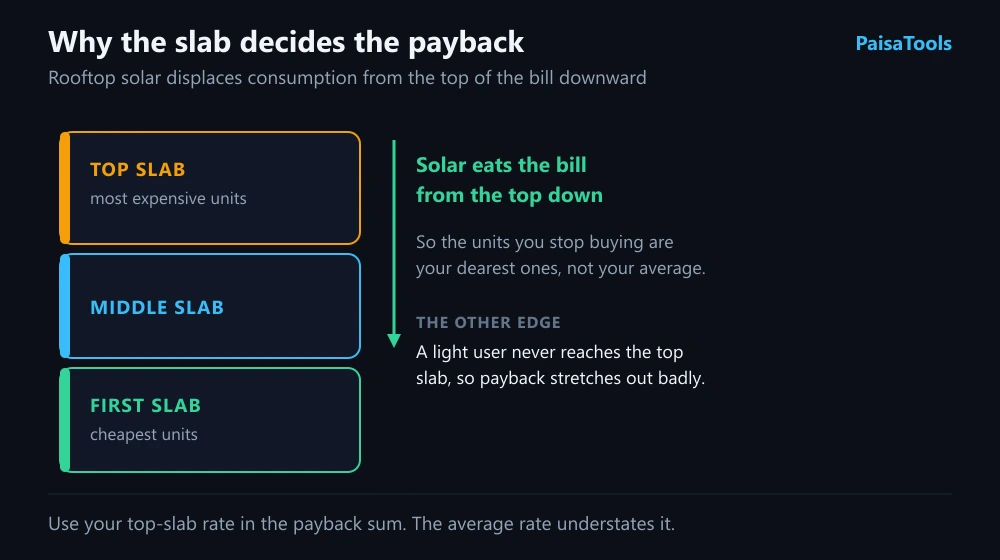
Domestic electricity in India is billed in slabs. The first hundred units or so are cheap. The units above that cost meaningfully more, and the top slab in a heavy-use household can be two or three times the rate of the first. When solar starts generating, it does not remove your cheap units. It removes your most expensive ones first, because it offsets consumption from the top of the bill downward.
So the right rate to use in a payback sum is not the average rate printed on your bill. It is the rate of the top slab you currently reach. A household paying ₹8 per unit at the top of its bill and averaging ₹6 across the whole bill will see the ₹8 saving, not the ₹6 one, until the system has eaten through that slab.
The same logic cuts the other way, and this is the honest warning. If your monthly consumption is low enough that you never leave the cheap slabs, solar saves you cheap units, and the payback stretches out badly. Rooftop solar rewards heavy users. It is close to pointless for a light one.
Rough arithmetic you can do on your own bill
Across most of India a rooftop system generates in the region of four units per kilowatt per day averaged over the year, cloudy months included. A 3 kW system is therefore generating roughly 350 to 400 units a month, or a little over 4,000 units a year.
Multiply your own top-slab rate by the units you would actually displace — not by the full generation, if your household uses less than the system makes and your state does not pay well for exported units. Divide the net cost after subsidy by that annual saving. For a household on a high slab in a state with genuine net metering, the answer usually lands somewhere in the four-to-six-year range. For a light user in a state that credits exports poorly, it can double.
Compare that payback against what the same money earns investedWhat can actually go wrong
- Net metering rules are set by your state, not by Delhi, and they are the single biggest variable in the whole calculation. Some states credit exported units at the full retail rate, some at a much lower rate, and some cap the system size they will allow against your sanctioned load.
- Shading is unforgiving. A water tank, a parapet or a neighbour's new floor can knock out a disproportionate share of a string's output, not just the panel it falls on.
- In an apartment, the terrace is common property. An individual flat generally cannot install on it without a society resolution, which is a different project from a bungalow rooftop.
- If you are on a rented roof or expect to move within a few years, the payback window probably outlives your stay, and a solar system is not something you take with you.
- The cheapest quote frequently saves money on the inverter and the mounting structure — the two components whose failure costs you the most later.
Who it genuinely pays for
Rooftop solar is a good decision for a household that owns its roof, expects to stay a decade, has real unshaded space, and consistently reaches the expensive end of its tariff slabs. For that household the arithmetic is strong and gets stronger every time tariffs rise.
It is a poor decision for someone with a modest bill, a shaded roof, a short horizon, or a state that will not credit exported units properly. No subsidy fixes any of those four. Work out your top-slab rate first, and let that number decide, not the discount on the quote.
Frequently asked questions
- How much does a 3 kW rooftop solar system cost in India?
- Typically ₹1.7 lakh to ₹2.1 lakh before subsidy, depending on panel efficiency, inverter quality and how much structure your roof needs. The central residential subsidy is capped for systems of 3 kW and above, and several states add their own on top, so the net figure varies by state. Confirm current rates on the national portal before budgeting.
- How long does rooftop solar take to pay for itself?
- It depends far more on your tariff slab than on the system price. A household that consistently reaches an expensive slab, in a state with full-rate net metering, commonly lands in the four-to-six-year range. A light user, or one in a state that credits exported units poorly, can take twice as long. Use your top-slab rate in the sum, not the average rate on your bill.
- How much roof space do I need for solar?
- Roughly 100 square feet of unshaded roof per kilowatt, so about 300 square feet for a 3 kW system. Shade matters more than raw area — a water tank or a neighbour's new floor can cut output well beyond the panel it falls on.
- Can I install solar on an apartment terrace?
- Generally not as an individual flat owner. The terrace is common property, so it needs a society resolution and is usually done as a society-level project rather than a personal one.
- Does the subsidy come as a discount on the quote?
- No. You pay the vendor and claim the subsidy through the national portal after commissioning and inspection, which means you need the full amount up front. It also requires an empanelled installer, so an unregistered fitter offering a cheaper price can cost you the entire subsidy.