
Advance tax is not a form of tax. It is a schedule — the same liability, paid across the year instead of at the end of it. If the full amount reaches the department by the dates it is meant to, nothing else happens. The penalty for falling behind is not a fine; it is interest, and it accrues quietly until you file and find it sitting on your return.
The next date is 15 December, and it is the instalment most worth getting right. By then three quarters of the year's income is visible, so it is the first point at which you can compute your liability with something close to accuracy — and also the last point at which being wrong is still cheap to fix.
Who this applies to
Advance tax is payable by anyone whose total tax liability for the year, after accounting for TDS already deducted, comes to ₹10,000 or more. That threshold catches far more people than the word "advance" suggests: salaried employees whose employer TDS does not cover a capital gain, interest income or rent; freelancers and consultants with no TDS at all on part of their billing; and anyone who sold property or equity during the year.
A resident senior citizen aged 60 or above with no income from business or profession is exempt from paying advance tax altogether. That exemption is narrower than it is usually quoted — it falls away the moment there is business or professional income.
The schedule, and what 15 December means
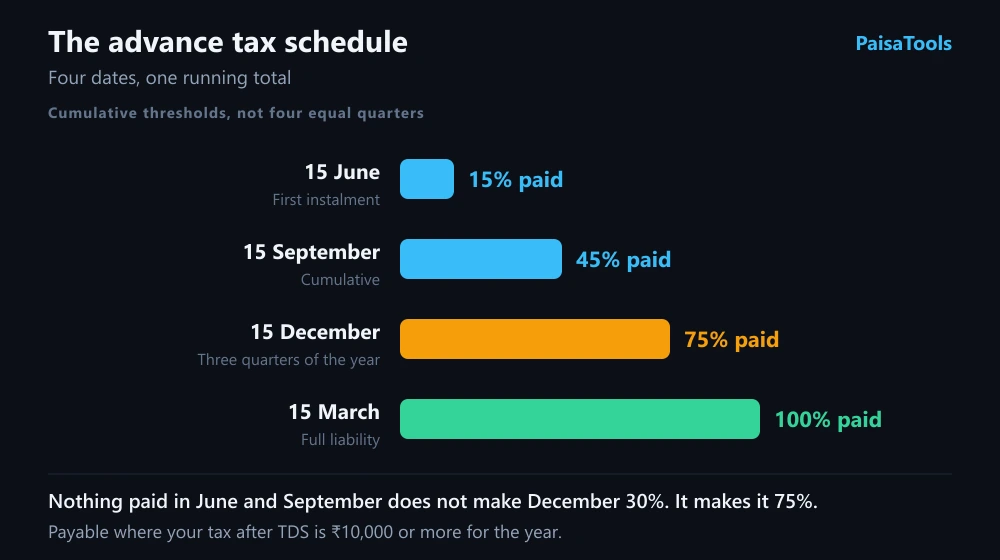
- By 15 June — 15% of the year's estimated tax.
- By 15 September — 45% cumulative.
- By 15 December — 75% cumulative.
- By 15 March — 100%.
These are cumulative, not instalments of equal size, which is the first thing people get wrong. If you paid nothing in June and September, the 15 December payment is not 30% — it is the whole 75%, and the shortfalls on the two earlier dates have already started accruing interest.
What missing it actually costs
A shortfall against any of the first three instalments attracts interest under Section 234C at 1% per month, simple, for three months — so missing the 15 December date entirely costs roughly 3% of the shortfall, not an open-ended penalty. Paying late still helps and is almost always worth doing, because the 234C charge for that instalment is capped at three months regardless, while the separate Section 234B charge keeps running at 1% per month from 1 April until you actually pay if your total advance tax ends below 90% of the assessed liability. One asymmetry is worth knowing: the first two instalments carry a tolerance band — 12% by June and 36% by September are treated as compliant — but the December and March thresholds have no such cushion, so 74% paid by 15 December is a shortfall in full.
The capital-gains exception nobody uses
Nobody can forecast a capital gain in June. The law accepts this: where income from capital gains, lottery winnings or certain other sources arises after an instalment date, no 234C interest applies for that instalment provided the tax on it is paid in the remaining instalments of the year. So if you sold equity or property in November, the relevant deadline for that tax is 15 December — and if you pay it then, the earlier dates are not held against you for that income.
This is why December is the instalment that matters for anyone who transacted during the year. It is the date on which an autumn gain stops being free of interest.
What to do in the next week if this applies
- Add up everything received since 1 April, including interest credited to savings and deposits, rent, and any capital gain realised — not just salary.
- Subtract the TDS already deducted. The gap is what advance tax is meant to cover.
- Check whether 75% of that gap has reached the department by 15 December. If not, pay the difference on the e-filing portal as a self-assessment challan under the advance-tax head for the current assessment year.
- If you are taxed presumptively under Section 44AD or 44ADA, your schedule is different — a single payment of 100% by 15 March, with no quarterly instalments.
- Keep the challan. It is what you will key into the return, and a mismatch there is the most common cause of an avoidable notice.
The reason to treat this as a diary entry rather than a tax topic is that it is one of the only money mistakes that is strictly cheaper the earlier you catch it, with no judgement involved. The arithmetic does not care why you were late.
Work out what you actually owe this yearFrequently asked questions
- Is there a penalty, or just interest?
- Interest. Falling behind on advance tax does not attract a penalty in the sense of a separate fine — it is a charge for the use of money, which is why the amount depends on how much and for how long.
- Can I pay the whole year's advance tax in one go?
- Yes, and paying ahead of a date is never penalised. The schedule sets minimums, not maximums, so a single early payment covering the full liability keeps you clear of all four dates.
- I am salaried and my employer deducts TDS. Does this still concern me?
- Only if you have income your employer does not know about — interest, rent, a capital gain, freelance billing. Employer TDS is computed on the salary it pays, so anything outside it can leave a gap above the threshold.
- What if I overpay?
- Excess advance tax comes back as a refund when you file, with interest payable by the department for the period it was held. Overpaying is inefficient but it is not a loss.
- Does the old or new tax regime change the dates?
- The dates and the percentages are the same under both. The regime changes the liability you are computing, and therefore the amount of each instalment, not the schedule.