
You have an offer with a joining date four weeks out and a notice period of three months. The conversation turns, as it always does, to buying out the difference. Somebody quotes a number. It is almost always the wrong number — not because the arithmetic is hard, but because the figure being quoted is a gross amount, and gross is not what this costs you.
There are two separate questions hiding inside one. The first is how much the buyout is. The second is who pays it and through which route — and that second question changes the real cost materially, for the same contract and the same rupees.
What the buyout is calculated on
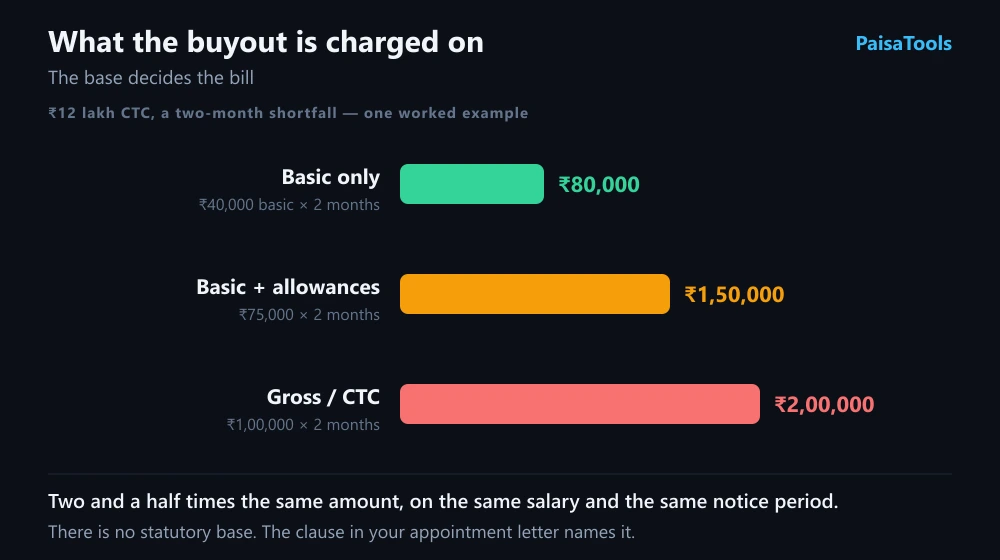
There is no statutory formula here. A notice-period buyout is a contractual term, so the base is whatever your appointment letter says it is, and letters differ sharply on this point. The three bases you will actually encounter are basic salary, basic plus a defined set of allowances, and full gross CTC. On the same salary, the gap between the narrowest and widest of those can be more than double.
- Basic only — the most employee-friendly base, and common in older letters.
- Basic plus HRA and fixed allowances — the middle case, and the most frequent today.
- Gross or CTC — the widest base; worth checking whether it includes the employer's PF contribution and any variable pay, because those inflate CTC without ever reaching you.
Read the recovery clause rather than asking HR for a number. The clause names its own base. If it says "gross salary" and your CTC includes a performance bonus you have not earned yet, that is a point you can argue before you agree to anything.
The part that decides the real cost
The same buyout can cost you two different amounts depending on how it is settled. If your outgoing employer recovers the notice pay by deducting it from your final settlement, the ITAT held in Nandinho Rebello v. DCIT that only the salary actually received is taxable — the recovered portion never became your income, so the deduction effectively comes out of pre-tax money. If instead you pay the amount yourself and your new employer reimburses you, that reimbursement is a receipt in your hands and is taxable as a perquisite, so you bear tax on money whose entire purpose was to settle a debt. Identical rupees, two different net costs, decided by whether the amount is deducted at source or reimbursed afterwards.
Why no calculator tells you this
The buyout calculators that rank for this query ask for your salary and your shortfall in days, then return a figure. Not one of them asks which base the clause uses, and none models tax at all — one of them prints a line in its own output conceding that taxes and recoveries are not applied. That is honest of it, and it also means the number it gives you is not the number you need.
The GST question, settled in 2022
For a few years employers added GST to notice-pay recoveries, on the theory that the company was being paid to tolerate an early exit. The CBIC closed this in Circular 178/10/2022-GST, dated 3 August 2022, clarifying that notice pay recovery is not a consideration for a supply and therefore attracts no GST. If a recovery statement you are handed includes GST on the notice-pay line, it is being applied against the department's own stated position.
What to establish before you negotiate
- The exact base named in your recovery clause — not HR's verbal summary of it.
- Whether unused earned leave can be set off against the shortfall. Many employers allow this, and it is the cheapest way to shorten the gap because it uses a liability they already owe you.
- Whether your new employer's buyout support is structured as a reimbursement or as a sign-on amount. It matters for tax, and it is usually negotiable at the offer stage and never afterwards.
- Whether the outgoing employer will deduct from the final settlement instead of invoicing you. Ask for this explicitly.
- Whether any joining bonus from the previous role carries its own clawback that triggers on early exit — that is a second recovery, separate from notice pay.
The reason this is worth an hour of your time is the size of it. A three-month buyout on a mid-level salary is frequently a larger single outflow than anything else that year apart from rent or an EMI, and it is paid at precisely the moment your income has a gap in it. Treating it as a line item in a negotiation rather than a fee you are handed is the whole difference.
Work out what actually reaches your accountFrequently asked questions
- Can I claim a deduction for notice pay I paid out of pocket?
- There is no specific deduction for it under the salary head. This is exactly why the settlement route matters: a recovery netted off against your final settlement is treated differently from an amount you pay and then claim back.
- My Form 16 shows the gross salary, before the recovery. Is that wrong?
- It is common. Employers often report salary before netting off the recovery, which is what led to the dispute in the ITAT case. Keep the settlement statement showing the deduction, because that document is what evidences the position.
- Does the employer have to accept a buyout at all?
- No. Serving notice or accepting payment in lieu is the employer's call unless your contract gives you the option outright. Many letters are silent, which means it is a negotiation rather than a right.
- Can the company hold my relieving letter until I pay?
- In practice companies do link the two, which is why settling the recovery route in writing before your last working day is worth more than arguing about it afterwards.
- Is the buyout amount the same if I am on probation?
- Usually not. Probationary notice periods are typically much shorter, so the shortfall and therefore the buyout is smaller. Check which clause applies to your current status.