
Most couples approach this as a price question. They ask what a delivery costs, get a range, decide it is manageable, and move on. The range is the easy part. The thing that actually determines whether you pay that bill yourself is not a price at all — and by the time most people learn about it, it is already too late to change the outcome.
The bill, honestly ranged
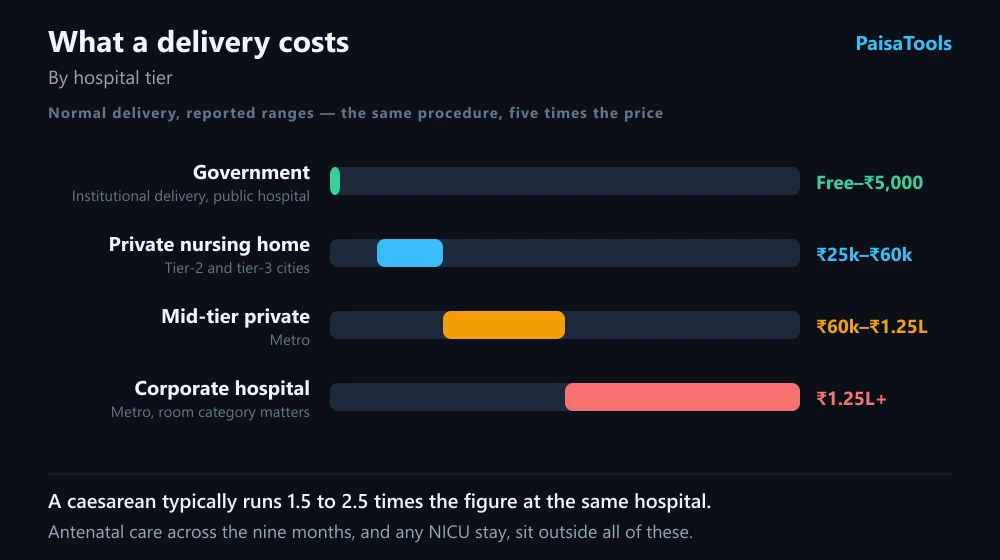
There is no single national figure, because the same procedure in the same city varies by a factor of five depending on the hospital tier and the room category. What is reliable is the shape of the range.
- Government hospitals: free or near-free for the delivery itself, with institutional delivery actively supported under the National Health Mission.
- Smaller private nursing homes in tier-2 and tier-3 cities: broadly ₹25,000 to ₹60,000 for a normal delivery.
- Mid-tier private hospitals in metros: broadly ₹60,000 to ₹1,25,000 for a normal delivery.
- Large corporate hospitals in metros: ₹1,25,000 upward, and room category alone can move this by ₹50,000.
- A caesarean typically runs 1.5 to 2.5 times the normal-delivery figure at the same hospital, because of the longer stay and the operating theatre.
Two things routinely sit outside whatever number you are quoted. The first is the nine months before — scans, blood work, consultations and supplements, which add up quietly and are rarely in anyone's budget because no single item feels large. The second is the newborn: if the baby needs NICU time, that is a separate and potentially much larger bill, and it is not covered by the mother's delivery package.
The number that decides who pays
Maternity cover in Indian health insurance carries a waiting period, and it is long: commonly between nine months and four years from policy inception depending on the insurer and plan, with two to three years being the most frequent. During that window a pregnancy-related claim is simply not payable, regardless of how much premium you have paid. Because conception can only be planned around the end of the window and not the start, the practical rule is that a policy bought after you are already expecting will not pay for this delivery — the decision had to be made years earlier. Many group employer policies waive the waiting period entirely, which is why the same couple can be fully covered or fully uncovered on identical medical facts.
Why the employer policy is the fault line
A corporate group policy usually has no maternity waiting period, often covers the newborn from day one, and carries a sub-limit instead — a capped amount for normal delivery and a higher cap for caesarean. That cap is frequently well below a metro corporate-hospital bill, so the realistic planning question is not whether you are covered but by how much you are short.
This also makes resignation timing a money decision that nobody frames as one. Leaving a job while expecting replaces a policy with no waiting period with one that has years of it. If a job change and a pregnancy are both on the table in the same year, the order they happen in has a direct cost.
What exists outside insurance
- The Maternity Benefit Act entitles eligible women to 26 weeks of paid leave for the first two children, in establishments covered by the Act — that is income protection, not a medical bill, and it is the larger number of the two for most salaried women.
- Pradhan Mantri Matru Vandana Yojana provides a conditional cash incentive for the first living child, paid in instalments against antenatal check-up and immunisation milestones.
- Ayushman Bharat PM-JAY covers institutional delivery for eligible households at empanelled hospitals.
- ESIC members have their own maternity benefit, separate from both the above.
A planning sequence that works
- Read the maternity clause of whatever policy you hold now — both the waiting period and the sub-limit. Not the brochure; the policy wording.
- If you hold a group policy, find the sub-limit figure and treat the gap between it and a realistic local bill as the amount you need in cash.
- If you hold only a retail policy and the waiting period has years left, plan the delivery as a self-funded expense and stop waiting for the cover to arrive.
- Set the target at the caesarean figure for your intended hospital, not the normal-delivery figure. You do not get to choose, and the higher number is the one that would hurt.
- Keep the newborn question separate. Confirm from what day the baby is covered, because that is where the genuinely large bills live.
The reason this is worth doing early is that it is one of the very few large expenses with a known approximate date months in advance. That makes it the easiest kind of goal to fund — and the easiest one to discover you have mistimed.
Check whether the number is within reachFrequently asked questions
- Can I add maternity cover to a policy I already hold?
- Insurers may offer it as a rider or an upgrade, but the waiting period generally runs from when that cover starts rather than from when the base policy started. Adding it does not backdate it.
- Is a pregnancy already underway a pre-existing condition?
- An existing pregnancy is treated as an existing condition when you buy a new policy, which is the mechanism by which a late purchase fails to help with the current delivery.
- Do all group policies cover maternity?
- No. It is common in larger corporate plans but not universal, and the sub-limits vary widely between employers. The only reliable source is your own policy document, not what a colleague's covered.
- What about the baby's own expenses after birth?
- Newborn cover is a distinct feature with its own terms. Some policies cover the child from day one, others only after a set number of days, and NICU costs are precisely where that difference becomes expensive.
- Is a government hospital delivery actually safe to plan around?
- Institutional delivery at a public hospital is the standard of care for most births in India. The honest trade-off is comfort and room privacy rather than clinical safety, and for many couples that is the right call.