
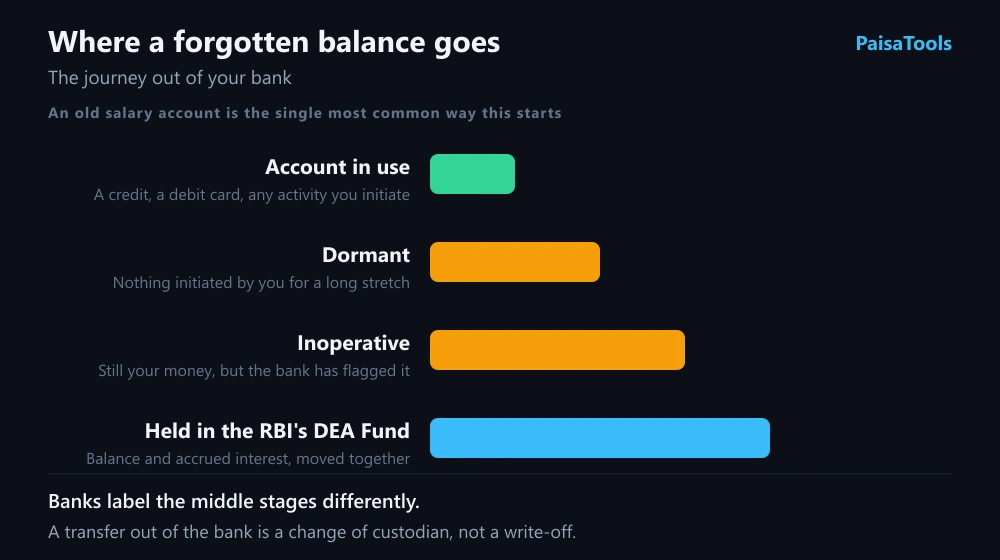
An account you stopped using does not quietly disappear. It goes dormant, then inoperative, and eventually the balance is moved out of the bank altogether — to the Reserve Bank of India. The money is still yours. It is simply no longer where you left it.
As of 28 January 2026 the RBI's Depositor Education and Awareness Fund held about ₹72,454 crore of such deposits. That is not abandoned wealth belonging to nobody. It is overwhelmingly ordinary balances: an old salary account from a job someone left, a fixed deposit that matured while the family had other things to deal with, an account opened in a town they have since moved away from.
How an account becomes unclaimed
A savings or current account that has not been operated for ten years, or a term deposit left unclaimed for ten years from its maturity date, is classified as an unclaimed deposit. The bank then transfers the balance — including the interest accrued up to that point — to the RBI's DEA Fund, on the last working day of the month after the ten years complete. Crucially, this extinguishes nothing: the depositor or legal heir remains entitled to claim the amount afterwards, with interest, from the bank where it was held.
The part most people get backwards
The RBI holds the money, so it seems obvious to approach the RBI for it. You cannot. The RBI is explicit that unclaimed deposits can be claimed only from the respective bank — the portal it runs tells you the deposit exists and points you to that bank's own settlement process, and nothing more. Expecting the central bank to hand it over is the single most common way people stall.
How to search, in about ten minutes
- Go to udgam.rbi.org.in — UDGAM, the RBI's own search portal — and register with your mobile number.
- Search by account holder name and bank, plus any one of PAN, driving licence number, voter ID, passport number or date of birth.
- A match returns a reference number for that deposit. That reference is what you take forward — the portal itself does not release money.
- Approach the branch of the bank named in the result with the reference and your KYC documents, and follow that bank's claim process.
- If the depositor has died, the claim is made by the legal heir or nominee, and the bank's succession formalities apply.
One limitation worth knowing before you conclude there is nothing: as of 4 March 2024, 30 banks were on UDGAM, covering around 90% of unclaimed deposits by value. That is most of the money but not every bank. If the account was with a smaller co-operative or regional bank that is not listed, the absence of a result proves nothing — approach that bank directly.
A window that closed yesterday
From 1 October 2025 the RBI ran a one-year scheme paying banks an incentive to actively trace depositors and settle inoperative accounts, scheduled to run until 30 September 2026. For that year, finding you was something banks were paid to do. With that period now behind us, the initiative sits back where it usually does — with the depositor. If you have been meaning to check, the easy tailwind has just passed.
Who should actually bother checking
- Anyone who has changed jobs more than once — old salary accounts are the single biggest source, because they are opened by the employer and abandoned on exit.
- Anyone who has moved city or state, especially before internet banking was routine.
- Families settling an estate, where the deceased's older accounts may predate anything the family knows about.
- Anyone who held a fixed deposit that matured without auto-renewal during a period of illness, bereavement or relocation.
Frequently asked questions
- Does the money expire if nobody claims it?
- No. There is no point at which the deposit stops belonging to the depositor or their legal heirs. The custodian changes and the claim route changes, but the entitlement does not lapse with time.
- Do I get interest for the years it sat unclaimed?
- Interest continues to be payable on the amount when it is claimed. The interest accrued before the transfer is moved across with the principal rather than being forfeited.
- The search returns nothing. Does that settle it?
- Not by itself. The portal covers the large majority of unclaimed deposits by value but not every bank in the country, so for a smaller or co-operative bank you should ask that bank directly.
- The account holder has died. Can the family claim it?
- Yes. The claim is made by the nominee or legal heir through the bank, using that bank's succession process, which will ask for proof of death and of entitlement.
- Is there a fee for searching?
- The RBI's portal is free to use. Treat any site asking for payment to run this search, or offering to recover the money for a cut, with suspicion.