
The pitch for Dubai is always the same sentence: there is no income tax. It is true, and it is the least useful fact for deciding whether to go. What decides it is the shape of the spending, which is nothing like an Indian family's — a much larger share goes on housing and school, almost none on tax, and an uncomfortable amount of the first year has to be paid before the first salary arrives.
The figures below are in dirhams, with rupee equivalents at AED 1 = ₹26.14, the rate on 16 September 2026. The dirham is pegged to the US dollar, so that rate moves only as the rupee moves against the dollar — which, over the last few years, has been in one direction.
Rent, and the custom that catches Indians out
Rent in Dubai is quoted per year, not per month, and it is paid with post-dated cheques — commonly one to four for the whole year. Fewer cheques buys a lower rent in almost every building, and the gap is real: a twelve-cheque plan is routinely priced six to ten per cent above a single-cheque plan on the same apartment.
That is the part an Indian family does not see coming. At home, renting means a deposit of two or three months and then a monthly transfer. In Dubai, signing a lease can mean writing a cheque for a quarter of the year's rent, or the whole year's rent, on the day you move in.
- A one-bedroom apartment: roughly AED 45,000 to AED 105,000 a year depending on the community and the age of the building.
- A three-bedroom in a central location averages around AED 16,500 a month, which is close to AED 200,000 a year.
- Most Indian families land somewhere in between, in a two-bedroom in a mid-range community, and the year's rent is the single largest line in the budget by a wide margin.
The one-time fees nobody quotes you
On top of the rent itself, a first tenancy carries a set of charges that are all calculated off the annual rent, so they scale with the flat you choose.
- Agency commission: 5 per cent of the annual rent, plus 5 per cent VAT on that commission, paid once.
- Security deposit: 5 per cent of the annual rent for an unfurnished place, 10 per cent if it is furnished. Refundable, but it has to exist first.
- Ejari registration: roughly AED 120 to AED 155 if you file it yourself through the Dubai REST app, about AED 220 at a trustee centre. Without it the contract has no standing, and you cannot connect utilities or sponsor a family visa on that address.
- DEWA deposit: AED 2,000 for an apartment or AED 4,000 for a villa, plus an activation fee of about AED 130. The deposit comes back when you close the account.
- Housing fee: 5 per cent of the annual rent, charged to the tenant by Dubai Municipality and billed in monthly slices through the DEWA bill. It is not optional, and it is the closest thing to a tax on living there.
School fees, the line that decides the city for you
For a family with children, school is usually the second largest cost, and it varies more than anything else in the budget. Indian-curriculum schools are the reason Dubai works financially for many families at all: a CBSE or ICSE school commonly charges somewhere around AED 9,000 to AED 14,000 a year per child at the affordable end.
Move to a British or IB curriculum and the same child costs several times that — the middle of that market sits near AED 48,000 a year, and the top of it runs past AED 110,000. Private school fees across the emirate are frozen for the 2026-27 academic year under a KHDA directive, which helps this year's planning but is not a promise about the next.
Two children in a British-curriculum school can cost more than the apartment. That single choice, more than the salary, is what makes a Dubai offer work or not work.
The running month
- Groceries for a family of four: roughly AED 3,000 to AED 4,500 a month.
- Utilities: roughly AED 500 to AED 1,200 a month for an apartment, higher in summer when cooling runs constantly, plus AED 300 to AED 500 for internet and phone.
- Transport: a car is close to unavoidable outside the metro corridors. Fuel is cheaper than in India, insurance and Salik tolls are not.
- Health insurance is mandatory for every resident and the employer usually covers the employee, often not the family. Cover for a spouse and children is a real line, not a footnote.
Put together, a family of four with one or two children in school, a car, and housing in a decent school catchment generally lands somewhere between AED 30,000 and AED 50,000 a month all-in. The wide range is not vagueness — it is the school choice and the postcode, and both are decisions rather than facts.
What year one actually asks for
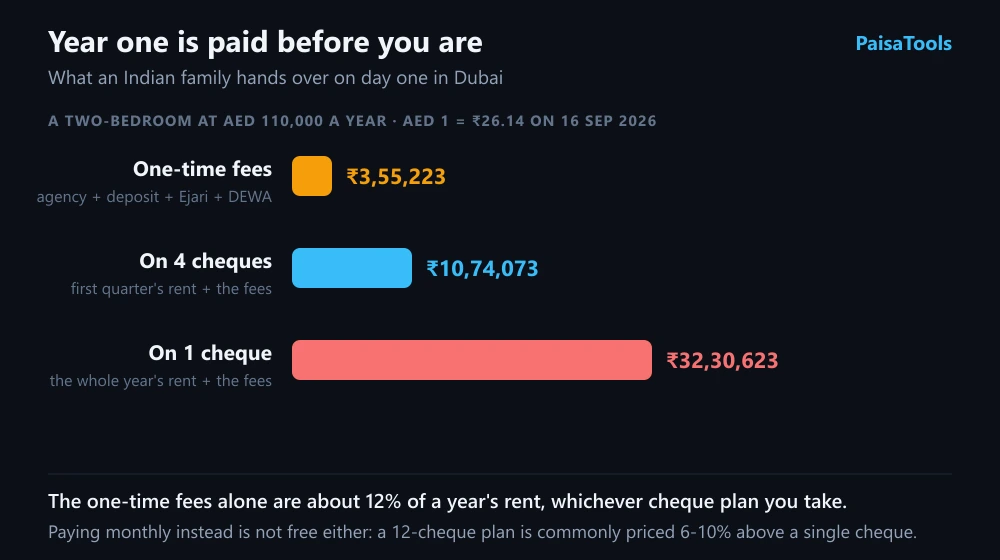
Take a two-bedroom at AED 110,000 a year. The one-time fees come to about AED 13,600 — roughly 12 per cent of the annual rent — before any rent is paid. On a four-cheque plan the day-one cash is about AED 41,100, close to ₹10.7 lakh. On a single cheque it is about AED 123,600, close to ₹32.3 lakh. Add school admission fees, a car deposit and furniture, and the first month in Dubai can absorb more cash than a year of saving in India produced. The salary is tax-free from day one; the cash requirement does not wait for it.
No income tax is not the same as no deductions
There is no personal income tax in the UAE, and for a salaried person that is the whole story on tax. But the comparison people make is usually wrong: they compare an Indian gross salary with a Dubai gross salary.
The honest comparison is what is left after housing, school and insurance in each place, because in India a large part of those is either subsidised, cheaper, or shared with family. A package that looks like a doubling can leave the same surplus once a year's rent and two school seats are paid, and a package that looks like a modest raise can leave far more if the employer provides housing or schooling. Work out the surplus, not the salary.
See what your Indian salary actually leaves you after deductionsSending money home, and what it costs
Most families move money back monthly. The exchange rate you are given is where the cost hides — the transfer fee is usually small and visible, while a markup of one to two per cent on the rate is neither. On AED 5,000 a month that markup is a few thousand rupees a year that nobody notices leaving.
Compare what it costs to send money to IndiaThe thing worth deciding before you go
A Dubai stint pays off when the surplus is converted into something that lasts — usually invested back in India, where the family's long-term costs sit. It stops paying off when the surplus is absorbed by a larger apartment and a more expensive school each year, which is the easiest thing in the world to let happen there.
Decide the monthly number you will send home and invest before you accept the offer, and treat it as a fixed cost rather than whatever is left at the end of the month. That single decision is what separates the families who come back with a corpus from the families who come back with photographs.
See what a fixed monthly investment becomes over the yearsCheck whether a move abroad is affordable for youFrequently asked questions
- How much does a family of four need per month in Dubai?
- Including rent, school for one or two children, a car and health cover, most families land between AED 30,000 and AED 50,000 a month. The spread is driven almost entirely by two choices: the curriculum of the school and the community you rent in.
- Why do Dubai landlords ask for post-dated cheques?
- Rent is contracted for the year and collected in one to four post-dated cheques, which is the local norm. Fewer cheques usually buys a lower rent, and spreading it over twelve cheques commonly costs six to ten per cent more on the same apartment.
- What are the one-time costs of renting in Dubai?
- Agency commission of 5 per cent plus VAT, a security deposit of 5 per cent unfurnished or 10 per cent furnished, Ejari registration of roughly AED 120 to AED 220, and a DEWA deposit of AED 2,000 for an apartment with an activation fee of about AED 130. Together they come to roughly 12 to 13 per cent of the annual rent.
- How much are Indian school fees in Dubai?
- Indian-curriculum schools at the affordable end commonly charge around AED 9,000 to AED 14,000 a year per child. British and IB curricula run far higher, with the middle of that market near AED 48,000 and the top past AED 110,000. Fees are frozen for the 2026-27 academic year under a KHDA directive.
- Is a Dubai salary really tax-free?
- There is no personal income tax in the UAE, so a salaried resident pays none. Dubai still charges a housing fee of 5 per cent of annual rent through the utility bill and 5 per cent VAT on most spending, so the take-home advantage is real but smaller than the headline suggests.