
Germany's reputation among Indian students rests on one fact: most public universities charge no tuition. It is true, and it is the reason the country is so popular. It is also where the word free stops being accurate, because the visa requires proof that you can pay for a year of living in advance, and the living costs are real.
Tuition: mostly free, with exceptions
- Most public universities charge no tuition for bachelor's and consecutive master's programmes.
- Every student pays a semester contribution, commonly €150 to €350 a semester, which usually includes a public transport pass.
- Public universities in Baden-Württemberg charge non-EU students €1,500 a semester.
- Private universities, and some specialised or non-consecutive master's programmes, charge full tuition.
The blocked account
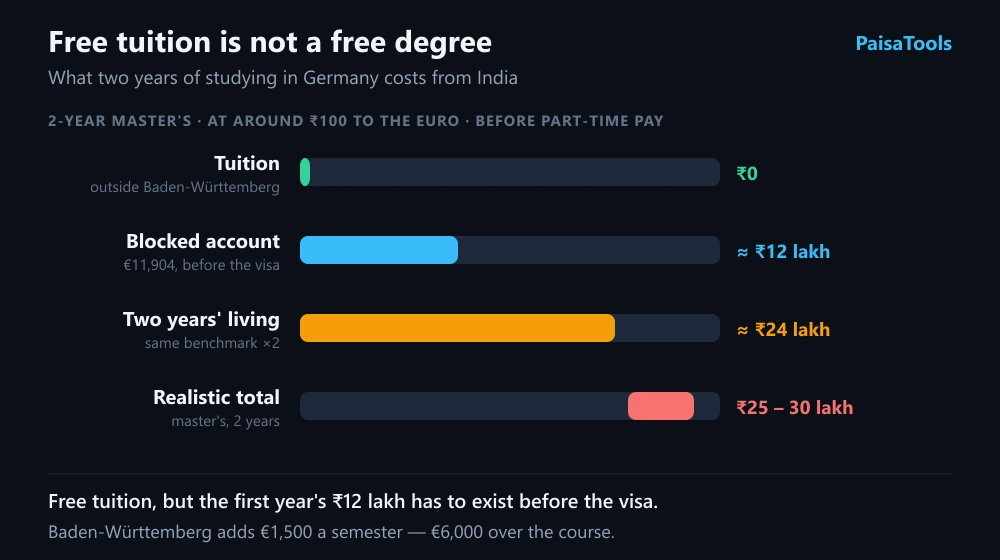
For a student visa in 2026, Germany requires proof of €11,904 for one year, which works out to €992 a month, usually held in a blocked account. At around ₹100 to the euro, that is roughly ₹12 lakh that has to exist before the visa is granted. The money is yours: after you arrive and register, the account releases €992 each month to live on. But it has to be available up front, and the provider charges setup and monthly fees on top.
The required amount is revised periodically. Confirm the current figure on the German mission's website before transferring money.
Before you fly
- APS certificate, which Indian applicants need before applying for the visa: about ₹18,000.
- National visa fee: €75.
- Language tests, English or German depending on the programme, and university application fees.
- Health insurance, which is compulsory from arrival.
- A one-way flight, first month's rent deposit, and basic setting-up costs.
Living there
The €992 benchmark is the amount the government considers enough to live on, and in smaller university towns it can be. In Munich, Frankfurt and parts of Berlin, rent alone can consume most of it, and a room in a student residence is much cheaper than a shared flat on the open market. Public health insurance for students typically costs more than €100 a month, and it is not optional.
Can part-time work cover it?
Non-EU students may work 140 full days or 280 half days a year, and Germany's statutory minimum wage is €13.90 an hour from 2026. Over a full year, part-time work can make a real difference to living costs. It rarely does in the first months, when students are settling in, and many part-time jobs expect some German. Plan the first year as if that income does not exist.
Adding it up for a two-year master's
At a public university outside Baden-Württemberg, the two years' living benchmark is about ₹24 lakh at current exchange rates, and semester contributions add around €600 to €1,400 across four semesters. Pre-departure costs, flights and deposits add a few lakh more. A realistic total lands around ₹25 lakh to ₹30 lakh before any part-time earnings, and a Baden-Württemberg programme adds €6,000 of tuition over four semesters.
Funded with a loan, ₹20 lakh at an illustrative 11% over ten years carries an EMI of about ₹27,550 and total interest of about ₹13 lakh. Money sent abroad for education can also attract tax collected at source, depending on the amount and how it is funded, which is worth checking before the first transfer.
Plan the education loan EMIThe honest summary
Studying in Germany is genuinely cheaper than most English-speaking destinations, because tuition at public universities is usually zero. It is not free. Budget roughly ₹12 lakh for each year of living costs, have the first year's amount ready before the visa, add a few lakh for everything that happens before you land, and do not count on part-time income in the first semester.
Check whether you can afford to study abroadFrequently asked questions
- How much money do I need to study in Germany from India?
- For 2026, the visa requires proof of €11,904 for the first year, roughly ₹12 lakh, usually in a blocked account. Add semester contributions, health insurance, the APS certificate, visa fee and flights. A two-year master's at a tuition-free public university commonly totals ₹25 lakh to ₹30 lakh before part-time earnings.
- What is the blocked account amount for Germany in 2026?
- €11,904 for one year, released at €992 a month after arrival. The amount is revised periodically, so confirm it on the German mission's website before applying.
- Is education really free in Germany for Indian students?
- Most public universities charge no tuition, but students pay a semester contribution, living costs, and compulsory health insurance. Public universities in Baden-Württemberg charge non-EU students €1,500 a semester, and private universities charge full fees.
- How many hours can international students work in Germany?
- Non-EU students can work 140 full days or 280 half days a year, and the statutory minimum wage is €13.90 an hour from 2026.