
This is one of the few money questions where the confidently given family answer is usually out of date. An uncle says the daughter's claim depends on when the father died. A neighbour says marriage ended it. Both were arguable positions once. Neither survives the law as it currently stands.
First, the distinction that decides everything
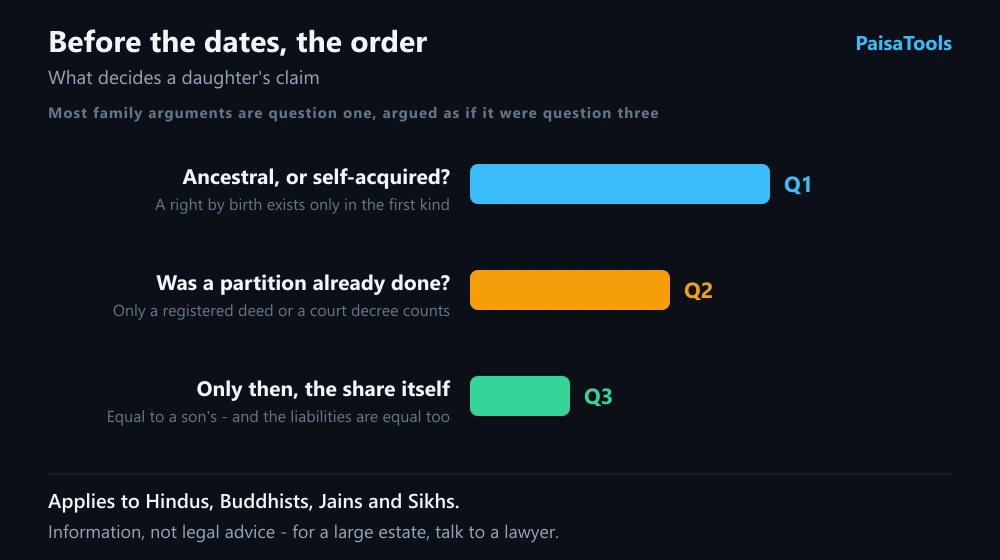
Before any date matters, one question does: is the property ancestral, or was it self-acquired? Ancestral — more precisely, coparcenary — property is what has come down an undivided Hindu family line. A child has a right in it by birth. Self-acquired property is what a person bought or earned themselves, and that is a different world entirely: the owner may will it to whomever they choose, and no child, son or daughter, has a birthright in it.
A very large share of family disputes are really arguments about which of these two categories a house falls into, conducted in the language of the first one.
What changed in 2005, and what changed again in 2020
The Hindu Succession (Amendment) Act, 2005, effective 9 September 2005, made daughters coparceners in their own right, with the same rights and the same liabilities as sons. But it left a question the courts then disagreed about for fifteen years: what if the father had already died before that date? One line of judgments said the daughter got nothing, reasoning that there had to be a living coparcener for the new right to attach to.
In Vineeta Sharma v. Rakesh Sharma, decided on 11 August 2020, the Supreme Court settled it: a daughter is a coparcener by birth, and that right does not depend on the father being alive on 9 September 2005. The earlier view in Prakash v. Phulavati was overruled. The right flows from being born into the family, not from who happened to be living on a particular date — so a father who died in, say, 1998 does not defeat his daughter's claim to coparcenary property.
Who this applies to
- The Hindu Succession Act governs Hindus, and also Buddhists, Jains and Sikhs. Other communities are governed by their own personal laws, where this reasoning does not transfer.
- The right is equal to a son's — and so are the liabilities, which is the half people tend to leave out.
- Marriage does not end it. A daughter does not stop being a coparcener in her father's family by marrying into another.
- It applies to daughters born before the amendment as much as after. The right is by birth, not by birth date.
What the 2020 ruling does not do
- It does not reach self-acquired property. If the father bought it himself, he may leave it to anyone by will.
- It does not reopen a partition that was genuinely completed before 20 December 2004 — but the Court was strict about what counts: a partition effected by a registered deed or by a court decree. A claimed oral partition, even backed by revenue entries, was held insufficient to extinguish a daughter's right.
- It does not convert a moral claim into an automatic transfer. The right exists; enforcing it against relatives who disagree is still a civil process that takes time.
Keep one thing straight: this is information, not legal advice. Property matters turn on documents and on facts specific to a family, and the sums involved are usually large enough that a lawyer who can read the actual papers is worth the fee — particularly where a partition, a will or a release deed is already in play.
See how a property share fits your overall positionFrequently asked questions
- My father died before 2005. Does that end my claim?
- No. The Supreme Court addressed exactly this in 2020 and held that the right arises from birth rather than from who was living on any given date, so an earlier death does not by itself defeat the claim to coparcenary property.
- I am married. Does that change anything?
- No. Marriage does not remove a daughter from her father's coparcenary. The contrary belief is common and simply predates the amendment.
- My brothers say the property was already divided years ago.
- What matters is how it was divided. A partition recorded by registered deed or decreed by a court before the cut-off is preserved; an informal or purely oral division asserted afterwards was expressly held not to be enough.
- Does this apply to property my father bought himself?
- No. That is self-acquired property, and the owner is free to dispose of it by will. The birthright being discussed here exists only in ancestral coparcenary property.
- Am I liable for family debts too?
- The amendment gave daughters the same rights and the same liabilities as sons in the coparcenary. People remember the first half of that sentence more readily than the second.