
You opened the passbook, the contributions are all there, and the interest line is not. This sends a lot of people straight to a grievance form, and usually nothing is wrong — but the reason is less reassuring than "wait for it", because there are two separate things going on and only one of them is about timing.
Why it is late: the credit is a batch, not a switch
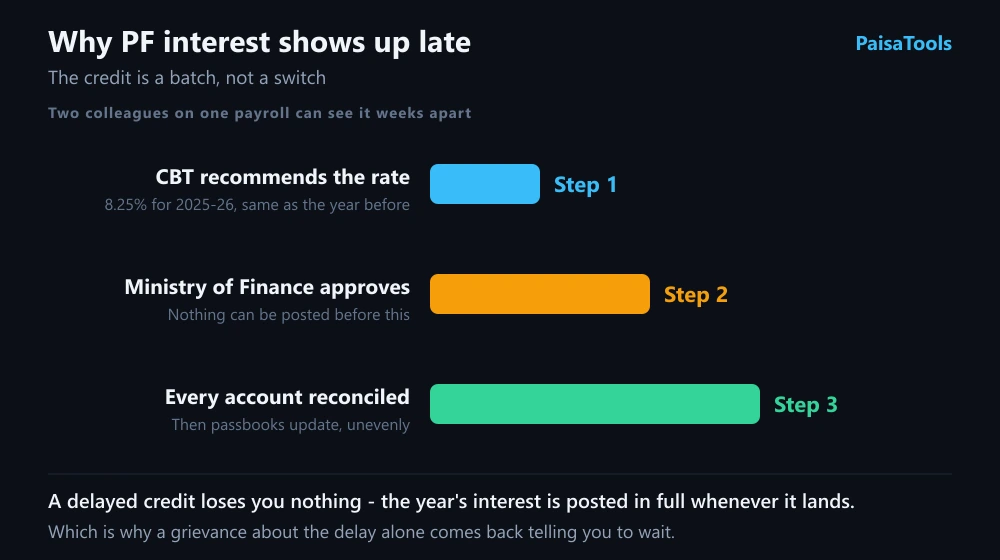
The rate does not become real when it is announced. EPFO's Central Board of Trustees recommends a rate — 8.25% for 2025-26, the same as the year before — and that recommendation then needs the Ministry of Finance to approve it. Only after that can EPFO post interest, and posting means reconciling every member account before the passbooks update.
So the credit arrives as a batch, months after the announcement, and not on the same day for everyone. Two colleagues on the same payroll can see it weeks apart. An empty interest line in the months after a financial year closes is the normal state of things, not a fault.
Nothing is lost in the wait. The interest is computed for the full year and posted in full whenever it lands, so a delayed credit costs you nothing — which is also why a grievance filed purely about the delay tends to come back with a note telling you to wait.
The part that actually surprises people
The commoner complaint is not that interest is missing but that it is too small. People multiply the rate by the balance they can see, get one number, receive a noticeably smaller one, and conclude something has gone wrong. Nothing has. The expectation was built on the wrong arithmetic, and one widely-copied explanation online states it wrongly — that interest is calculated on your closing balance on 31 March. It is not.
EPFO works on the monthly running balance: the balance at the start of each month earns that month's share, at the annual rate divided by twelve. A contribution made during a month therefore starts earning from the month after it arrives, not from the day it lands.
That timing is the whole gap. A contribution made in month m of the year earns interest for only the remaining months, so across twelve equal monthly contributions the year's new money earns 5.5 months of interest on average — about 0.46 of the annual rate, not the full rate. Practical form: your credit is roughly the full rate on the balance you STARTED the year with, plus a little under half the rate on everything added during it. For someone in their first year, starting from nothing, that works out near 3.6% of the closing balance rather than 8.25%.
And a third of your employer's share never earns interest at all
This one compounds the surprise. The employer's 12% does not all land in your provident fund. Only 3.67% goes to EPF; the other 8.33% goes to the pension scheme, EPS, which pays no interest whatsoever.
So when you tally "12% from me plus 12% from them" and apply the rate to the lot, the sum is wrong twice over — once for the month-by-month timing above, and once because a large slice of the employer side was never in the interest-earning pot.
When it IS worth raising
- Interest for a year that is already fully credited for colleagues at the same employer, months after the batch — that is an account-level problem, not the batch.
- Contributions themselves missing from the passbook, not just the interest. A gap in contributions is the employer's filing, and it needs fixing before any interest on it can be right.
- Interest credited but visibly inconsistent with the balance carried into the year — worth a recalculation using the running-balance method above before you conclude it is wrong.
- An exited account: interest keeps accruing after you leave, so a long-dormant account showing none is worth a question.
The route is EPFO's own grievance portal, EPFiGMS, against the office that holds your account. Quote the financial year and the balance you are comparing against — a grievance that just says interest is missing gets a wait-for-it reply.
See where your savings actually standFrequently asked questions
- Do I lose interest if the credit is delayed?
- No. The interest is calculated for the whole financial year and posted in full whenever the batch reaches your account, so a late credit does not reduce it.
- Why is my credited interest smaller than the rate times my balance?
- Because EPFO uses the monthly running balance, so money added during the year earns for only part of the year, and because the EPS slice of the employer's contribution earns no interest.
- Does the pension part of my employer's contribution earn interest?
- No. Of the employer's 12%, only 3.67% goes to EPF. The 8.33% that goes to EPS earns no interest.
- My colleague got the credit and I have not. Is that a problem?
- Not by itself in the weeks around a batch, since accounts update unevenly. It is worth raising once the batch is long finished and comparable accounts at the same employer are done.