
The gold rate is the one number every shop displays and the one number none of them compete on — it moves together across the market every morning. What actually decides your bill is everything printed under it, and that part is not on the board.
Two people can buy an identical 10 gram chain on the same day, at the same quoted rate, and pay several thousand rupees apart. Nothing dishonest has happened. They were quoted on different bases.
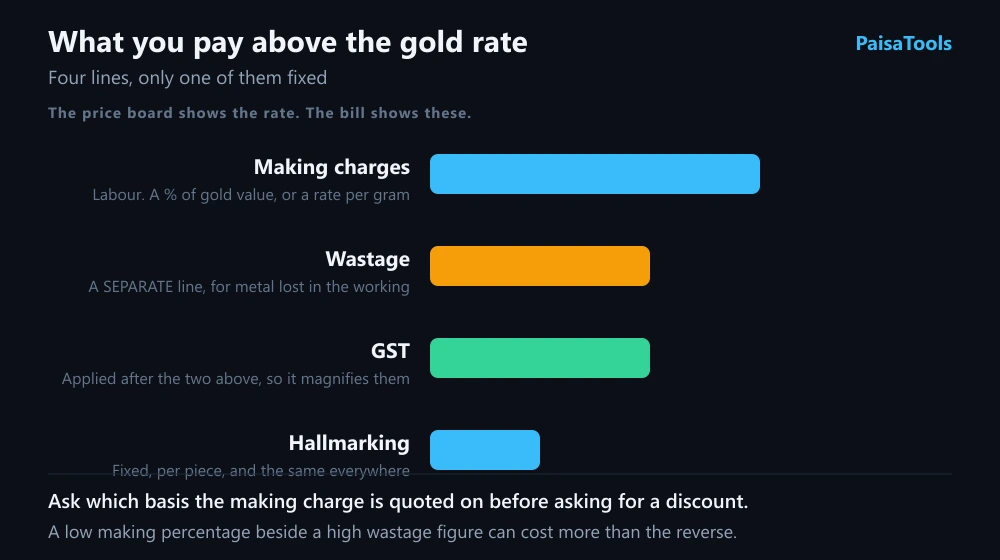
The four things stacked on top of the gold rate
- Making charges — the labour. Quoted either as a percentage of the gold value or as a flat rate per gram, and the two are not interchangeable.
- Wastage — a SEPARATE line, for the gold genuinely lost in cutting, melting and polishing. A shop can show low making charges and recover it here.
- GST — applied after the first two, so it magnifies whatever they came to.
- BIS hallmarking — a small fixed charge per piece for the purity mark and its HUID code. Roughly ₹45, and the only line here that is the same everywhere.
Percentage or per gram: the question to ask first
Ask which basis you are being quoted on before you ask for a discount, because the answer changes which piece is expensive. A percentage scales with the gold rate and with weight; a per-gram rate scales only with weight. On a heavy plain chain the percentage usually costs you more. On a light, intricate piece the per-gram rate usually does.
Typical retail ranges in 2026: making charges run from roughly 6% to 25% of the gold value, or about ₹150 to ₹500 a gram on plain 22K work, higher on chains and designer pieces. Wastage, where a shop charges it, is commonly another 2% to 7% of the gold value.
The GST line almost every explainer gets wrong
When you buy finished jewellery from a showroom it is a single composite supply, so GST is 3% on the gold and the making charges together — not 3% on gold plus 5% on making. The 5% rate is for making charges billed separately as job work, which is what happens when you hand over your own gold to be remade. If a retail bill shows 5% on the making line, ask why.
What to do standing at the counter
- Ask for the bill broken into gold value, making, wastage, hallmarking and GST. A shop that will not itemise is telling you something.
- Compare the TOTAL per gram, not the making percentage. A 9% shop with 6% wastage costs more than a 12% shop with none.
- Plain and machine-made pieces carry the lowest making charges; hand-crafted and stone-set pieces the highest. The design decides most of it before any negotiation does.
- Check the HUID on the piece itself. Hallmarking is the one charge you should insist on paying.
None of this makes jewellery a bad purchase. It makes it a purchase where the sticker and the bill are different documents, and the difference is knowable before you agree.
See what your savings can actually absorbFrequently asked questions
- Are making charges negotiable?
- Often, on plain and machine-made pieces where the labour is low and the shop has room. Rarely on hand-crafted or stone-set work, where the charge reflects real hours.
- Is wastage the same as making charges?
- No. Making charges are labour; wastage is a separate line for gold lost in working the metal. A low making charge alongside a high wastage figure can cost more than the reverse.
- What GST applies when I buy a gold chain?
- Finished jewellery from a showroom is one composite supply, so a single rate applies to the gold and making together. A different, higher rate applies only to making charges billed on their own as job work.
- Do I get making charges back when I sell or exchange?
- No. Making, wastage, hallmarking and GST are the cost of turning metal into an ornament. On resale you are paid for the gold content, which is why the buy-sell gap on jewellery is wider than on coins or bars.