
Ask three clinics in the same city what a single implant costs and you can get three answers that are not close to each other. People assume one of them is overcharging. Usually none of them is. They are quoting different hardware, and the hardware is most of the price.
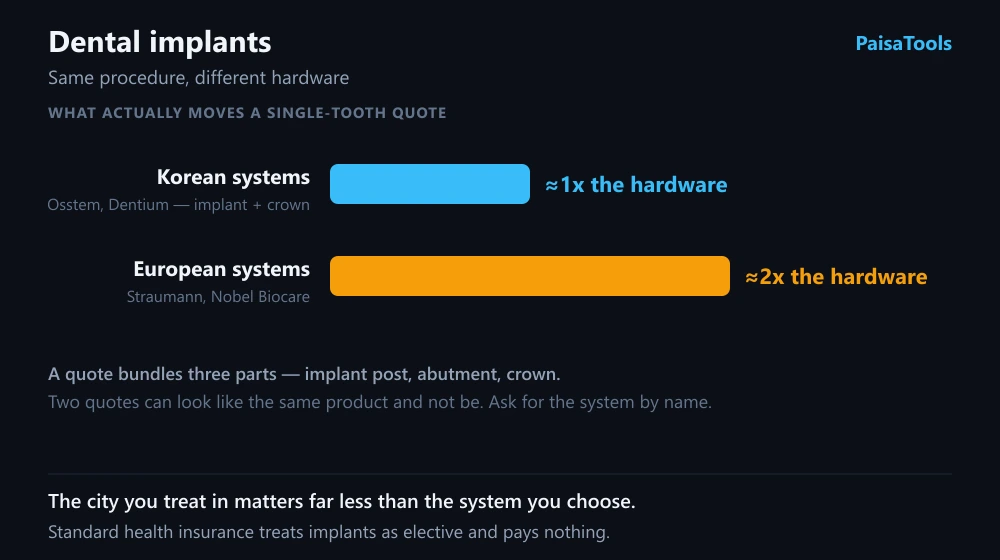
A quote is three things, not one
An implant is a post placed in the jawbone, an abutment on top of it, and a crown on top of that. Clinics quote these bundled, which is why two quotes can look like the same product and not be. When you compare, you have to compare the same three components, and you have to know which system is being used.
The system is the part that moves the price. Korean systems such as Osstem and Dentium sit at one end. European systems such as Straumann and Nobel Biocare sit at the other, and they cost roughly twice as much for the implant and crown together. Both are legitimate; the European systems have longer published track records and wider component availability, which matters in twenty years when something needs replacing.
In practice the Korean systems land around ₹15,000 to ₹30,000 for the implant and crown, and the European ones around ₹35,000 to ₹70,000. Most clinics quote somewhere in the ₹25,000 to ₹60,000 band for a single tooth, which is wide because it spans both choices. The city matters far less than people expect — a metro premium is real but small next to a 4x difference in hardware.
What insurance pays, which is almost always nothing
This is the part that catches people, because they hold a health policy and assume a surgical procedure in a clinic is covered. Implants are classified as elective, and elective dental work sits outside standard health insurance in India. Being short of a tooth is not, in the insurer's reading, a medical necessity.
- Routinely excluded: implants, dentures, crowns and bridges, orthodontics, and anything the policy can call cosmetic.
- The usual exception: dental work needed because of an accident to natural teeth, and then generally only where it required hospitalisation.
- OPD riders and dental add-ons do exist, but their annual caps are small relative to one implant — read the cap before you buy the rider for this purpose.
- Group cover through an employer is sometimes broader than a retail policy. It is worth checking rather than assuming, because this is the one place implants occasionally get paid.
So plan this as money you will pay yourself. That changes the decision: it is not "what will insurance allow", it is "which system do I want to own for the next two decades, and can I fund it now".
The full-mouth number is a different decision entirely
Full-arch work — the All-on-4 and All-on-6 approaches, where a whole arch is carried on four or six implants — runs from roughly ₹2 lakh to ₹6 lakh and upward, depending on the count and on whatever bone grafting is needed first. It is not the single-tooth price multiplied out, and quotes vary more than for single implants because the surgical plan varies more.
At that size it stops being a dental decision and becomes a funding one. If it would come out of an emergency fund, or go onto a card, the cost of the money is a real part of the cost of the teeth.
What to ask before you accept a quote
- Which implant system, by brand name — not "imported" or "premium". Write it down.
- Is the crown included, and in what material? A quote without the crown is not a quote for a finished tooth.
- Is bone grafting or a sinus lift likely, and what does that add? This is the most common reason a final bill exceeds the quote.
- What is the warranty, and is it on the implant, the crown, or both? Systems carry manufacturer warranties; clinics carry their own.
- How many of this system has the clinic placed? Component availability later depends on the system being a mainstream one.
Frequently asked questions
- Why do two clinics quote such different prices for one implant?
- Almost always because they are quoting different implant systems. A Korean system with a crown and a European system with a crown are roughly a factor of two apart, before any difference in the clinic's own fee. Ask both for the brand name and you will usually find the gap explained.
- Does health insurance in India cover dental implants?
- As a rule, no. Implants are treated as elective dental work and are excluded from standard health policies. The common exception is dental work required after an accident to natural teeth, and typically only where hospitalisation was involved. Some employer group policies and some OPD riders pay a limited amount, but the caps are small compared with the cost of one implant.
- Is a cheaper implant system a worse one?
- Not necessarily worse, but different. The mainstream Korean systems are widely used and clinically established. What you pay more for with the long-established European systems is a longer published track record and broader availability of matching components years later, which matters if a crown or abutment ever needs replacing.
- Is it cheaper to get implants done in a smaller city?
- Somewhat, but less than people think. Clinic fees do vary by city, while the hardware costs roughly the same everywhere. Since the system is the larger part of the variation, choosing the system matters more to the final number than choosing the city.
- How long do dental implants last?
- The implant post is designed to be permanent and commonly lasts decades when the surrounding bone and gum stay healthy. The crown on top is the wearing part and is the component more likely to need replacing at some stage, which is why component availability for the chosen system is worth asking about.