
Every monsoon the same question arrives after the water recedes: is any of this insured? In India you do not buy a separate flood policy. Flood, storm, earthquake and landslide are already inside the standard home policy that every general insurer must sell — Bharat Griha Raksha, which IRDAI introduced in January 2021 and made compulsory for all insurers from 1 April 2021.
Because the wording is standard, the cover is identical whichever company you buy from. Only the price and the service differ. What you actually have to get right is the sum insured, and that is where most policies fail their owners.
What the standard policy covers
- The structure: walls, floors, fittings, and permanent fixtures, against fire, flood, storm, earthquake, landslide and similar events.
- The contents: if you take both covers, general household contents are included automatically at 20% of the building's sum insured, capped at ₹10 lakh — you do not have to list them.
- Architect, surveyor and consulting engineer fees, up to 5% of the claim.
- Removing debris from the site, up to 2% of the claim.
- Rent, if an architect or the local authority certifies the house is not fit to live in — but only when the damage claim itself has been accepted.
- You can take contents cover alone if you rent, which is the version most tenants need and almost nobody buys.
The sum insured: the number people get wrong
- You insure the cost of rebuilding, not the market price of the flat. Land is not insurable and is usually most of what you paid.
- The formula is fixed: carpet area × the current construction cost per square foot in your area.
- Pick it too low and every claim is cut proportionately; pick it too high and you pay premium for money you can never claim.
- Jewellery, cash, paintings and anything valuable are not in the automatic 20% — they need to be declared separately.
- Cover can run up to 30 years on one policy, so the sum insured needs a reality check every few years as construction costs rise.
Working out your own sum insured
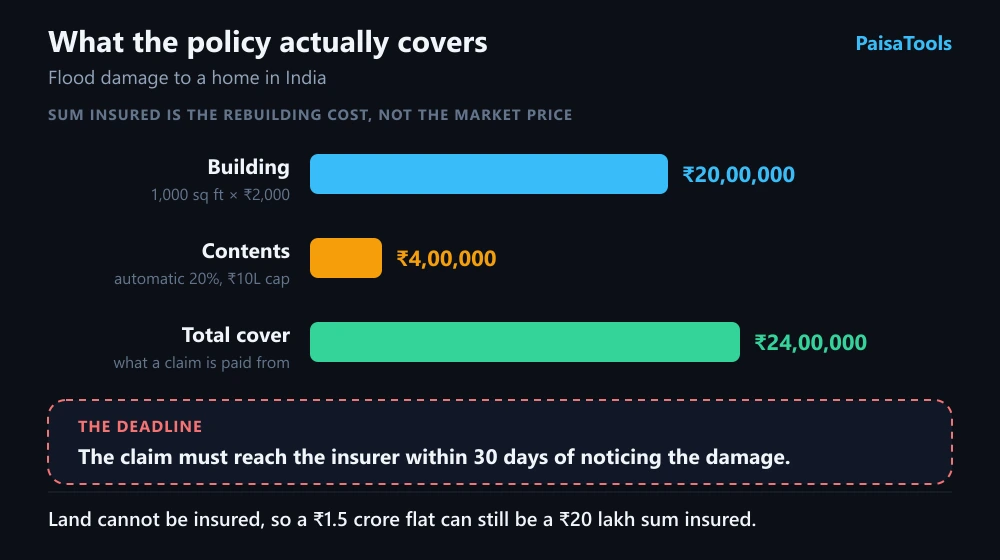
Take a 1,000 sq ft carpet-area flat where construction costs about ₹2,000 per square foot today. The building sum insured is 1,000 × ₹2,000 = ₹20,00,000 — regardless of whether the flat would sell for ₹50 lakh or ₹1.5 crore, because the land is not being insured. Take the contents cover too and general contents come in automatically at 20% of that, which is ₹4,00,000, inside the ₹10 lakh cap. Total cover ₹24,00,000. On an accepted claim the policy additionally pays architect and surveyor fees up to 5% and debris removal up to 2%, so a ₹5 lakh claim carries up to ₹25,000 and ₹10,000 for those two lines on top.
The claim process, in order
- Call the insurer as soon as it is safe and take down a claim number. Do this before you start clearing up.
- Photograph and video everything while it is still wet and in place — this is the evidence the surveyor cannot collect later.
- Submit the claim form and documents within 30 days of first noticing the damage. Miss that window and the claim can be refused outright.
- The insurer appoints a surveyor who inspects the house, photographs it, and writes the report the claim is decided on. You must let them in and answer fully.
- Keep the damaged items until the surveyor has seen them; throwing out a ruined sofa before the inspection removes your own proof.
- Claiming lost rent needs a separate certificate from an architect or the local authority saying the house is uninhabitable.
What gets claims refused
- Clearing and repairing before the survey, so nothing can be assessed.
- Filing after the 30-day window with no explanation.
- A sum insured set from the property's market value rather than construction cost, which does not increase the payout — it just wastes premium.
- Valuables that were never declared and so were never covered.
- Any false statement or document: the insurer can refuse the claim and cancel the policy.
Frequently asked questions
- Is flood damage covered by home insurance in India?
- Yes. Flood, inundation, storm, earthquake and landslide are built into Bharat Griha Raksha, the standard policy every general insurer must offer since April 2021. No separate flood policy exists or is needed.
- How much home insurance do I need for my flat?
- Insure the rebuilding cost, not the market price: carpet area multiplied by the construction cost per square foot in your area. Land cannot be insured.
- Are household goods covered against flood?
- If you take both covers, general contents are included automatically at 20% of the building sum insured, capped at ₹10 lakh. Jewellery, cash and other valuables must be declared separately.
- How long do I have to file a flood damage claim?
- The claim form and documents must reach the insurer within 30 days of your first noticing the loss, though you should call and get a claim number immediately.
- Can tenants insure against flood damage?
- Yes. Contents-only cover is available under the same standard policy, which is what a tenant needs since the structure belongs to the landlord.
- Does the policy pay for rent while the house is repaired?
- Only if the physical damage claim is accepted and an architect or the local authority certifies the home is unfit to live in.