
Couples considering IVF usually meet a single package price first, and it is almost never the amount they end up paying. The package covers the core procedure. The medicines, the add-ons a doctor may recommend, the storage of embryos, and above all the possibility of needing more than one cycle are what decide the real cost. This is a money guide, not medical advice; the medical decisions belong with a fertility specialist.
What one cycle costs
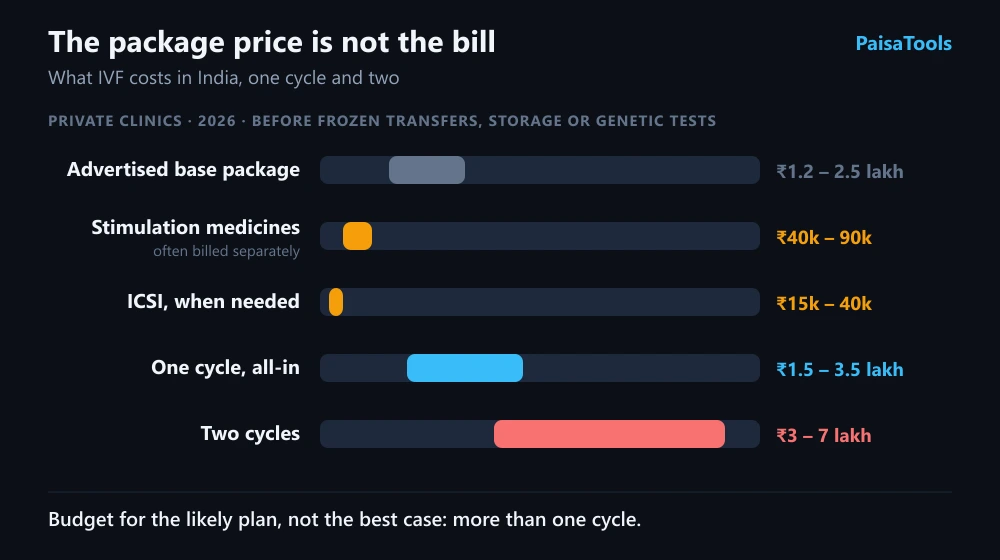
At private clinics in 2026, one IVF cycle commonly costs ₹1.5 lakh to ₹3.5 lakh all-in, while advertised base packages often start around ₹1.2 lakh to ₹2.5 lakh. Metro clinics are typically ₹50,000 to ₹1 lakh more expensive than those in smaller cities.
- Stimulation medicines, often billed separately from the package: commonly ₹40,000 to ₹90,000, which can be 30% to 40% of the bill.
- ICSI, where the sperm is injected directly into the egg, when it is needed: commonly an additional ₹15,000 to ₹40,000.
- Embryo freezing, and annual storage fees for as long as embryos are kept.
- A frozen embryo transfer in a later cycle, billed separately.
- Genetic testing of embryos, where a doctor recommends it, which adds substantially to the cost.
- Tests and consultations before treatment begins.
Why the real budget is more than one cycle
Success rates vary strongly with age. Clinics report their highest success rates for women under 35, and rates decline with age, particularly from the late thirties. Many couples need more than one attempt, which makes a single-cycle budget the most optimistic plan available rather than the likely one.
Budget for the likely case, not the best one. Two full cycles at the typical all-in range come to ₹3 lakh to ₹7 lakh, before any frozen embryo transfers, embryo storage or genetic testing. Planning for that amount from the start is far less stressful than discovering it one cycle at a time.
Will insurance pay for it?
Most standard health insurance policies in India exclude infertility treatment. Some newer policies and riders offer limited cover after a waiting period, usually with a sub-limit well below the cost of a cycle, so read the policy wording rather than the brochure.
The tax position is also unhelpful. Section 80D covers health insurance premiums and preventive health check-ups, not treatment costs, and Section 80DDB applies only to a list of specified illnesses that does not include infertility treatment.
The law sets limits too
The Assisted Reproductive Technology (Regulation) Act, 2021 governs IVF in India. It sets eligibility ages, with the woman between 21 and 50 and the man between 21 and 55, and requires clinics and banks to be registered. Checking a clinic's registration is a sensible first step before paying anything.
Paying for it
Many clinics offer EMI plans, and personal loans are common. A ₹2.5 lakh loan at 14% a year repaid over twelve months carries an EMI of about ₹22,447 and interest of about ₹19,361, before any processing fee. If a clinic advertises a no-cost EMI, compare the plan's total against any discount for paying up front. Revolving credit card debt is the most expensive way to fund treatment and is best avoided.
Work out the EMI before choosing a financing planThe honest summary
One IVF cycle commonly costs ₹1.5 lakh to ₹3.5 lakh in 2026 once medicines and add-ons are included, and a realistic plan allows for more than one attempt. Expect little help from insurance or tax deductions, ask every clinic for an itemised estimate that separates the package from medicines and add-ons, and decide how the full plan will be funded before the first cycle starts.
Check whether you can afford IVF, and how long to saveFrequently asked questions
- How much does IVF cost in India in 2026?
- One cycle at a private clinic commonly costs ₹1.5 lakh to ₹3.5 lakh all-in, including stimulation medicines and ICSI where needed. Base packages are often advertised from about ₹1.2 lakh to ₹2.5 lakh, and metro clinics are typically more expensive than those in smaller cities.
- Does health insurance cover IVF in India?
- Most standard policies exclude infertility treatment. Some newer policies and riders offer limited cover after a waiting period, usually with a sub-limit below the cost of a full cycle.
- Can I claim a tax deduction for IVF expenses?
- Generally no. Section 80D covers health insurance premiums and preventive check-ups, and Section 80DDB applies only to specified illnesses, which do not include infertility treatment.
- What is the age limit for IVF in India?
- Under the Assisted Reproductive Technology (Regulation) Act, 2021, the woman must be between 21 and 50 years old and the man between 21 and 55.