
There is no official figure for what a middle-class Indian family spends in a month, and the averages that circulate are usually either too broad to be useful or quietly built on one city. The honest way to answer the question is to build the budget line by line and let each family swap in its own numbers.
The figures below are estimates for a family of four, two working-age adults and two school-going children, at typical 2026 prices. They are not survey averages. They are what the individual lines commonly cost.
In a metro, line by line
- Rent for a 2BHK: ₹25,000 to ₹45,000, and more in Mumbai and prime parts of Bengaluru.
- Groceries, milk, fruit and vegetables: ₹12,000 to ₹18,000.
- Electricity, cooking gas, water, internet and two mobile plans: ₹5,000 to ₹9,000.
- School fees for two children at private schools, averaged across the year including transport: ₹10,000 to ₹25,000.
- Commuting and fuel: ₹6,000 to ₹12,000.
- Domestic help for cleaning and cooking: ₹6,000 to ₹15,000.
- Health and term insurance premiums, spread monthly: ₹3,000 to ₹5,000.
- Eating out, subscriptions and weekend outings: ₹5,000 to ₹12,000.
- Medicines and doctor visits: ₹2,000 to ₹5,000.
- Support to parents, where it applies: ₹5,000 to ₹15,000.
- Clothes, festivals, gifts and birthdays, spread monthly: ₹4,000 to ₹8,000.
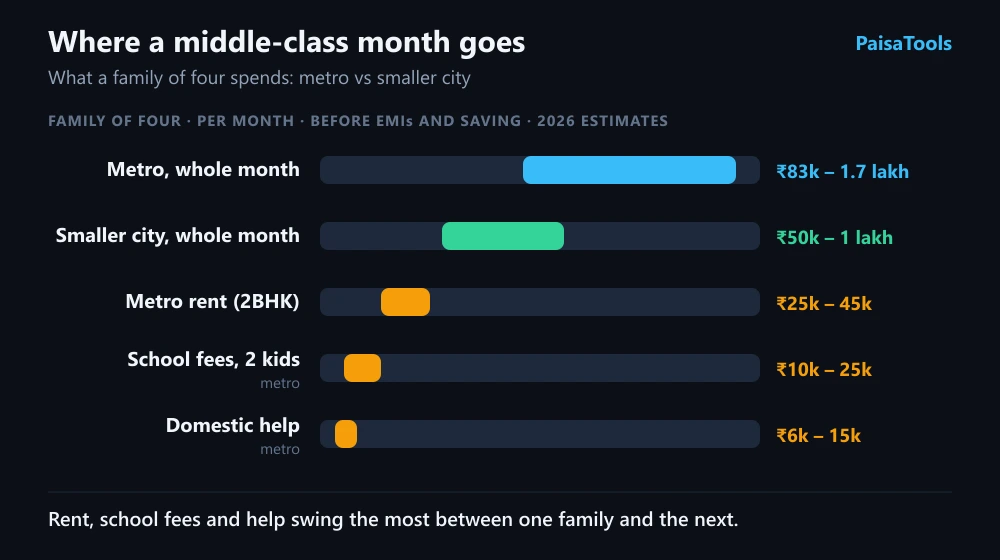
Added up, a metro family of four spends roughly ₹83,000 to ₹1.7 lakh a month, before a single rupee of EMI or saving. The range is wide because rent, school fees and domestic help swing more than anything else, and those three lines alone can account for half the budget.
In a smaller city
- Rent: ₹10,000 to ₹20,000.
- Groceries: ₹10,000 to ₹14,000.
- Utilities, internet and phones: ₹4,000 to ₹7,000.
- School fees for two children: ₹6,000 to ₹15,000.
- Commuting and fuel: ₹4,000 to ₹8,000.
- Domestic help: ₹3,000 to ₹8,000.
- Insurance premiums: ₹3,000 to ₹5,000.
- Eating out and outings: ₹3,000 to ₹7,000.
- Medical: ₹1,500 to ₹4,000.
- Support to parents: ₹3,000 to ₹10,000.
- Clothes, festivals and gifts: ₹3,000 to ₹6,000.
That comes to roughly ₹50,000 to ₹1 lakh a month. Insurance barely changes between cities, which is why it takes a bigger share of a smaller-city budget.
The costs that aren't monthly but break budgets
- School fees billed quarterly or annually, with admission, uniform and book costs landing in the same month.
- Health, vehicle and home insurance renewals.
- The festive season, when gifts, clothes, travel and home spending all arrive together.
- Weddings in the extended family, travel to hometowns, and the gadget that stopped working.
A budget that only looks at monthly spending will feel fine for ten months and fail in two. Divide the annual lines by twelve and set that amount aside every month.
What income that needs
If the family spends ₹1 lakh a month, saves 20% of its income and has no loan, it needs a take-home income of about ₹1.25 lakh. Add a home loan EMI and the requirement climbs quickly, which is why so many middle-class households feel stretched even on salaries that look comfortable on paper.
Get your family's financial health scoreWhere middle-class budgets leak
- Food delivery and subscriptions that were each small when they started.
- EMIs on phones and appliances, which commit future income to past purchases.
- School extras such as activities, trips and events that were not in the fee quoted at admission.
- Lifestyle upgrades that arrive with every increment and never leave.
The honest summary
A family of four commonly spends ₹83,000 to ₹1.7 lakh a month in a metro and ₹50,000 to ₹1 lakh in a smaller city, before EMIs and savings. The useful number is not the average; it is your own, built line by line, with the annual expenses spread across the year. Once that is written down, deciding how much to save and how big a loan the household can carry becomes arithmetic.
Frequently asked questions
- What are the monthly expenses of a middle-class family in India?
- For a family of four at 2026 prices, roughly ₹83,000 to ₹1.7 lakh a month in a metro and ₹50,000 to ₹1 lakh in a smaller city, before EMIs and savings. Rent, school fees and domestic help drive most of the difference.
- How much should a middle-class family save each month?
- A common target is at least 20% of take-home income, set aside before discretionary spending, with an emergency fund built first.
- What is the biggest expense for Indian families?
- In metros, housing is usually the largest single line, followed by school fees for families with children. In smaller cities, groceries and school fees often come close to rent.
- How do I make a monthly budget for my family?
- List every expense line, including annual costs such as school fees, insurance renewals and festival spending divided by twelve, then compare the total with take-home income and set the saving amount first.