
Buying health insurance for parents is one of the most common money decisions for a working Indian in their thirties, and one of the most confusing. The premium depends on their age more than anything else, and two policies with the same cover can pay out very differently when the bill arrives.
The rules also moved in their favour recently. Here is what it costs, what changed, and the three clauses that decide what you actually pay.
What it costs, by age
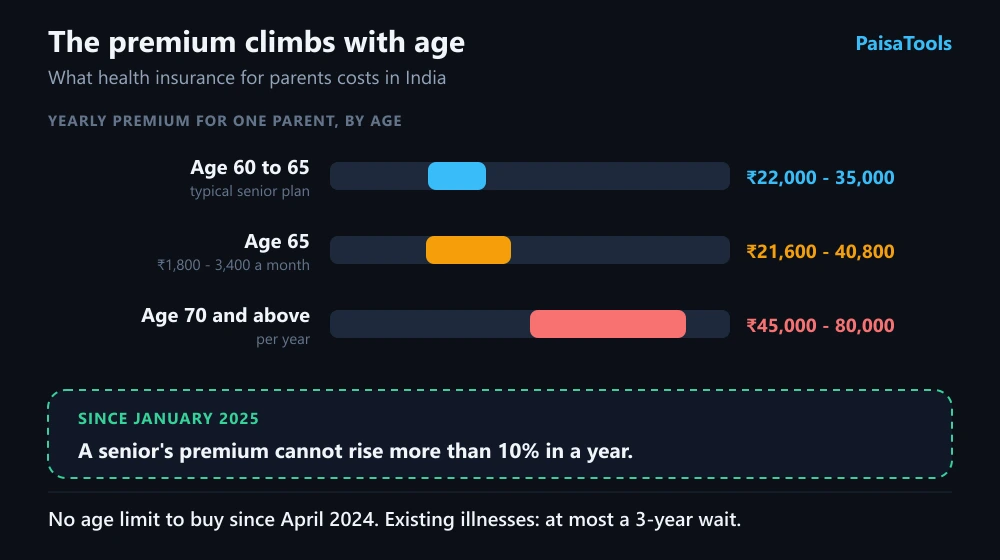
- Age 60 to 65: roughly ₹22,000 to ₹35,000 a year for a typical senior-citizen plan.
- Age 65: the same plans commonly run ₹1,800 to ₹3,400 a month, about ₹21,600 to ₹40,800 a year.
- Age 70 and above: roughly ₹45,000 to ₹80,000 a year.
- A ₹5 lakh cover is the bare minimum in a smaller city; in a metro, ₹10 lakh to ₹15 lakh is the usual advice.
What changed in 2024 and 2025
- No age limit to buy: since April 2024 insurers must offer health insurance to anyone, whatever their age. A 72-year-old can buy a new policy.
- Shorter wait for existing illnesses: the maximum waiting period for pre-existing conditions such as diabetes or blood pressure fell from 4 years to 3.
- Premium hikes capped: from January 2025, insurers cannot raise a senior citizen's premium by more than 10% a year.
- Free cover at 70: under Ayushman Vay Vandana, every citizen aged 70 or more gets ₹5 lakh of free treatment per family per year, whatever their income.
The three clauses that decide your bill
- Co-payment: many senior plans make you pay 10% to 20% of every claim yourself. It lowers the premium and raises what you pay at discharge.
- Pre-existing disease waiting period: up to 3 years before diabetes- or BP-related treatment is covered. A policy bought after a diagnosis will not pay for it straight away.
- Room-rent limits: a cap on the room charge cuts the whole bill in proportion, not just the room. It is the most common reason a claim pays less than expected.
What a co-payment costs in a real claim
A ₹4 lakh hospital bill on a policy with 20% co-payment: the insurer pays ₹3.2 lakh and you pay ₹80,000. On the same bill with a 10% co-payment you pay ₹40,000. A plan without co-payment costs more each year, and the difference in one claim can be larger than several years of that extra premium - which is why the cheapest premium is rarely the cheapest policy for a parent in their seventies.
Ways to keep it affordable
- Buy earlier. A policy bought at 60 has finished its waiting periods by 63; one bought at 68 is still waiting at 71.
- Use a base policy plus a super top-up for a large cover at a lower premium.
- Do not rely on the employer's parent cover alone: it ends when the job does.
- Under the old tax regime, the premium you pay for senior-citizen parents is deductible, up to a separate limit.
Frequently asked questions
- What is the premium of health insurance for parents aged 60?
- Roughly ₹22,000 to ₹35,000 a year for a typical senior-citizen plan between 60 and 65, depending on cover, city and health.
- Can I buy health insurance for parents above 65 or 70?
- Yes. Since April 2024 insurers must offer health insurance to anyone regardless of age, so parents above 65 or 70 can buy a new policy.
- What is the waiting period for pre-existing diseases for seniors?
- At most 3 years, down from 4, for conditions such as diabetes or high blood pressure.
- What is co-payment in senior citizen health insurance?
- The share of every claim you pay yourself, commonly 10% to 20%. On a ₹4 lakh bill a 20% co-payment means you pay ₹80,000.
- Can the premium increase every year?
- Yes, but since January 2025 insurers cannot raise a senior citizen's premium by more than 10% in a year.
- Do parents above 70 get free health cover?
- Under Ayushman Vay Vandana, every citizen aged 70 or above gets ₹5 lakh of free treatment per family per year, regardless of income.