
Almost every conversation about building a house in India begins and ends with one number: the rate per square foot. It is a useful number and it is the smaller half of the project. The rate covers the structure a contractor builds; it does not cover getting permission to build it, connecting it to water and power, walling the plot, or making it liveable inside.
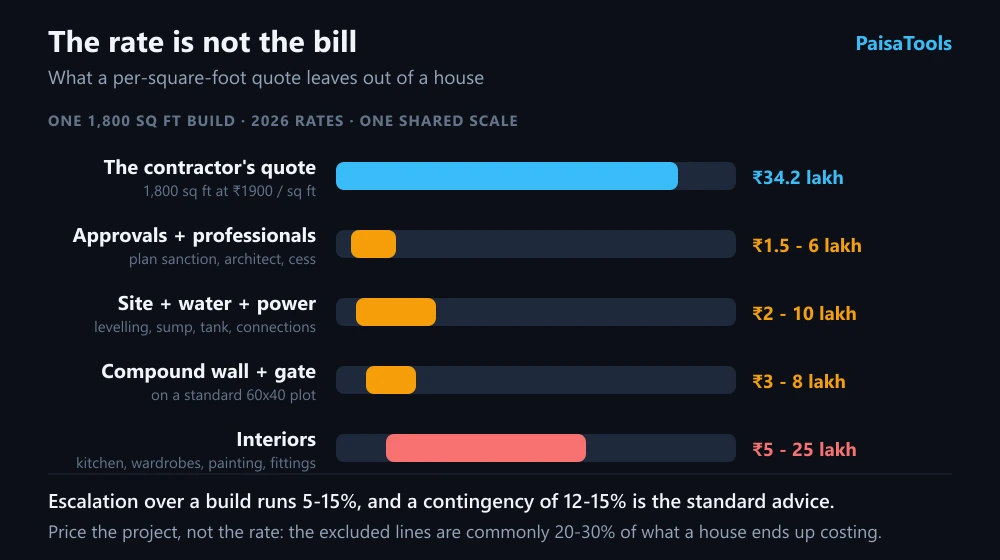
That gap is not a rounding error. The lines a per-square-foot quote leaves out commonly add twenty to thirty per cent to what the house finally costs, which is exactly the size of the overrun families describe as the build having gone wrong.
What the rate actually is
For 2026, a standard residential build in India runs roughly ₹1,500 to ₹2,200 per square foot of built-up area. A basic, no-frills build can start near ₹1,200. In metros the same specification sits higher, commonly ₹2,200 to ₹4,500, and luxury finishes go past that without an upper limit.
Inside that rate, materials are the bulk — roughly 50 to 60 per cent of the budget — and labour is another 25 to 30 per cent. Cement at ₹350 to ₹500 a bag and TMT steel at ₹65 to ₹85 a kilo are the two lines that move the rate most, and both are quoted on the day, not for the duration of your build.
Ask one question before comparing any two quotes: what is the rate per square foot OF, and what is it inclusive of. Built-up area, carpet area and super built-up area are three different denominators, and a quote is only comparable to another quote on the same one.
The approvals
Nothing can legally start until the plan is sanctioned, and approvals together usually come to one to three per cent of the project cost. The absolute figures vary by city more than by house.
- Building plan sanction: broadly ₹80,000 to ₹2 lakh under BBMP in Bengaluru, ₹1 lakh to ₹3 lakh under BMC in Mumbai, ₹50,000 to ₹1.5 lakh under GHMC in Hyderabad, and ₹60,000 to ₹2 lakh in Delhi.
- Architect and structural engineer: roughly ₹15 to ₹40 per square foot, or 3 to 7 per cent of the construction cost where they are engaged for the whole build.
- Labour welfare cess under the BOCW Act: 1 to 2 per cent of the project cost, payable on most builds above the threshold.
- Completion and occupancy certificates at the end, which matter later for a loan, a resale and a legal water connection.
The lines the quote leaves out
These are not extras in the sense of luxuries. Most of them are the difference between a structure and a house somebody can live in.
- Compound wall and gate: ₹3 lakh to ₹8 lakh on a standard 60x40 plot.
- Site preparation — levelling, demolition, debris removal: ₹30,000 to ₹2 lakh, and soil testing ₹5,000 to ₹25,000 before any of it.
- Borewell: ₹1.5 lakh to ₹5 lakh, and it is a gamble on depth, not a fixed price.
- Underground sump ₹40,000 to ₹1.2 lakh and an overhead tank ₹15,000 to ₹35,000.
- Water and sewage connection ₹30,000 to ₹1.5 lakh; electricity connection with internal wiring ₹80,000 to ₹2.5 lakh.
- Interiors — kitchen, wardrobes, false ceilings, painting and fittings: ₹5 lakh to ₹25 lakh for a three-bedroom house, and this is the line that expands most while the build is happening.
Escalation and contingency
A house takes a year or more, and material and labour prices do not hold still for a year. Escalation over a build commonly runs 5 to 15 per cent, and the standard advice is to hold a contingency of 12 to 15 per cent of the budget that is not allocated to anything.
Families who skip the contingency do not avoid the cost. They meet it as a shortfall at the point when the structure is up and the money is gone, which is the most expensive moment in a build to be short of cash.
Pricing the project, not the rate
Take an 1,800 square foot build at ₹1,900 per square foot. The contractor's quote is about ₹34.2 lakh. Approvals and professionals add roughly ₹1.5 lakh to ₹6 lakh, site work with water and power another ₹2 lakh to ₹10 lakh, the compound wall ₹3 lakh to ₹8 lakh, and interiors anywhere from ₹5 lakh to ₹25 lakh. Before escalation and contingency, the same house is realistically a ₹46 lakh to ₹83 lakh project rather than a ₹34 lakh one — and the plot is not in any of those figures.
Paying for it
A construction loan is not a home loan with a different label. The money is released in tranches against progress on site, so the EMI ramps up as the build proceeds rather than starting in full — and interest is charged on what has been drawn, which is why the total interest depends on how quickly the build actually moves.
Two consequences worth planning for. A build that stalls costs interest on drawn money while producing nothing, so delay is a cash cost and not just a frustration. And most lenders fund construction, not the plot and not the interiors, so the very lines this post is about are usually the ones a family has to find from savings.
Work out the EMI before you commit to the buildCheck how much loan your income supportsBuilding versus buying
Building is usually cheaper per square foot than buying the equivalent finished home, and that is the real argument for it. What it costs instead is time, attention and tolerance for uncertainty across a year or more, and a cash profile that is lumpy rather than an EMI that is smooth.
The honest version of the decision is not construction against purchase in the abstract. It is this plot, this contractor and this year of your life against a specific flat you could buy instead.
Read the rent versus buy arithmetic before eitherFrequently asked questions
- What is the construction cost per square foot in India in 2026?
- A standard residential build runs roughly ₹1,500 to ₹2,200 per square foot of built-up area, from about ₹1,200 for a basic build. In metros the same specification commonly sits at ₹2,200 to ₹4,500, and luxury finishes go higher.
- What does a contractor's per-square-foot quote not include?
- Usually the compound wall and gate, site levelling and soil testing, the borewell, sump and overhead tank, water, sewage and electricity connections, approvals and professional fees, and all interiors. Those lines together commonly add 20 to 30 per cent to the final cost.
- How much do building approvals cost in India?
- Approvals together generally come to one to three per cent of the project cost. Plan sanction runs broadly ₹80,000 to ₹2 lakh in Bengaluru, ₹1 lakh to ₹3 lakh in Mumbai, ₹50,000 to ₹1.5 lakh in Hyderabad and ₹60,000 to ₹2 lakh in Delhi, with architect fees and BOCW cess on top.
- How much contingency should a house build have?
- Twelve to fifteen per cent of the budget, held unallocated. Material and labour escalation over a build commonly runs 5 to 15 per cent on its own, and a build that runs short after the structure is up is the most expensive point at which to arrange money.
- Is building a house cheaper than buying a flat?
- Per square foot, usually yes. The cost you pay instead is a year or more of time and supervision, a lumpy cash requirement rather than a smooth EMI, and the fact that lenders typically fund the construction but not the plot or the interiors.