
An EMI (Equated Monthly Installment) is the fixed amount you pay every month on a loan. It stays the same start to finish — but what's inside it quietly shifts from mostly interest to mostly principal. Understanding that shift is the key to using a loan smartly.
The formula
EMI is calculated as P × r × (1+r)^n ÷ ((1+r)^n − 1), where P is the loan amount, r is the monthly interest rate (annual rate ÷ 12 ÷ 100), and n is the number of months. The math looks scary, but the idea is simple: it's the level payment that exactly clears your loan over n months, given the interest.
Why your early EMIs are mostly interest
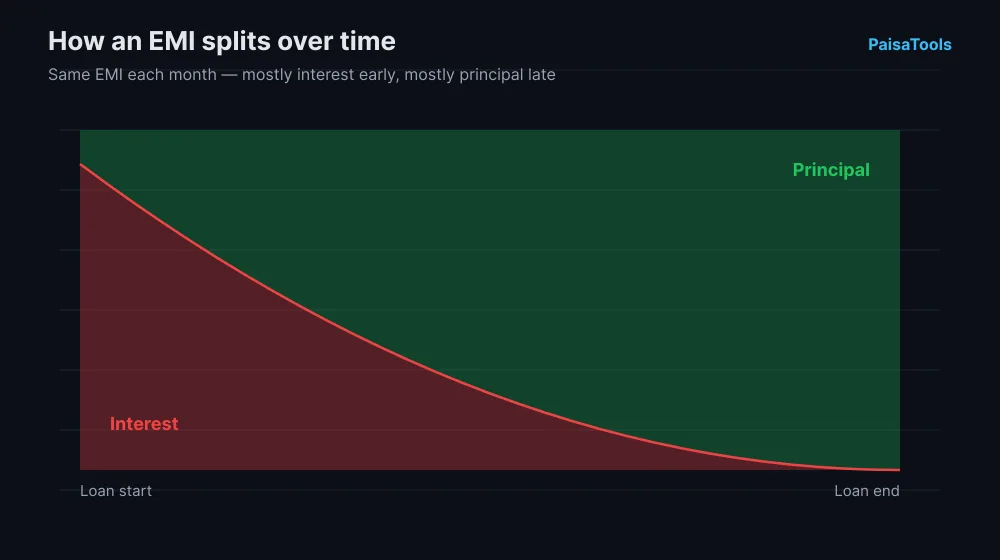
Banks use the reducing-balance method: interest each month is charged only on the outstanding balance. Early on, the balance is huge, so most of your EMI goes to interest and very little to principal. As the balance shrinks, the split flips — later EMIs are mostly principal.
Take a ₹30 lakh home loan at 9% for 20 years. The EMI is about ₹26,992. In the very first month:
- Interest = ₹30,00,000 × 9% ÷ 12 = ₹22,500
- Principal repaid = ₹26,992 − ₹22,500 = just ₹4,492
- So in month 1, 83% of your EMI is pure interest.
This is exactly why prepaying early saves the most: a rupee paid in year 1 knocks out far more future interest than the same rupee paid in year 15. See the full month-by-month split for your own loan:
EMI Calculator + amortization scheduleFrequently asked questions
- How is EMI calculated?
- EMI = P × r × (1+r)^n ÷ ((1+r)^n − 1), where P is the loan amount, r is the monthly interest rate, and n is the number of months. It's the fixed monthly payment that exactly clears the loan over its full tenure.
- Why are my early EMIs mostly interest?
- Interest is charged on the outstanding balance, which is highest at the start. So early EMIs are mostly interest and little principal; the split flips later. That's why prepaying early saves the most interest.
- Does a higher EMI reduce total interest?
- Yes. A higher EMI (or a shorter tenure) repays principal faster, so less interest accrues overall. Early prepayments work the same way — a rupee paid in year 1 saves far more than the same rupee in year 15.