
Most personal finance education fails for the same reason: it starts with definitions. You read what an index fund is, what an ELSS is, what an emergency fund is — and a week later none of it has changed anything you do, because nothing you read was attached to a decision you actually faced.
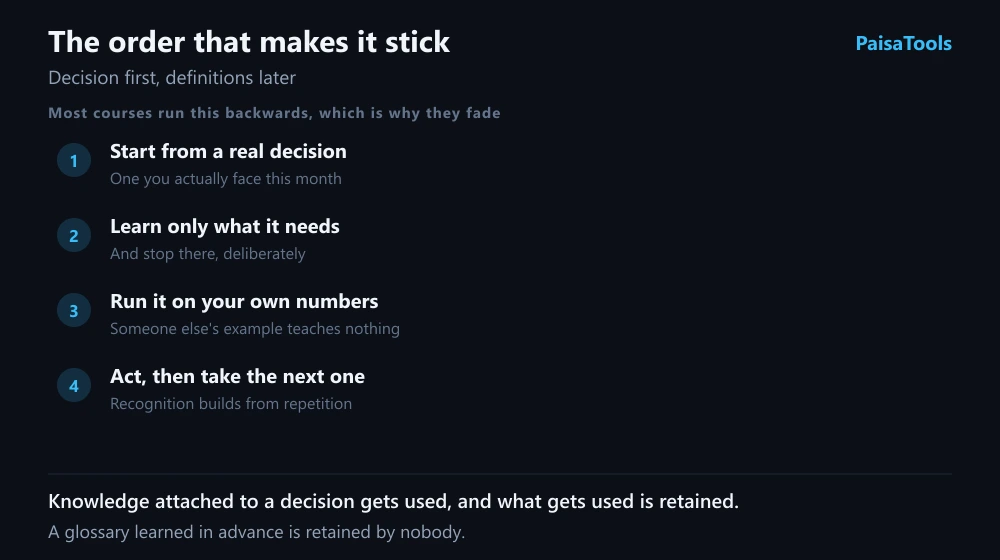
The reliable way to learn it is the reverse order. Start with a decision that is in front of you, learn only what that decision needs, and act. Then repeat.
1. Learn by decision, not by definition
Pick the money question you are genuinely facing this month. Should I prepay the loan or invest? Which tax regime fits me? Is this insurance policy worth keeping? Learn only what that question needs — and stop there.
This feels inefficient and is the opposite. Knowledge attached to a decision gets used, and knowledge that gets used is retained. A glossary learned in advance is retained by nobody.
2. Master the four numbers that matter
Almost every personal finance decision rests on four numbers about you: your real monthly surplus (income minus everything that actually leaves the account), your emergency buffer measured in months of expenses rather than rupees, the interest rate on your most expensive debt, and your effective tax rate — not your slab, but what you actually pay divided by what you actually earn. Know those four and most questions answer themselves, because almost every choice is a comparison against one of them. Prepay or invest is a comparison against the third. Which regime is a comparison against the fourth.
3. Use real tools on your real numbers
A worked example with somebody else’s salary teaches nothing. The same calculation with your own figures is the moment it becomes concrete — and it is usually the moment people discover the answer is not what they assumed.
Run the numbers before you need them, not after. The EMI you can afford, the tax under each regime, what the SIP actually becomes. Seeing the result changes the decision more reliably than reading about it.
4. Repeat until it is instinct
After six or seven decisions handled this way, something shifts: you start recognising the shape of a question before you work it out. That is the actual goal. Not knowing more terms — recognising faster.
What to ignore while you are learning
- Anything promising a return with no mention of risk. The omission is the information.
- Stock tips, which teach nothing transferable even when they happen to work.
- Complex products pitched before you have an emergency fund — the order matters more than the product.
- Comparisons of headline rates across different tax treatments, which is the single most common way people reach a confidently wrong answer.
None of this requires a course, and none of it requires a year. It requires one real decision, handled properly, and then the next one.
Start with the four numbers about youFrequently asked questions
- How long does it take to get competent?
- Competent enough to make your own decisions well, a few months of handling real ones. The learning tracks the number of decisions you have actually made, not the hours you have spent reading.
- Do I need to understand markets?
- Far less than people assume. Most of what determines an outcome is savings rate, debt cost, tax treatment and consistency — all of which are arithmetic rather than forecasting.
- Where do most beginners go wrong?
- Starting with products instead of their own numbers. The product question is almost always the last one, and it is far easier once the first four are known.
- Is a paid course worth it?
- Rarely at the start. Everything needed for the first several decisions is freely available, and a course taken before you have a decision to apply it to tends to be forgotten at the same rate as a glossary.