
You applied for an IPO, you did not get an allotment, and the money is still showing as blocked in your account. The first thing worth knowing is that it was never a refund in the first place — under ASBA the amount is placed under a lien in your own bank account and never leaves it. Nothing has to travel back to you. A lien simply has to be lifted.
The second thing is the one almost nobody is told: if lifting it runs late, the rules do not merely say sorry. They set a rate, per day, payable to you — and they name who has to pay it.
The date the clock starts from
The trigger is not the listing date and not the day you noticed. SEBI defines it as BOA+1 — the day after the basis of allotment is finalised. For a non-allotted or partly allotted application, every day after BOA+1 that your funds stay blocked is a day of delay, whether or not you have complained.
Anchor on BOA+1 rather than on a listing-day count. The listing calendar has been shortened over the years, but the compensation trigger in the circular has stayed tied to the basis of allotment.
The rate, and the half that usually gets dropped
The circular is SEBI/HO/CFD/DIL2/CIR/P/2021/2480/1/M, dated 16 March 2021, and the compensation table sits in its annexures. The amount is Rs.100 per day or 15% per annum of the application amount, whichever is higher.
That last clause is the part most write-ups leave out, and it is the part that matters to anyone applying at size. For a typical retail application the flat Rs.100 a day is the higher of the two by a wide margin. Past a certain application size the percentage overtakes it, and from there the flat figure understates what is owed.
The two are equal when 15% per annum of the application equals Rs.100 a day — that is an application of about Rs 2,43,333. Below roughly Rs 2.43 lakh the flat Rs.100 per day is the higher figure and the one to claim. Above it, 15% per annum of your application amount is higher, and a small-HNI bid of Rs 5 lakh accrues a little over Rs 205 a day rather than Rs 100.
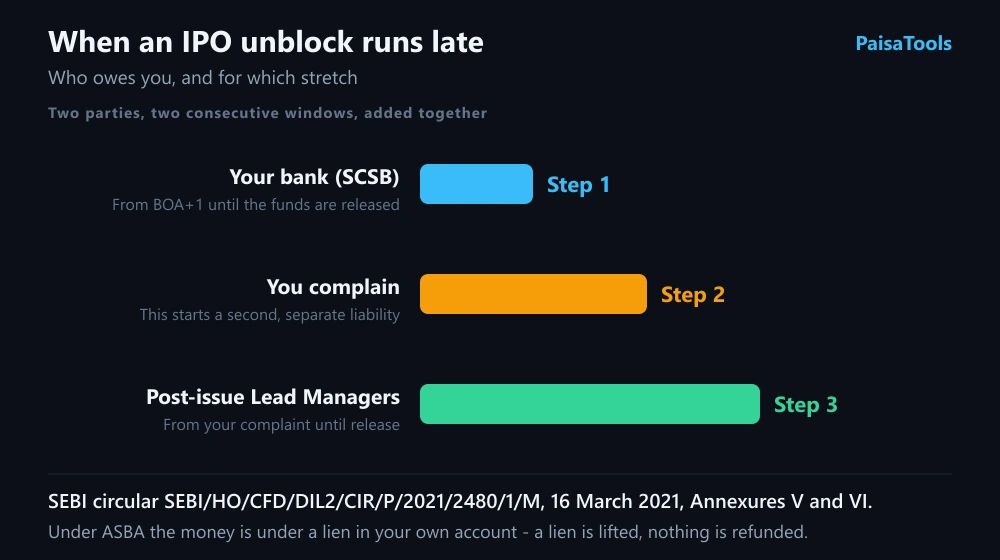
Two parties can owe you, for two different stretches
This is the structural point that gets missed. The compensation is split across two annexures, and they cover different windows, so a long delay produces two claims rather than one.
- Your bank — the SCSB — owes for the delayed unblock itself, running from BOA+1 until the funds are actually released.
- The post-issue Lead Managers owe separately for delay in redressing the grievance, running from the day your complaint reaches them or the registrar until the funds are actually released.
- SEBI's own worked example adds the two together: on a Rs 15,000 application with no allotment, the bank's window ran from the BOA+1 date to the day the investor complained, and the Lead Managers' window ran from the day after that complaint to the day of the actual unblock.
So the sum is not one rate over one period. It is the same rate over two consecutive periods, billed to two different parties, and complaining is what starts the second one.
The other three situations that carry the same rate
- Your bank blocked more than you applied for: the excess must be released instantly, and the same per-day rate applies to the difference until it is.
- The same application got blocked more than once: the duplicate blocks must be revoked instantly, with the same per-day rate on the cumulative extra amount.
- You cancelled, withdrew or deleted the bid and the block stayed: the clock runs from the day the request was placed on the exchange platform.
How to actually claim it
Start with the bank whose account holds the lien, in writing, quoting the application number and the UPI mandate reference. Say the words "compensation for delayed unblocking" and cite the circular by number — a generic complaint about a pending refund gets treated as a status query and closed.
If that goes nowhere, the complaint belongs on SEBI SCORES, against the bank and, where grievance redressal itself was slow, against the post-issue Lead Managers as well. Keep the bank statement showing the lien and the date it cleared; those two dates are the entire claim.
Track live IPOs and your allotment oddsFrequently asked questions
- Is IPO money actually refunded?
- No. Under ASBA it is blocked in your own bank account under a lien and never leaves it, so a non-allotment releases a lien rather than sending money back.
- Do I have to complain before compensation applies?
- Not for the bank's share — the circular runs that from BOA+1 regardless. Complaining is what starts the separate Lead Manager liability for delayed grievance redressal.
- Who pays if the delay drags on after I complain?
- Both can. The bank owes for the unblock delay and the post-issue Lead Managers owe for the redressal delay, over consecutive periods that are added together.
- Does this apply if I got a partial allotment?
- Yes. The annexure names non-allotted and partially-allotted applications together, so the unreleased balance on a partial allotment is covered.