
You need money and you have a fixed deposit. The branch will offer you both options in the same conversation, usually in the same breath, and they are presented as near-equivalent. They are not. One of them has a cost that is visible on the form and a second cost that is not.
What breaking it actually costs
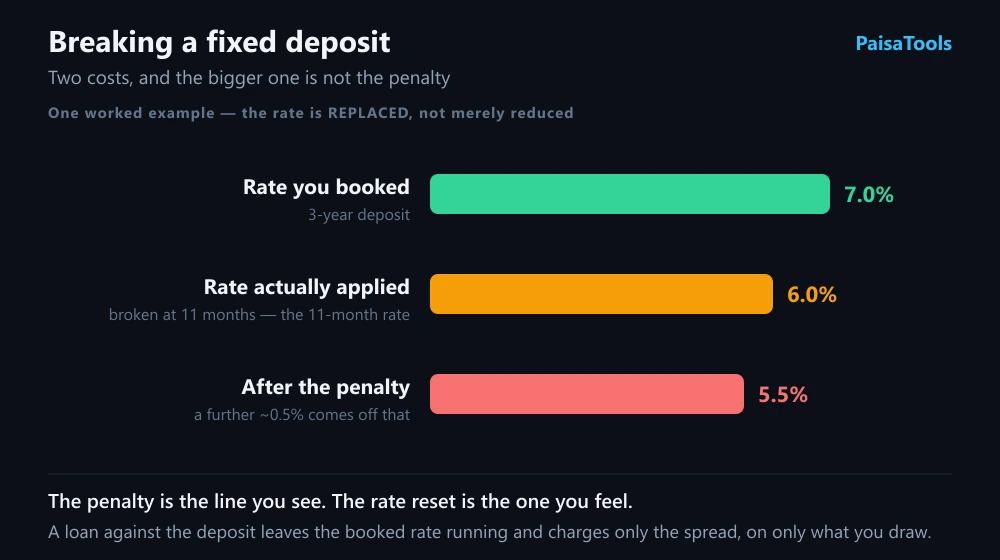
Premature withdrawal is widely understood as a penalty, and the penalty is the smaller half of it. There are two charges and the second is the one that does the damage.
- The penalty itself — typically a reduction of around half a per cent to one per cent, depending on the bank and the deposit.
- The rate reset, which is the real cost: interest is recalculated at the rate applicable to the period the deposit actually ran, not the rate you booked. A three-year deposit broken at eleven months earns roughly the eleven-month rate, and then the penalty comes off that.
That second mechanism is why the money returned is often far below what the maturity figure led you to expect. You do not lose the remaining interest; you lose part of the interest you thought you had already earned, because the rate it was earned at is retrospectively replaced.
What borrowing against it costs
An overdraft or loan against the deposit leaves it intact and running. The deposit keeps earning its booked rate for its full term, and you pay interest on what you draw — commonly a spread of one to two per cent above the deposit rate. The key structural difference is that the cost applies only to the amount drawn and only for the period it is drawn.
Which one wins
It turns on how much of the deposit you need and for how long, and the two cases point in opposite directions. If you need a fraction of the deposit, borrowing is almost always cheaper by a wide margin — breaking it resets the rate on the entire deposit to raise a part of it, which is the most expensive way to access a small sum. The spread, by contrast, is charged only on what you draw. If you need substantially all of it and will not repay quickly, the spread accrues on a large balance for a long period and the arithmetic turns: the one-time cost of breaking stops compounding, while the spread does not. The other variable is how far the deposit has left to run — a deposit near maturity has very little rate reset left to suffer, so breaking it late is cheap, whereas breaking one early forfeits the most. In short: small need or long remaining tenure favours the loan; near-total need on a deposit about to mature favours breaking it.
The point everyone misses about the spread
Because you keep earning the deposit rate while paying the loan rate, the real cost of borrowing is not the loan rate — it is the difference between them. A deposit earning seven per cent against a loan charged at eight and a half costs you one and a half per cent on the drawn amount, not eight and a half. People compare the loan rate against zero and conclude that breaking the deposit is free. It is the opposite way round.
Before you decide
- Ask the bank for the exact premature withdrawal figure in rupees, not the penalty percentage. The percentage hides the rate reset; the rupee figure does not.
- Ask what rate the loan or overdraft carries and subtract your deposit rate from it. That difference is your actual cost of borrowing.
- Work out how much you genuinely need now, rather than breaking the whole deposit for a part of it — this is the single most expensive habit in this decision.
- Check how long the deposit has left. Close to maturity, the case for borrowing weakens considerably.
- If the deposit is a tax-saving five-year FD, premature withdrawal is not permitted at all, and a loan against it is generally not available either — that money is locked by design.
Frequently asked questions
- How much can I borrow against a fixed deposit?
- Banks commonly lend a high proportion of the deposit value, often in the region of ninety per cent, because the deposit itself is the security. The exact figure varies by bank and deposit type.
- Does a loan against FD need a credit check?
- It is secured against your own deposit, so approval is typically far simpler than an unsecured loan and does not hinge on your credit score in the same way.
- Does my FD keep earning interest while the loan is outstanding?
- Yes. The deposit continues to run at its booked rate for its full term, which is the whole basis of why borrowing can be cheaper than breaking it.
- Can I break a tax-saving FD early?
- No. The five-year tax-saving fixed deposit carries a statutory lock-in and cannot be withdrawn prematurely, which is a different situation from an ordinary deposit.
- What happens if I do not repay the loan against my FD?
- The bank can recover the outstanding from the deposit itself when it matures, since that deposit is the security. You are not pursued as you would be on an unsecured loan, but the deposit is consumed.