
A long-running endowment policy is often the largest asset a household has outside the house itself, and it is the one people reach for when money is needed quickly. There are two ways to reach for it. They are not variations of the same thing — one keeps the policy alive and the other ends it — and the difference shows up years later, usually to somebody other than the person who made the decision.
First, whether you can borrow at all
A policy loan is only possible once the policy has acquired a surrender value, which generally requires premiums to have been paid for a minimum period. Two consequences follow, and both catch people out.
- A pure term plan has no surrender value at any point, so there is nothing to borrow against. This is the single most common disappointment — the policy with the largest cover is the one that cannot lend.
- A policy in its first year or two usually has not acquired a surrender value yet, so a recently bought plan is not a source of emergency money however large the premiums have been.
- Endowment, money-back and whole-life plans do build surrender value, and those are the ones a loan is available against.
What the two routes actually do
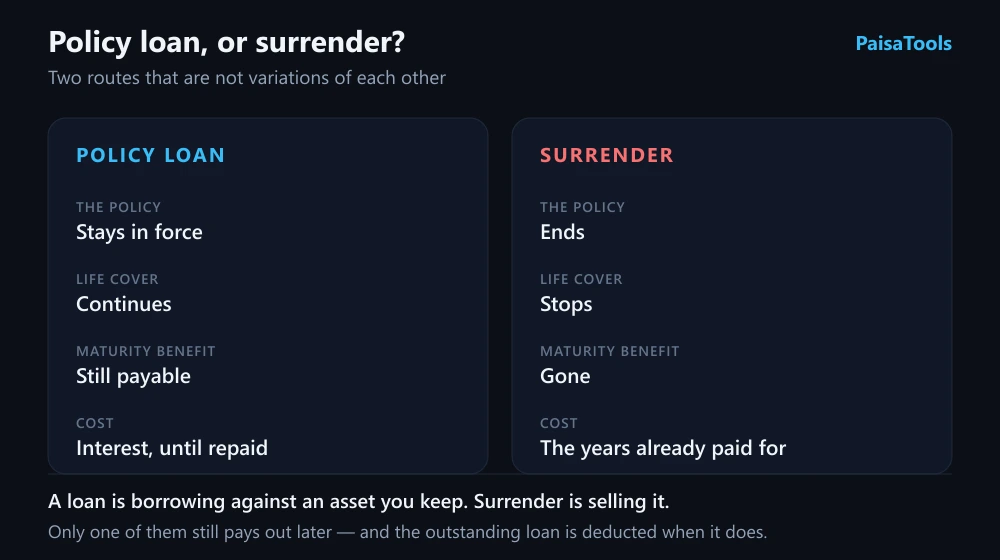
A loan keeps the policy in force: the cover continues, the maturity benefit continues, and the insurer simply holds a charge over the policy. The interest is charged periodically and — this is the part nobody budgets for — if it is not paid it is added to the outstanding, so it compounds. At claim or maturity the outstanding loan plus accumulated interest is deducted before anything is paid out, which means a loan taken quietly in a difficult year reduces what a family receives at the worst possible moment, often without their knowing it existed. Surrender is the opposite trade: you take the surrender value now and the policy ends, so the cover stops, the maturity benefit disappears, and the years of premiums already paid buy nothing further. The surrender value is also materially less than the premiums paid in the early and middle years, which is why surrender is usually the more expensive of the two unless the policy was a poor fit to begin with.
What the calculators leave out
The loan calculators that rank for this query ask for your policy details and return an eligible amount — commonly a high proportion of surrender value, at a rate in the region of nine to ten per cent. That figure is correct and it is not the question. Nobody searching this is uncertain whether they can borrow; they are uncertain whether they should. The number that decides it is not how much you can take out, it is what the taking out costs by the time the policy pays.
The failure case worth knowing about
If the loan plus accrued interest grows until it approaches the surrender value, the insurer can foreclose the policy and close it against the debt. That is the quiet ending: not a decision to surrender, but a policy that lapses into one because the interest was never serviced. Anyone taking a policy loan and intending to leave it outstanding indefinitely should know that this is where that path finishes.
How to decide, in order
- Establish whether the policy has a surrender value at all. A term plan does not, and no amount of asking will change that.
- Ask the insurer for the current surrender value and the loan eligibility as separate figures. They are not the same number and the gap matters.
- Decide honestly whether you can service the loan interest. If the answer is no, you are not choosing a loan, you are choosing a slow surrender.
- Weigh what the cover is worth to the people who depend on it. If the policy is the only life cover in the house, ending it to raise cash solves one problem by creating a larger one.
- If the policy was mis-sold and is a poor product regardless, surrender becomes a reasonable choice — but then it is an exit decision, not a borrowing decision, and should be judged as one.
The reason to be careful here is that both routes feel like using your own money, and only one of them is. A loan is borrowing from an asset you keep. Surrender is selling it. The paperwork makes them look like neighbouring options on the same form; the outcomes are decades apart.
Check what your policy is actually worth to youFrequently asked questions
- Does a policy loan affect my credit score?
- A loan against your own policy is secured by that policy and is not a credit assessment in the usual sense, so it does not depend on your score the way a personal loan does.
- Can I repay a policy loan early?
- Yes. Policy loans are generally repayable at any time, and because the cost is interest on the outstanding, repaying sooner costs less. There is no benefit to leaving it running.
- What happens to the loan if I die before repaying it?
- The outstanding loan and the interest accrued on it are deducted from the death claim before it is paid to the nominee. That is the mechanism families are most often unprepared for.
- Is the surrender value the same as the premiums I have paid?
- No, and the gap is usually large in the early and middle years. Surrender value is calculated under the policy's own terms and is typically well below total premiums paid until the policy is well advanced.
- Can I take a loan on a paid-up policy?
- A paid-up policy that has acquired surrender value can generally support a loan, though the proportion available is usually lower than for a fully in-force policy. Confirm the figure with the insurer rather than assuming.