
Most people have never chosen their salary account. It was opened by an employer, the card arrived, and that was the end of the thinking. It behaves like an ordinary savings account in every visible way, which is why the one way it does not behave like one goes unnoticed until it matters.
What makes a salary account different
A salary account is a savings account operating under a corporate arrangement between the bank and the employer. The benefits flow from that arrangement rather than from the account type itself, and typically include some combination of the following.
- No minimum balance requirement — the headline benefit, and the one people rely on without noticing they are relying on it.
- Waived or reduced charges on the debit card, cheque book and other services.
- In some arrangements, a group personal accident cover attached to the account while it is active.
- Occasionally an overdraft facility sized against the salary credited.
What happens when the salary stops
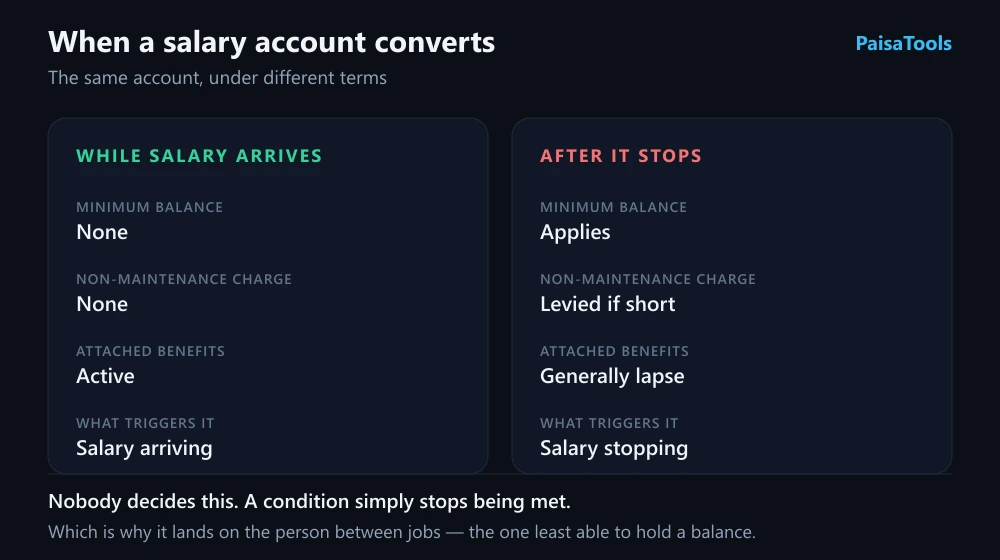
The zero-balance status is conditional on salary credits continuing, and when they stop for a sustained period — commonly around three consecutive months, though the exact trigger is the bank's — the account is converted to a regular savings account. At that point a minimum average balance requirement begins to apply, and falling short of it attracts non-maintenance charges, levied monthly or quarterly. The attached benefits generally lapse at the same time. The timing is what makes this sharp: the conversion is triggered precisely by income stopping, so the charge lands on someone between jobs, or newly self-employed, or recovering from an illness — the person least able to maintain a balance is the one the requirement switches on for, and it does so automatically, without anyone deciding to impose it.
The second account most people should have
Because the salary account belongs to an arrangement you do not control, it is worth having one account that does not. A separate savings account in your own name, opened on terms you chose, continues unchanged through a job move, a resignation or a redundancy. It is also where an emergency fund belongs — not in the account whose terms are tied to the employment you may be between.
What to do about it, concretely
- Find out your bank's conversion trigger and the minimum balance that would then apply. Both are in the account terms; neither is usually mentioned when the account is opened.
- Before leaving a job, decide whether to keep the account. Many banks let you convert it yourself to a chosen savings product rather than being defaulted into one.
- Move standing instructions, SIPs and auto-debits off the salary account before income stops, so a non-maintenance charge does not combine with a failed mandate.
- If the account carried an accident cover, confirm whether it survives the conversion. It frequently does not, and that is a gap to close deliberately rather than discover.
- Keep the old account open only if it earns its keep. Dormant accounts with balance requirements quietly cost money for years.
None of this is hidden exactly — it is in terms everyone accepts and nobody reads. But it is the kind of condition that is invisible while it is being met and expensive the moment it is not, and the moment it is not is rarely a convenient one.
See where your money is actually sittingFrequently asked questions
- Can I keep my salary account after leaving a job?
- Usually yes, but not on the same terms. It generally continues as a regular savings account with that product's balance requirement, unless you ask the bank to convert it to something you have chosen.
- How long before a salary account converts?
- It varies by bank, with a sustained gap in salary credits of around three months being a common trigger. The precise rule is in your account terms rather than a universal standard.
- Do I get told before the charges start?
- Banks are expected to communicate changes, but the notice often arrives as a routine message that is easy to miss. The charge itself is frequently what alerts people.
- Is it worth having two savings accounts?
- One account on terms you control is useful precisely because the salary account's terms depend on an employment arrangement. It matters most during exactly the period you would rather not be managing bank charges.
- What if my new employer uses the same bank?
- The account can often be re-designated as a salary account under the new employer's arrangement, which restores the zero-balance status. It is worth asking rather than opening another account.