
Since the new tax regime became the default, the question every salaried Indian asks in March is the same: should I stay in the new regime, or opt back into the old one? The honest answer is that it depends on one thing — how many deductions you actually claim. Here's the math, in plain language.
The new regime (FY 2025-26)
The new regime has wide, gentle slabs and a flat ₹75,000 standard deduction, but almost no other exemptions. The slabs are:
- Up to ₹4 lakh — nil
- ₹4–8 lakh — 5%
- ₹8–12 lakh — 10%
- ₹12–16 lakh — 15%
- ₹16–20 lakh — 20%
- ₹20–24 lakh — 25%
- Above ₹24 lakh — 30%
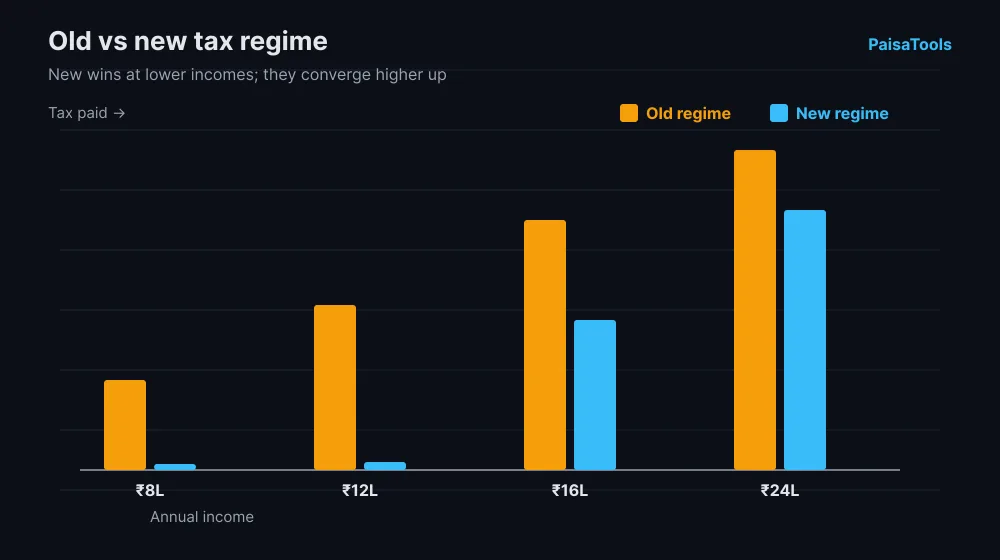
The headline feature is the Section 87A (section 156 of the new Income-tax Act, 2025) rebate: if your taxable income is ₹12 lakh or less, your tax is effectively zero. Add the ₹75,000 standard deduction and a salary up to ₹12.75 lakh pays no income tax at all.
The old regime
The old regime has higher rates (5% / 20% / 30%) and a lower exemption limit, but it lets you subtract a long list of deductions first: Section 80C (section 123 of the new Income-tax Act, 2025) (up to ₹1.5 lakh for PPF, ELSS, EPF, life insurance, home-loan principal), 80D (section 126 of the new Income-tax Act, 2025) for health insurance, HRA exemption, home-loan interest under 24(b) (section 22 of the new Income-tax Act, 2025), NPS under 80CCD(1B) (section 124 of the new Income-tax Act, 2025), and more.
So which one wins?
The rule of thumb: the new regime wins unless your total deductions are large. If you mostly take the standard deduction and a bit of 80C, the new regime almost always pays less now — the ₹12 lakh rebate is hard to beat. The old regime starts to win only when your combined deductions (80C + 80D + HRA + home-loan interest + NPS) climb past roughly ₹4–4.5 lakh, which usually means you're paying significant rent or a home loan.
Don't guess — the break-even shifts with your exact salary and rent. Run your real numbers in both directions:
Income Tax Calculator — Old vs New, side by sideHRA Exemption CalculatorA practical tip: you can switch regimes each year if you're salaried (business income is more restricted). So re-check every March — a new home loan or a baby's school fees can flip the answer.
Frequently asked questions
- Is the new tax regime better than the old one?
- For most salaried people with few deductions, yes — the new regime's lower rates plus the Section 87A rebate make tax nil up to ₹12 lakh taxable income. The old regime wins only when your total deductions (HRA + 80C + home-loan interest + NPS) cross roughly ₹4–4.5 lakh.
- What income is tax-free under the new regime in FY 2025-26?
- Up to ₹12 lakh taxable income pays zero tax thanks to the Section 87A rebate. Adding the ₹75,000 standard deduction, a salary up to ₹12.75 lakh pays no income tax at all.
- Can I switch between the old and new tax regime every year?
- Yes, if you're salaried you can choose afresh each financial year. Those with business income face more restrictions. Re-check every March, since a new home loan or rent can flip which regime is cheaper.