
Every advertisement quotes ex-showroom. Nobody drives away at ex-showroom. The difference is routinely a sixth of the price of the car, and it arrives as a list of line items most buyers see for the first time on the day they are paying.
The useful thing is not the total. It is knowing which of those lines is set by the government, which is set by the insurer, and which the showroom has added on its own — because only the last kind is a conversation.
What ex-showroom already includes
Ex-showroom is the manufacturer's price with GST and cess already in it. It is the same for that variant across the city. What it does not include is the cost of putting the car on a public road in your name, and that is everything below.
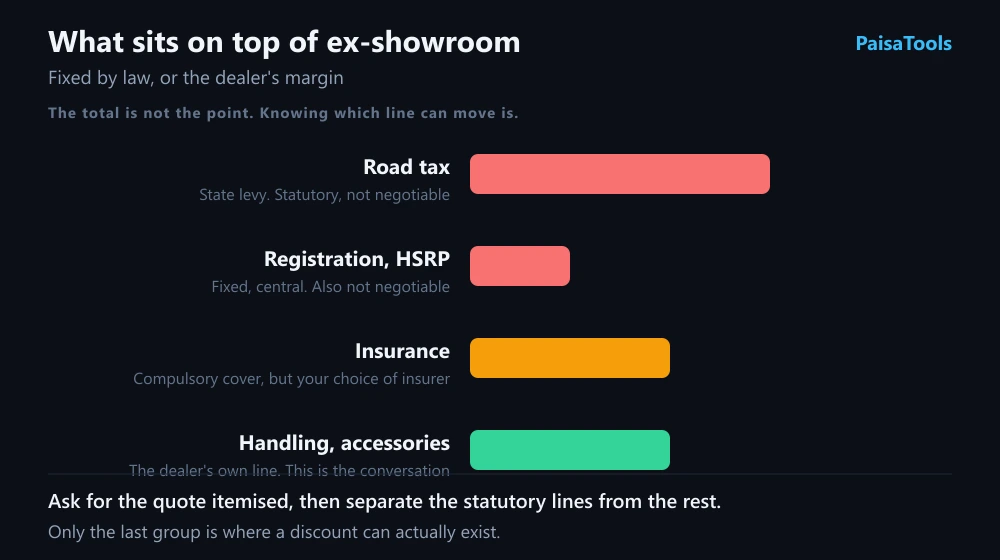
Road tax: the line that makes the same car cost differently in two states
Road tax is charged by the STATE, as a percentage of the ex-showroom price, and the slab depends on the state, the price band, and often the fuel type. It is the largest single addition and the reason a friend in another state quotes you a number that does not match yours.
Road tax on a new car runs from roughly 4% to 15% of ex-showroom depending on the state and slab, with some states and price bands going higher still. It is statutory: the showroom neither sets it nor keeps it, so there is nothing to negotiate on this line — the only way it changes is registering in a different state, which brings its own rules about residence and re-registration.
The small fixed lines
- Registration fee — a central, fixed charge, a few hundred rupees. Not the same thing as road tax, though the bill often merges them under RTO.
- High Security Registration Plate — a fixed, mandated cost for the plate itself.
- FASTag — mandatory for a new vehicle, and a small fixed amount.
- Hypothecation — only if you are financing. It records the lender on the RC, and it is removed later when you close the loan.
Insurance, where the quote is genuinely yours to make
Third-party cover is compulsory and its rate is regulated. Everything beyond it — own-damage cover, zero-depreciation, engine protection, roadside assistance — is a policy you are buying, and you are not obliged to buy it through the showroom. A dealer-arranged policy is a convenience with a commission in it.
And the lines that are the dealer's own
Handling, logistics, and similar charges are not government levies. Consumer forums have repeatedly treated them as an unfair trade practice, and buyers have had them refunded — which is not the same as saying they are outlawed everywhere, but it does mean the line is arguable in a way road tax never is.
The same applies to accessory packages, extended warranty and fitments added to the quote. Ask for the on-road price WITHOUT them first, then add back only what you actually want.
How to read the quote in one minute
- Ask for the breakup in writing: ex-showroom, road tax, registration, insurance, and everything else itemised.
- Statutory lines — road tax, registration, HSRP — are fixed. Move on.
- Insurance is a quote you can get elsewhere and compare on the same cover, not just the premium.
- Anything left over is the dealer's margin. That is where a discount actually exists.
Frequently asked questions
- Why is the on-road price different in another state?
- Because road tax is set by the state, as a percentage of ex-showroom, on its own slabs. It is the largest variable addition, so the same car legitimately costs different amounts across state lines.
- Can I refuse handling charges?
- You can question them. They are the dealer's own line rather than a government levy, and consumer forums have ordered refunds of them in individual cases. Ask for the charge to be identified and justified in writing.
- Do I have to buy insurance from the showroom?
- No. Third-party cover is compulsory, but you may buy the policy anywhere. Compare on identical cover and add-ons rather than on the premium alone.
- Is registration fee the same as road tax?
- No. Registration is a small fixed central fee; road tax is a state levy running into a percentage of the car's price. Bills often group them together, which is why they get confused.