
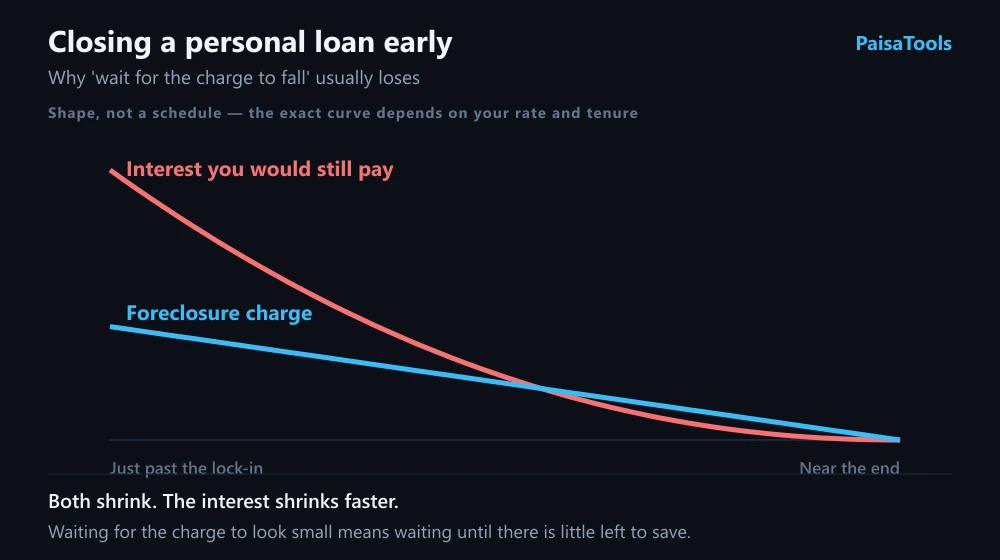
A bonus arrives, or a maturity, and the thought follows immediately: close the personal loan. Then someone mentions the foreclosure charge, and the plan becomes to wait — wait until the outstanding is lower, so the charge is smaller. It sounds careful. It is usually the more expensive choice, and the reason is in how the two numbers move.
The charge, and what it is levied on
A foreclosure charge on a personal loan is a percentage of the outstanding principal, commonly in the low single digits, with GST on top. Two conditions usually attach.
- A lock-in: many lenders do not permit foreclosure until a minimum number of EMIs have been paid, frequently somewhere between six and twelve.
- The charge is calculated on what is outstanding at the moment of closure, not on the original loan — so it does fall as the loan runs down, which is the fact that misleads people.
There is a separate point worth knowing: the RBI has barred foreclosure and prepayment charges on floating-rate loans taken by individuals for non-business purposes. Most personal loans are fixed rate, which is why the charge still applies here — but it is worth confirming which your loan is, because the answer occasionally saves the entire charge.
Why waiting usually loses
Both numbers shrink as the loan runs down — but they do not shrink at the same speed, and that is the whole decision. An EMI is level, yet its composition is not: in the early years most of it is interest and little is principal, which reverses as the loan matures. So the interest you would avoid by closing early falls away far faster than the foreclosure charge does. By the time the charge has become comfortably small, most of the interest it was weighed against has already been paid, and closing saves little. The net benefit — interest avoided minus the charge — is therefore at its largest shortly after the lock-in ends, and declines from there. Waiting for the charge to look reasonable means waiting until there is almost nothing left to save, which is precisely the opposite of what the instinct suggests.
What to ask the lender
- The exact foreclosure amount today, in rupees, including GST — not the percentage.
- The total interest you would still pay if you ran the loan to the end. Most lenders will produce this from the amortisation schedule on request.
- Whether the lock-in has passed, and if not, the earliest date you may foreclose.
- Whether your loan is fixed or floating rate, because a floating-rate personal loan to an individual for non-business purposes should not carry the charge at all.
- Whether part-prepayment is allowed and on what terms — sometimes a part-payment that shortens the tenure achieves most of the benefit at a fraction of the charge.
The comparison that settles it
Put the two figures side by side: the foreclosure amount today, and the total interest remaining. If the interest remaining is comfortably the larger, closing is worth doing and worth doing now. If they are close, the loan is far enough along that the decision barely matters either way — and that, rather than any charge, is the real reason to stop waiting for a better moment.
Work out what the loan still costs youFrequently asked questions
- Is there any benefit to foreclosing right at the end of a loan?
- Very little. By the final stretch most of the interest has already been paid, so closing early saves only the small remainder while still attracting the charge on what is left.
- Does foreclosing a loan hurt my credit score?
- Closing a loan in full is recorded as the account being settled as agreed, which is not a negative event. Some scoring models briefly reflect the change in your credit mix, but the account closing cleanly is a sound outcome.
- Can the lender refuse to let me foreclose?
- Within the lock-in period, yes. After it, foreclosure is generally a contractual right, though it must be done through the lender's stated process rather than by simply stopping payments.
- Is part-prepayment better than foreclosure?
- It depends on how much you have. A part-prepayment that reduces the principal can capture a large share of the interest saving, and some lenders charge less for it than for full closure.
- Should I get a no-dues certificate?
- Yes, and keep it. The closure should also be reflected in your credit report within a reasonable period, and the certificate is what resolves it if that does not happen.