
Almost every first-time buyer in India budgets the same way: price of the flat, minus the loan, equals the down payment to arrange. Then, days before registration, a second number appears — lakhs of rupees, payable in cash, and not a rupee of it inside the home loan.
That number is stamp duty and registration. It is the most predictable large cost in the whole purchase and the most reliably forgotten one.
Why your loan will not cover it
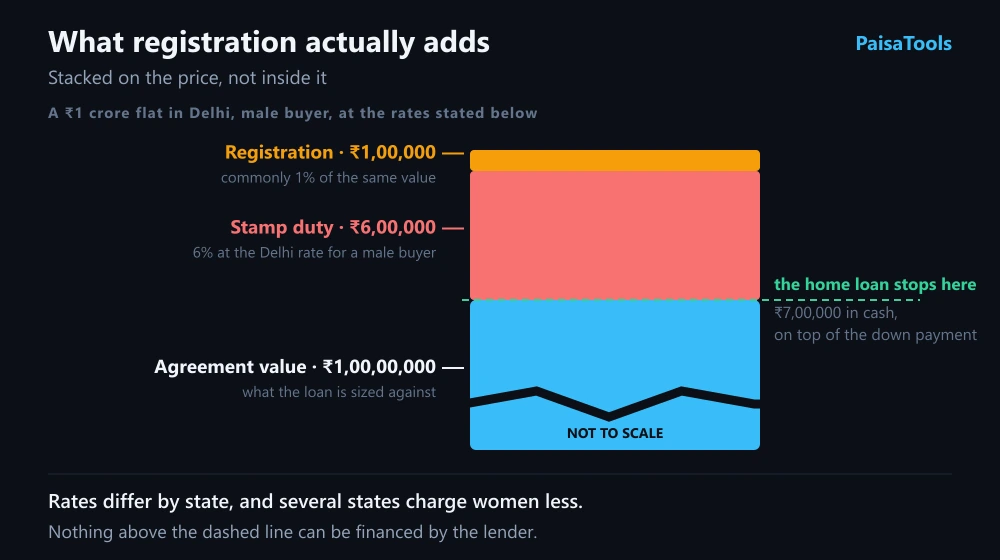
This is not a lender being difficult. The Reserve Bank directs banks to exclude stamp duty and registration charges from the loan-to-value calculation, with a narrow carve-out for properties costing up to ₹10 lakh, where they may be included. For everything above that, the charge sits outside the sanctioned amount by rule — so a larger loan does not solve it, and no amount of negotiating with the branch will.
What the duty is actually charged on
Stamp duty is not charged on what you paid. It is charged on the agreement value or the government's circle rate for that locality, whichever is HIGHER — so buying below circle rate does not reduce the duty, it only means you are taxed on a value you never paid. Registration is charged separately, commonly at 1% of the same value. The practical consequence is that your duty can be worked out before you negotiate, because it keys off a published rate, not off your bargaining.
The rate depends on the state, and on who is buying
There is no national rate. Each state sets its own, and several charge women less — a concession that is usually one to two percentage points and is widely under-used because buyers do not know to ask before deciding whose name the deed goes in.
- Delhi: 6% for a male buyer, 4% for a female buyer, 5% for joint male-female ownership.
- Uttar Pradesh: 7% for male, 6% for sole female ownership, 6.5% for joint, with a further rebate of up to 1% on properties valued up to ₹1 crore.
- Registration is typically a flat 1% across buyer categories, though some states cap it in absolute rupees.
- Check your own state's current schedule before you commit — these are revised, and a figure from a year-old article is a guess.
The ownership decision is worth making deliberately rather than by default. On a ₹1 crore property in Delhi, the gap between a male-only and a female-only deed is two percentage points — ₹2 lakh, for a choice that costs nothing to make correctly at the start and cannot be undone afterwards without a fresh transfer and fresh duty.
What else lands at the same time
- Legal and documentation charges, if you use a lawyer to verify title — which on a resale you should.
- The lender's processing fee and valuation charges, which are separate from the duty and also usually paid upfront.
- Society transfer charges and dues clearance on a resale flat.
- GST, where the property is under construction — but not on a completed property with an occupancy certificate.
Frequently asked questions
- Can I add stamp duty to my home loan?
- Generally no. Banks are directed to keep it outside the loan-to-value calculation, with a limited exception for low-value properties, so it has to be arranged as cash alongside the down payment.
- The circle rate is higher than what I paid. Which applies?
- The higher of the two is used. Paying below circle rate does not lower the duty, and the difference can also have income-tax consequences for both sides of the transaction.
- Is the women's rate worth registering in my wife's name for?
- On a large property the saving is substantial, but ownership is a legal and financial decision with consequences well beyond the duty, including on funding, succession and any future sale. Decide it on those grounds, with the duty as one input.
- Do I get any tax benefit for paying it?
- Stamp duty and registration charges are among the payments eligible under the older deduction regime for the year in which they are actually paid, subject to the overall limit and to conditions. Whether it helps depends on which regime you are in and what else you have already claimed.
- Is it refundable if the deal falls through?
- Partially, in some states and within a time limit, usually with a deduction. The process is slow and the rules are state-specific, so treat it as money committed once paid.