
The same five and a half years, the same degree and the same licence to practise can cost a family almost nothing or well over a crore. No other course in India has a price gap this wide, and very little of it is decided by the family's preferences. It is decided by the NEET rank, and then by how far down the list of options a family is willing to go.
Government medical colleges
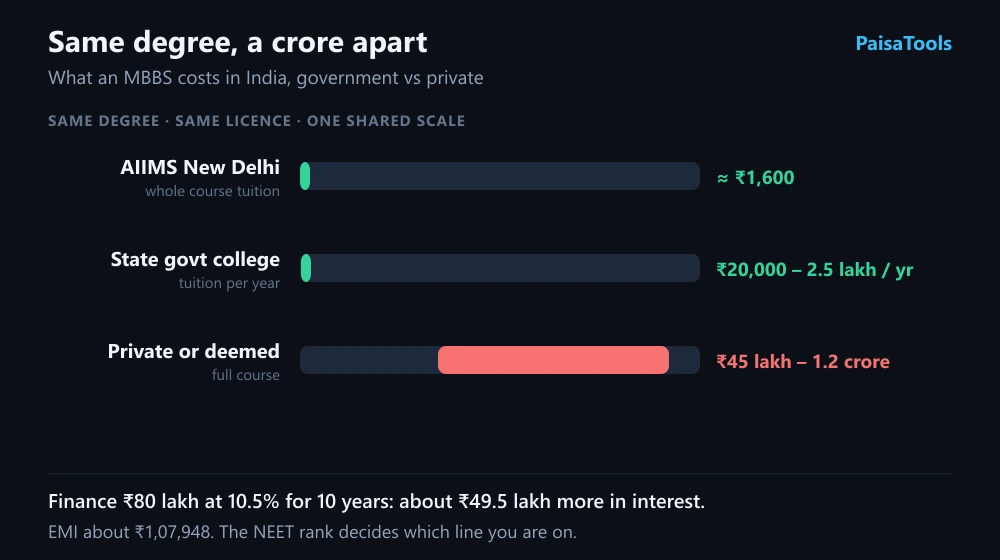
At the top, the fees are almost symbolic. The total tuition at AIIMS New Delhi for the whole course is in the region of ₹1,600, and some Delhi University colleges charge a few thousand rupees a year. Across state government colleges, annual tuition commonly ranges from around ₹20,000 to about ₹2.5 lakh depending on the state. Government hostels are cheap, roughly ₹5,000 to ₹25,000 a year, with mess charges of a few thousand rupees a month.
The cost that is easy to miss is the service bond. Several states require graduates of government colleges to work in public hospitals for a set period, with a substantial penalty for leaving it. The terms vary widely by state and they are part of the price of the seat.
Private colleges and deemed universities
Seats in private colleges filled through the state quota are regulated by fee committees and commonly cost several lakh rupees a year. Management and NRI quota seats, and deemed universities, are where the numbers climb: annual fees of ₹15 lakh to ₹26 lakh are common at the upper end, and the full course at an average private college commonly totals ₹45 lakh to ₹1.2 crore, with some seats above ₹1.5 crore.
- Annual fee increases of 5% to 10% are written into some colleges' fee structures.
- Hostel, mess, examination, library and caution deposit charges are billed on top of tuition.
- Some colleges ask for fees for later years in advance or against bank guarantees.
Costs outside the fee receipt
- NEET coaching, commonly ₹1 lakh to ₹3 lakh a year, and a drop year adds both coaching and a year of living costs.
- Books, instruments and devices across the course.
- Five and a half years of living costs, including the one-year internship.
- Postgraduate entrance preparation, which most MBBS graduates undertake, since specialisation drives earnings in medicine.
What a loan on a private seat looks like
Take an ₹80 lakh loan at an illustrative 10.5% a year, repaid over ten years. The EMI is about ₹1,07,948 and the interest totals about ₹49.5 lakh, so the family repays close to ₹1.3 crore. MBBS graduates rarely earn enough to carry that EMI straight after internship, especially while preparing for postgraduate entrance, which is why these loans so often become the parents' EMI.
MBBS abroad: cheaper, with a catch
Medical degrees from Russia, Central Asia, Georgia and similar destinations are marketed at a fraction of Indian private-seat fees. To practise in India, graduates must clear the National Medical Commission's screening examination, the FMGE, which the NMC intends to replace with the NExT exam. Historically, only a minority of candidates have cleared the screening test in a given attempt. The course also has to meet NMC rules on duration, internship and language to count at all.
The honest summary
A government seat costs a few thousand to a few lakh rupees in fees, plus a bond to read carefully. A private or deemed seat costs ₹45 lakh to well over a crore, and much more if financed. Before accepting any seat, write down the total for all five and a half years, including hostel, annual increases and deposits, and compare it with what another year of preparation for a better rank would cost.
Check whether your family can afford an MBBS seatFrequently asked questions
- What is the total cost of MBBS in India?
- At government colleges, tuition ranges from almost nothing at AIIMS to about ₹2.5 lakh a year at some state colleges, plus modest hostel costs. At private colleges and deemed universities, the full course commonly costs ₹45 lakh to ₹1.2 crore, and some seats exceed ₹1.5 crore.
- What is the MBBS fee at AIIMS?
- The total tuition at AIIMS New Delhi for the whole MBBS course is in the region of ₹1,600, among the lowest fees for any professional course in India.
- What is a medical bond in government colleges?
- Several states require graduates of government medical colleges to serve in public hospitals for a fixed period after the course, with a financial penalty for not completing it. The duration and penalty vary by state.
- Is MBBS abroad cheaper than a private college in India?
- The fees are usually lower, but graduates must clear India's screening examination to practise here, which only a minority have historically passed in a given attempt, and the course must meet NMC rules on duration, internship and language.