
Two loans of ₹1 lakh at 10% for 10 years can end up costing very different amounts — purely because of how the interest is calculated. The two methods, simple and compound interest, sound alike but diverge massively over time. Knowing which one applies to your loan or investment is one of the most useful bits of money math you can learn.
Simple interest: charged only on the principal
Simple interest is calculated only on your original amount (the principal), every year, using P × R × T ÷ 100. So ₹1 lakh at 10% for 3 years earns ₹10,000 each year — ₹30,000 in total. The interest never grows, because each year's interest is based on the same starting figure. You'll see simple (or 'flat') interest on some short-term and car loans, and certain fixed deposits.
Compound interest: interest that earns its own interest
Compound interest adds each period's interest back to the principal, so the next period earns on a bigger base. That same ₹1 lakh at 10% compounded yearly becomes about ₹1,33,100 in 3 years — ₹33,100 of interest, not ₹30,000. The gap looks small here, but it's the engine behind SIPs, PPF and long-term FDs.
The gap over time is huge
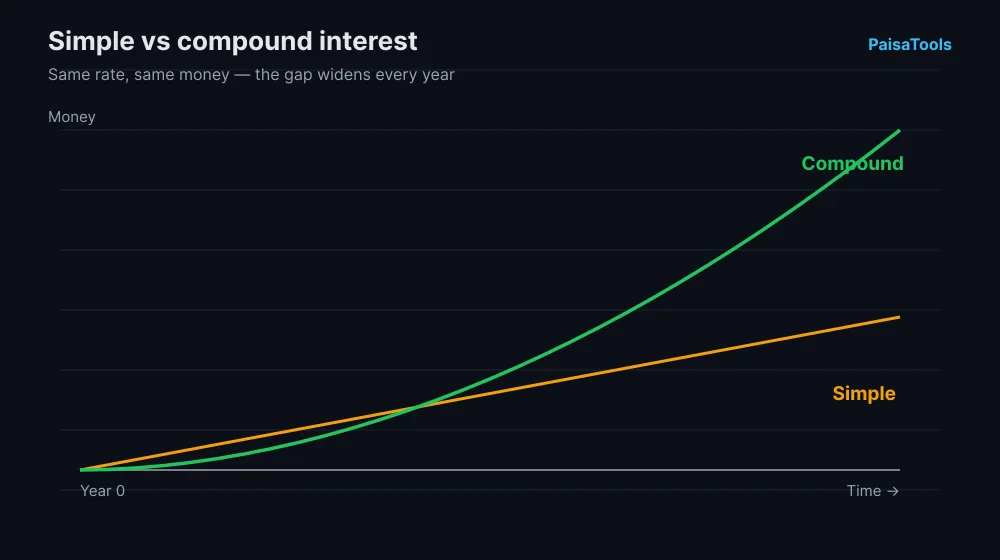
Take ₹1 lakh at 10% for 20 years. Simple interest gives ₹3 lakh in total (₹2 lakh of interest). Compound interest gives about ₹6.7 lakh — more than double. The longer the period, the wider the gap, because compounding accelerates while simple interest stays flat. That's why starting early matters so much for investments — and why high-interest compounding debt like credit cards is so dangerous.
Compound Interest Calculator — see the differenceSwitch between simple and compound for your own numbers and watch the totals change — it's the clearest way to feel the effect.
Frequently asked questions
- Which is better, simple or compound interest?
- For an investment, compound is far better — your money grows faster because interest earns interest. For a loan, simple interest is cheaper for you, since the interest doesn't snowball. So you want compound on what you save and simple on what you owe.
- Is FD interest simple or compound?
- Most bank fixed deposits compound quarterly, so your interest earns interest through the term. Some very short-tenure deposits use simple interest. The compounding frequency is shown in your FD details.
- Do loans use simple or compound interest?
- It varies — many home and personal loans effectively compound through EMIs (interest on the reducing balance), while some car or short-term loans quote a flat/simple rate. Always check, since a flat rate can look cheaper than it really is.