
Small-savings rates are reset every quarter, and the reset for October to December 2026 was announced at the end of September. Nothing changed. That is now a long run of nothing changing, and the more interesting question is not what the rates are but which of these schemes the freeze is actually costing you something.
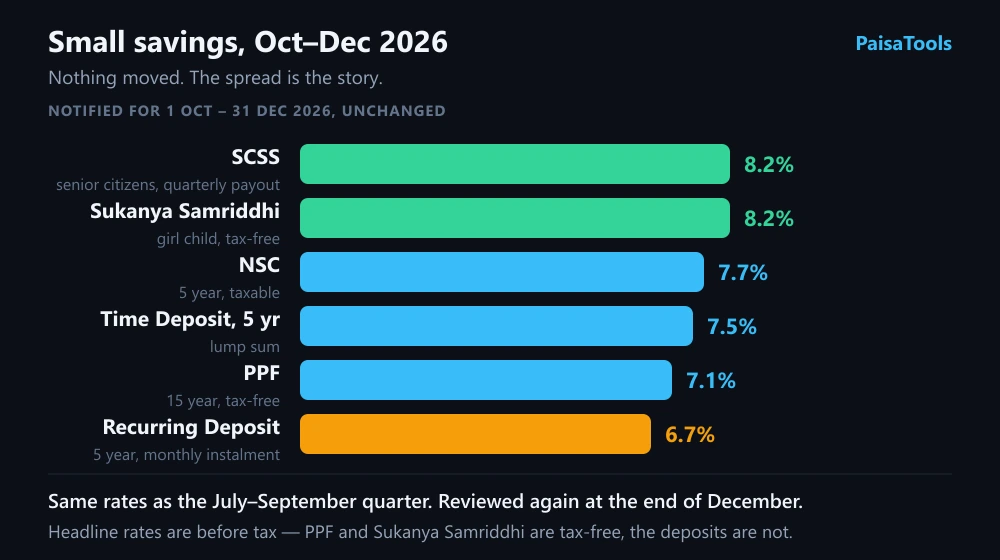
The table for this quarter
- Senior Citizens Savings Scheme — 8.2%
- Sukanya Samriddhi Yojana — 8.2%
- National Savings Certificate — 7.7%
- Kisan Vikas Patra — 7.5%, maturing in 115 months
- Post Office Time Deposit, 5 year — 7.5%
- Monthly Income Scheme — 7.4%
- Public Provident Fund — 7.1%
- Post Office Time Deposit, 3 year — 7.1%
- Recurring Deposit, 5 year — 6.7%
- Post Office Savings Account — 4%
These rates run from 1 October to 31 December 2026 and are the same ones that applied in the previous quarter. For the certificate-style schemes, the rate at the time you invest is the rate you keep for the full term, which is why the quarter you buy in matters more than it looks.
Why they stopped moving
Small-savings rates are meant to track government bond yields, reviewed quarterly against the five-year government security. In practice the review is a decision, not a formula — the government can and does hold rates where they are even when the benchmark has drifted, because these schemes are held by a politically sensitive group of savers and cutting them is unpopular.
The practical consequence for you is the opposite of the one people assume. A freeze is not neutral. It means the rate you are earning is no longer being reset toward anything, and whether that is good or bad depends entirely on which way bond yields have gone since the freeze began. It also means the gaps between these schemes are frozen too — and those gaps are large.
The one that the freeze penalises
Look at the bottom of the table. Among the schemes anyone saving monthly would consider, the five-year recurring deposit sits lowest of the deposit schemes at 6.7%, and it has been there a long time.
Here is the comparison worth sitting with: the five-year Post Office Time Deposit pays 7.5% while the five-year Recurring Deposit pays 6.7% — same institution, same five-year lock, eight-tenths of a point apart. They are not interchangeable, because the RD takes a monthly instalment and the TD takes a lump sum, so the right read is this: if you already have the money, the RD is the wrong product for it. The RD is for income you have not received yet, and you are paying most of a percentage point for the privilege of depositing it as it arrives.
That is a real decision rather than a trivia point. Plenty of people put a lump sum into an RD by standing instruction because the word "recurring" sounded disciplined, when a time deposit would have paid more for the same money over the same period.
What to actually do with this
- If you are saving out of monthly income, the RD is the right shape — but check the scheme's own rules, because the fee for a missed instalment and the rebate for paying ahead both change the real return.
- If you are placing money you already have for five years, compare against the time deposit before defaulting to the RD.
- For long-horizon, tax-free compounding, PPF's 7.1% is not the headline rate to compare — it is tax-free, which puts it well ahead of a taxable 7.5% for anyone in a higher slab.
- If you are over 60, SCSS at 8.2% is the highest rate on this list and is worth checking before any bank deposit.
- Interest on the post office deposit schemes is taxable at your slab. The headline rates above are before tax, so compare them against tax-free options on an after-tax basis, not directly.
Frequently asked questions
- What is the Post Office RD interest rate for October to December 2026?
- 6.7% a year, compounded quarterly, unchanged from the previous quarter. It is the lowest of the post office deposit schemes in this quarter's table, and it has stood at this level for a long stretch of consecutive quarters.
- Did any small savings rate change for this quarter?
- No. Every scheme carries the same rate it did in the July to September quarter — PPF at 7.1%, NSC at 7.7%, SCSS and Sukanya Samriddhi at 8.2%, KVP at 7.5%, the five-year time deposit at 7.5% and the five-year RD at 6.7%. The announcement came at the end of September 2026 and applies from 1 October.
- Why is the five-year time deposit paying more than the five-year RD?
- Because they take money in differently. A time deposit takes a lump sum that is invested for the whole term, while a recurring deposit takes an instalment a month, so the average money at work is far smaller for the same final contribution. The gap is still worth knowing about: if you already hold the money, the time deposit is the better-matched product for the same five-year commitment.
- When will small savings rates be reviewed next?
- At the end of December 2026, for the quarter beginning 1 January 2027. The review happens every quarter, and the rate you get on a certificate-style scheme is fixed at whatever applied when you invested, for the whole term.
- Is PPF at 7.1% worse than NSC at 7.7%?
- Not for most people, because the two are taxed differently. PPF interest is tax-free, while NSC interest is taxable at your slab as it accrues. Once you adjust for tax, PPF's lower headline rate is usually ahead for anyone in a meaningful tax bracket — which is why comparing these rates against each other directly is misleading.