
Ask a losing trader why they blew up and the answer is almost always the same: they didn't cut their losses. A stop-loss and a take-profit are the two simple orders that fix this — they decide, in advance and without emotion, when you get out. Master them and you've solved most of what sinks beginners.
What is a stop-loss?
A stop-loss is an order that automatically closes your trade if the price moves against you by a set amount. You buy at 100 and set a stop at 95 — if price hits 95, you're out, loss capped at 5. It removes the worst decision in trading: the 'let me just wait, it'll come back' that turns a small loss into a portfolio-ending one. The stop-loss is your seatbelt. You hope you never touch it, but you never drive without it.
What is a take-profit?
A take-profit (or target) does the opposite: it automatically closes your trade in profit when price reaches a level you chose. You buy at 100, set a target at 110 — price hits 110, the trade closes, gain locked. It protects you from your own greed: the winner you'd otherwise hold 'just a bit longer' until it reverses and the profit evaporates. Together, stop-loss and take-profit define your trade before emotion can hijack it.
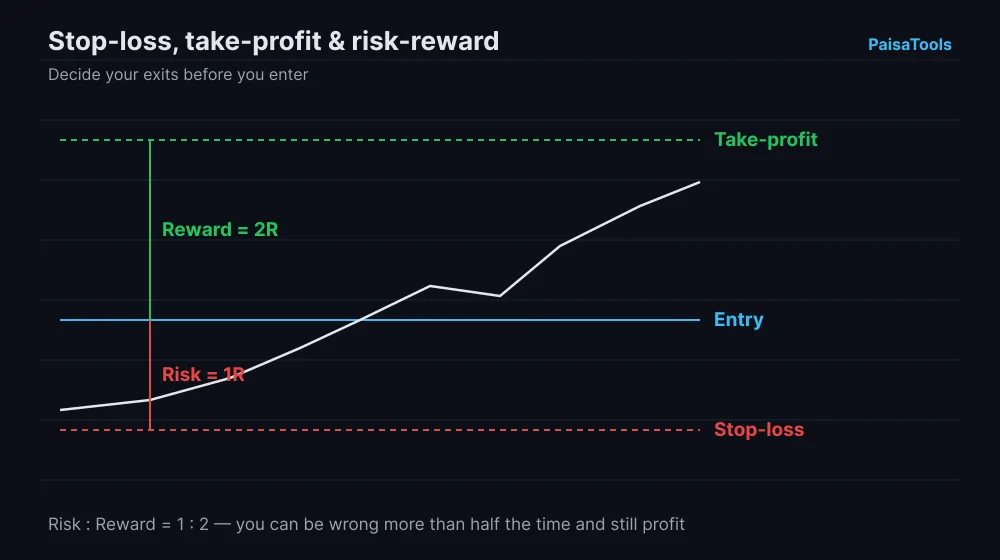
Where to place them
Don't pick round numbers at random. Place your stop just beyond a level the price would only break if your idea is wrong — below a recent support for a long trade, above a recent resistance for a short. Place your take-profit at a realistic level price could actually reach, often near the next resistance or support. Too tight a stop and normal noise knocks you out; too wide and one loss wipes many wins.
Practise setting stop-loss & take-profit — free gameThe risk-reward ratio: the number that makes it work
Risk-reward compares how much you're risking (entry to stop-loss) with how much you're aiming for (entry to take-profit). Risk 5 to make 10 and your risk-reward is 1:2. Here's the magic: with a 1:2 ratio you can be wrong more than half the time and still make money, because your winners are twice your losers. This is why professionals obsess over risk-reward and amateurs obsess over being 'right.' It's not about winning often; it's about winning bigger than you lose.
The mistake beginners make
The classic error is moving the stop-loss further away when price approaches it — 'giving it room.' That's not giving it room; it's removing the seatbelt mid-crash. The whole point of a stop is that it's decided before the trade and honoured no matter what. If you keep widening it, you don't have a stop — you have a hope. Practise holding the line where it's cheap to learn: on a game, with virtual money.
Trade with TP/SL in Market RacersFrequently asked questions
- What is a stop-loss in trading?
- A stop-loss is an order that automatically closes your trade at a set price if it moves against you, capping your loss. It removes the emotional 'wait for it to come back' decision that turns small losses into large ones.
- What is the difference between stop-loss and take-profit?
- A stop-loss auto-closes a losing trade to cap the loss; a take-profit auto-closes a winning trade to lock in the gain. One protects you from fear-driven holding, the other from greed-driven holding.
- What is a good risk-reward ratio?
- Many traders aim for at least 1:2 — risking one unit to make two. At 1:2 you can lose more than half your trades and still be profitable, because winners outsize losers. It shifts the focus from being right often to winning big when you're right.