
Financial freedom is usually described as never having to work again. That framing is why most people dismiss it. The useful version is narrower and far more achievable: the point at which your savings could cover your living costs, so that continuing to work becomes a choice rather than a requirement.
FIRE — Financial Independence, Retire Early — is simply a method for putting a number on that point.
The one number: 25× your yearly expenses
The starting rule is that you need about 25 times your annual spending invested. Spend ₹6 lakh a year and the target is roughly ₹1.5 crore. The multiple comes from the idea that you can withdraw about 4% of a portfolio each year and have it survive a long retirement.
That 4% came from a study of long-run US market and bond returns over 30-year retirements. It is a reasonable anchor. It is not a law, and it was not built for Indian conditions.
The reason 4% does not transfer cleanly to India is that three of its assumptions change. Inflation here has historically run higher than in the market the rule was derived from, which raises the amount you must withdraw every year. There is no state pension or health system to catch a shortfall, so the portfolio absorbs risks it was never asked to absorb in the original study. And early retirement stretches the horizon well past 30 years, which is the only period the rule was ever tested over. The practical consequence is that a more conservative withdrawal rate — and therefore a multiple above 25 — is the honest starting point here, with the exact figure depending on your horizon and how much of your spending is genuinely fixed.
Why it is about expenses, not income
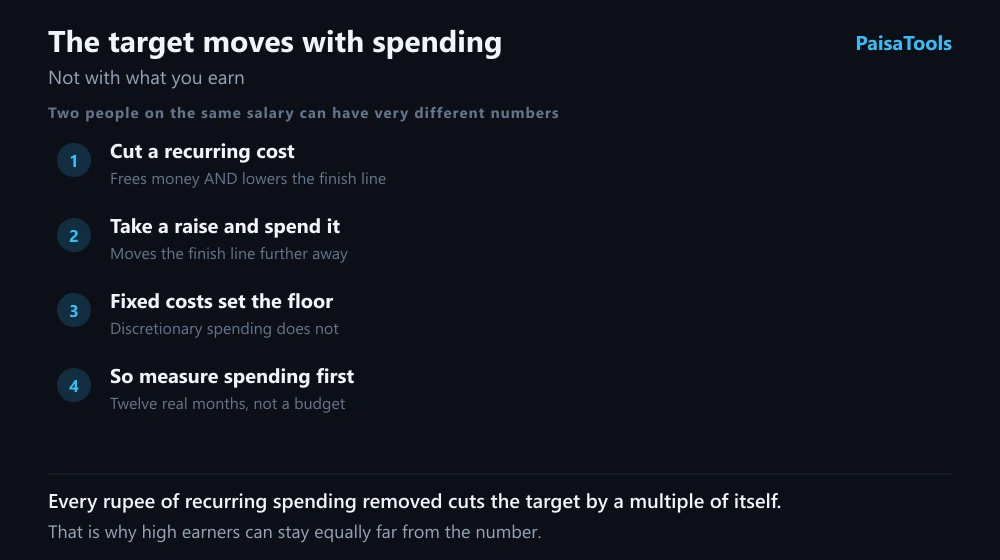
This is the part people skip. Your target is a multiple of your spending, so cutting a recurring expense does two things at once: it frees money to invest, and it lowers the finish line. Remove ₹10,000 a month of genuine recurring cost and you have cut roughly ₹30 lakh off the target.
A raise does not do that. A raise that you spend moves the finish line further away, which is exactly how high earners end up no closer to independence than they were five years earlier.
The variants, briefly
- Lean FIRE — the same arithmetic on a deliberately modest spending level, reached sooner, with less margin for a bad decade.
- Coast FIRE — invest enough early that compounding alone reaches the target by a normal retirement age, then stop adding and work to cover current costs only.
- Barista FIRE — a partial portfolio plus part-time income, which removes the hardest requirement: that the portfolio cover everything from day one.
- Fat FIRE — the same method at a higher spending level, which simply takes longer.
Coast FIRE is the one worth most people’s attention, because it rewards the years when compounding has the most time to work and asks nothing heroic afterwards.
How to work towards it without the label
- Know your real annual spending — twelve months of actual outgoings, not a budget you intend to keep.
- Separate fixed from discretionary. Only fixed costs set the floor on your target.
- Raise the savings rate before optimising returns. The rate does more in the early years than an extra percent of return.
- Invest the gap automatically on a date, so the decision is made once rather than monthly.
- Recheck the number yearly. It moves when your spending moves, which it will.
Frequently asked questions
- Is 25× enough in India?
- It is the starting anchor, not the answer. The rule behind it was derived in a different inflation and safety-net environment and tested over a 30-year horizon, so a longer retirement here generally calls for something more conservative.
- Does my house count towards the number?
- Not unless you intend to sell or rent it. The target is about assets that produce income you can spend; a home you live in reduces your expenses instead, which lowers the target from the other side.
- What if I retire early and markets fall immediately?
- That is sequence-of-returns risk, and it is the main reason the simple rule understates what is needed. A cash buffer covering a few years of spending, so you are not selling into a fall, is the usual defence.
- Do I need to retire early for this to be worth doing?
- No. The arithmetic improves every financial decision you make before that point, and most people who follow it keep working — the change is that the work becomes optional.